

Health and Nutrition
The Accident That Saved Her Life: Doctors Discover a Hidden Brain Aneurysm
A severe accident left 22-year-old Chana Feldman with multiple injuries, but a CT scan revealed a hidden brain aneurysm that could have become fatal
- Michal Arieli
- | Updated
Seven months have passed since the day that changed the life of 22-year-old Chana Feldman of Beit Shemesh, Israel. Chana, who is married to Yaakov and is the mother of a baby, had been working as a bookkeeper and living an ordinary routine.
Then, one day, she and her husband decided to go for a ride on an ATV.
“During the ride, we reached a deep ditch that we didn’t notice in time,” Chana recalls. “My husband wasn’t able to brake quickly enough, and the ATV simply overturned.”
The accident was severe. Chana was thrown several meters, while Yaakov fell onto the ATV. Both were injured but remained fully conscious.
“I felt like I was going to die,” she recalls. “The pain was unbearable — unlike anything I had ever experienced in my life. It’s impossible to describe in words.”
A Miracle Discovered on the CT Scan
Chana vividly remembers the moments immediately following the accident.
“I could barely breathe, and I tried to remove the helmet from my head. Only when I finally managed to get it off did I feel some relief and become able to breathe. Everything around me was black. I think I was very close to losing consciousness. I held my head with my hands simply to keep it from falling. Even my husband couldn’t help me because he was several meters away.”
Then their personal rescue angels appeared.
“Suddenly, out of nowhere, two people arrived,” she recalls. “They told us, ‘We came to help you.’ They called an ambulance for us and stayed until it arrived and took us to Shaare Zedek.”
At the hospital, Chana was immediately admitted to the trauma unit, suffering from excruciating pain that intensified with every movement.
“After some initial examinations, the doctors sent me for a CT scan. They diagnosed fractures in my pelvis and injuries to internal organs, including my kidney, liver, spleen, and others. But the most surprising discovery was that the scan also revealed a brain aneurysm. The doctors explained that the aneurysm had not been caused by the accident. It had apparently been there for years and was discovered only because of the scan.”
“Chana had a ticking time bomb in her brain that could have ruptured at any moment, causing bleeding and potentially killing her,” says Dr. Yaakov Amsalem, an interventional neuroradiologist and director of the Interventional Neuroradiology Unit at Shaare Zedek.
“The brain aneurysm was extremely large — about the size of a tennis ball, and was located in an artery at the back of the brainstem. It wasn’t only the size of the aneurysm that put Chana’s life in danger, but also its shape. The wall of the artery was severely diseased and weakened, creating a risk that it could rupture.”
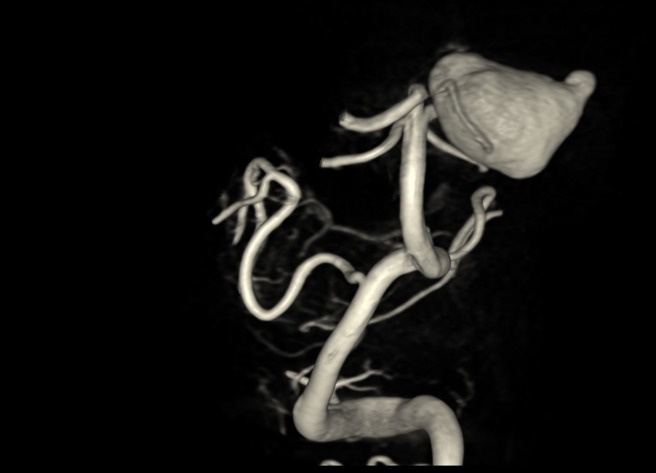 The aneurysm that was discovered in the brain. Credit: Shaare Zedek
What Is a Brain Aneurysm?
“It is an enlargement or bulging of a blood vessel in the brain that causes the vessel wall to weaken,” explains Dr. Amsalem. “This can lead to dangerous bleeding.”
“Unfortunately, in recent years at Shaare Zedek, we have seen an increase in the incidence of brain aneurysms among young men and women, apparently due to environmental influences and risk factors including smoking, high blood pressure, stress, lack of physical activity, and others.
“When caused by a congenital defect, the condition occurs in approximately 1% of the general population and can affect people from infancy through adulthood. Global statistics show that 50% of brain aneurysm cases end in death, 25% leave patients with significant disabilities, and the remaining 25% recover, although sleep disturbances and various behavioral problems may remain.”
“If You Have Unusual Headaches, Get Checked”
After learning just how serious her condition had been, Chana says emotionally, “My life was unquestionably saved because of the accident, because that is how the aneurysm was discovered.
“The doctor who operated on me told me that if the aneurysm had not been discovered, it would have ruptured within a year and a half. In situations like these, most people don’t survive and don’t even make it to the hospital.
“You can see in the image just how enormous the aneurysm was. It was sitting directly on the brainstem, in the most dangerous possible location.”
Dr. Alon Schwartz, director of the Trauma Unit, who treated Chana during her hospitalization, adds: “We never want anyone to be injured, God forbid. But in this particular case, had Chana not been injured, it is possible that we would not have been able to save her life.”
“If You’re in Pain, Don’t Ignore It”
Alongside her tremendous gratitude for having her life saved, Chana found herself beginning a painful and unexpected journey.
“The day after the accident, I underwent a catheterization procedure in which the doctors treated and sealed the aneurysm,” she explains. “Afterward, I was hospitalized at Shaare Zedek for two weeks to treat the fractures and my other injuries.
“My husband, who, thank God, recovered very quickly from his injuries, stayed by my side the entire time, while my mother took care of our baby.
“After that, I transferred to rehabilitation at Reuth Hospital in Tel Aviv, where I stayed for almost two months. Even today, seven months after the accident, I still haven’t completely returned to myself. I still have pain and require follow-up care, but thank God, my condition is much better.”
Chana also has an important message for others.
“If you have headaches that seem unusual, it is worth getting checked. I assume that in the vast majority of cases it won’t be an aneurysm, but it’s better not to take the risk.
“Looking back, I can say that for years I suffered from very severe headaches, but I never thought there was a reason to investigate them more thoroughly. Only after the aneurysm was diagnosed did I begin to understand how important it would have been for me to get checked.”
Dr. Amsalem also emphasizes that there can be warning signs associated with a brain aneurysm.
“If you experience severe headaches that you have never had before, sensitivity to light (photophobia), neck stiffness, or severe neck pain, you should seek medical evaluation so that the condition can be diagnosed and treated if necessary.”

