

5 Minutes of Tanakh a Day
II Samuel Chapter 16: David Is Cursed as Absalom Takes Jerusalem
Explore II Samuel Chapter 16, from Shimei’s shocking curse of King David to Hushai’s encounter with Absalom and Ahithophel’s fateful advice.
- Yonatan HaLevi
- | Updated
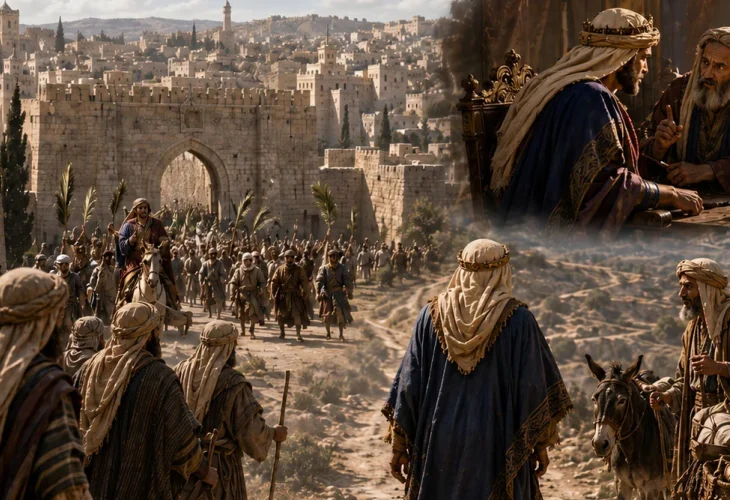
Chapter 16 of II Samuel continues the story of Absalom’s revolt. In the first half of the chapter, David encounters two people connected to Saul’s family. In the second half, the focus shifts to Jerusalem, where Absalom encounters Hushai the Archite and seeks the advice of Ahithophel.
Chapter Overview
Part One: David and the Fugitives Beyond the Jordan
Ziba lies to David: David unexpectedly encounters Ziba. As we may remember, Ziba first appeared several chapters earlier, in Chapter 9, where we learned that he had been “Saul’s servant,” possessed extensive property, and became “Mephibosheth’s servant” after David showed kindness to Mephibosheth.
Now Ziba comes to David without Mephibosheth. David asks where Mephibosheth is, and Ziba answers without hesitation that Mephibosheth has switched sides. In response, David transfers all of Mephibosheth’s property to Ziba: “Behold, all that belongs to Mephibosheth is yours.”
David does not know that Ziba is lying to him. The truth will only become clear several chapters later.
Shimei son of Gera curses David: David arrives at a place called Bahurim, where he encounters Shimei son of Gera, a man from Saul’s family. Shimei comes out cursing David: “Hashem has repaid you for all the bloodshed of Saul’s house, in whose place you reigned, and Hashem has given the kingdom into the hand of your son Absalom. Now you are caught in your own misery, because you are a man of blood.”
Shimei does not stop at words. He also throws stones at David. Abishai asks permission to strike Shimei, but David refuses: “Leave him alone and let him curse, for Hashem told him to do so.”
Part Two: Absalom and the Rebels in Jerusalem
Hushai meets Absalom: The chapter now shifts to Absalom, who has arrived in Jerusalem. There he encounters Hushai the Archite.
Absalom wants to know why Hushai has seemingly abandoned David. Hushai gives him two answers: Hashem and the people have chosen Absalom, and since Absalom is David’s son, Hushai will serve him just as he served David.
Absalom is convinced. Like David with Ziba, however, he does not realize that he is being deceived. Hushai is secretly working on David’s behalf.
Ahithophel’s advice: Absalom asks Ahithophel what he should do next. Ahithophel advises him to sleep with David’s concubines who remained behind at the palace.
His advice brings about the fulfillment of the punishment David had previously received from Hashem: “Thus says Hashem: Behold, I will raise up evil against you from within your own house. I will take your wives before your eyes and give them to your neighbor, and he will lie with your wives in broad daylight. For you acted in secret, but I will do this thing before all Israel and in the sight of the sun.”
As Hashem had foretold, Absalom carries out the act publicly before all Israel.
The Full Chapter
(1) David had gone a little beyond the summit when Ziba, Mephibosheth’s servant, came toward him with a pair of saddled donkeys carrying two hundred loaves of bread, one hundred clusters of raisins, one hundred summer fruits, and a skin of wine.
(2) The king said to Ziba, “What are these for?” Ziba said, “The donkeys are for the king’s household to ride, the bread and summer fruits are for the young men to eat, and the wine is for whoever becomes weary in the wilderness to drink.”
(3) The king said, “And where is your master’s son?” Ziba said to the king, “He is staying in Jerusalem, because he said, ‘Today the house of Israel will restore to me my father’s kingdom.’”
(4) Then the king said to Ziba, “Behold, all that belongs to Mephibosheth is yours.” Ziba said, “I bow down. May I find favor in your eyes, my lord the king.”
(5) When King David came to Bahurim, a man from Saul’s family came out from there. His name was Shimei son of Gera, and as he came out, he cursed continuously.
(6) He threw stones at David and at all King David’s servants, while all the people and all the mighty men were at his right and at his left.
(7) This is what Shimei said as he cursed: “Get out, get out, you man of blood, you scoundrel!
(8) Hashem has repaid you for all the bloodshed of Saul’s house, in whose place you reigned, and Hashem has given the kingdom into the hand of your son Absalom. Now you are caught in your own misery, because you are a man of blood.”
(9) Abishai son of Zeruiah said to the king, “Why should this dead dog curse my lord the king? Please, let me go over and remove his head.”
(10) But the king said, “What do I have to do with you, sons of Zeruiah? If he curses because Hashem told him, ‘Curse David,’ then who can say, ‘Why have you done this?’”
(11) David said to Abishai and to all his servants, “Look, my own son, who came from my body, seeks my life. How much more now this Benjaminite! Leave him alone and let him curse, for Hashem told him to do so.
(12) Perhaps Hashem will look upon my affliction and repay me with good in place of his curse today.”
(13) David and his men continued along the road, while Shimei went along the hillside opposite him, cursing as he went, throwing stones at him and tossing dust.
(14) The king and all the people with him arrived exhausted, and they rested there.
(15) Absalom and all the people, the men of Israel, came to Jerusalem, with Ahithophel alongside him.
(16) When Hushai the Archite, David’s friend, came to Absalom, Hushai said to Absalom, “Long live the king! Long live the king!”
(17) Absalom said to Hushai, “Is this your loyalty to your friend? Why did you not go with your friend?”
(18) Hushai said to Absalom, “No. The one chosen by Hashem, by this people, and by all the men of Israel—his I will be, and with him I will remain.
(19) And secondly, whom should I serve? Should I not serve before his son? Just as I served before your father, so I will serve before you.”
(20) Absalom said to Ahithophel, “Give us your advice. What should we do?”
(21) Ahithophel said to Absalom, “Sleep with your father’s concubines, whom he left behind to guard the house. Then all Israel will hear that you have made yourself repulsive to your father, and the hands of everyone with you will be strengthened.”
(22) So they pitched a tent for Absalom on the roof, and Absalom slept with his father’s concubines in the sight of all Israel.
(23) In those days, Ahithophel’s advice was regarded as if one had sought the word of Hashem. That was how all of Ahithophel’s advice was regarded, both by David and by Absalom.
Key Terms and Difficult Phrases
“And David had gone a little beyond the summit” — David had gone a short distance beyond the summit of the Mount of Olives.
“Bahurim” — A city named Bahurim.
“The Benjaminite” — Shimei, who was from the tribe of Benjamin.
“Sleep with your father’s concubines, whom he left behind to guard the house” — Ahithophel advises Absalom to publicly take David’s concubines for himself, demonstrating that his break with his father is complete.
“Then all Israel will hear that you have made yourself repulsive to your father” — After you marry your father’s concubines, all the people of Israel will hear that you have completely rejected your father.
“And the hands of everyone with you will be strengthened” — Everyone supporting Absalom will be emboldened. Until this point, they may still fear that Absalom is not fully committed to the rebellion and could eventually reconcile with his father. By marrying David’s concubines—an extremely drastic act demonstrating that reconciliation is no longer possible—Absalom makes it clear that his revolt against his father is complete and final. His supporters will therefore feel more confident joining him.
“As when a man inquires of Hashem” — Just as someone who asked Hashem through the Urim VeTummim could be confident in the answer he received, so too Ahithophel’s advice was regarded as exceptionally reliable.
Noteworthy Commentary
Malbim: “Perhaps Hashem will look upon my affliction” — When suffering is added beyond what a person deserves, it may bring atonement for sin. Absalom’s revolt had already come upon David as punishment for the sin involving Bathsheba. Now that an additional hardship has been added, with Shimei cursing him, David hopes that good may ultimately come from it.
Radak: “Ahithophel’s advice in those days was regarded as if one had inquired of Hashem” — According to the written text, the word “man” does not appear, and the reference is to David: whenever David sought Ahithophel’s counsel, his advice was as reliable as if David had inquired through the Urim VeTummim. The written text can also be understood to mean that anyone who sought Ahithophel’s advice received counsel regarded as comparable to an answer obtained through the Urim VeTummim.

