

Parashat Nitzavim
What Is Your “Bullet”? A Powerful Lesson in Gratitude Before Rosh Hashanah
A wounded soldier’s unusual reminder of survival reveals a deeper message in Parashat Nitzavim about gratitude, accepting Hashem’s kingship, and recognizing every new day as a gift
- Moran Kors
- | Updated
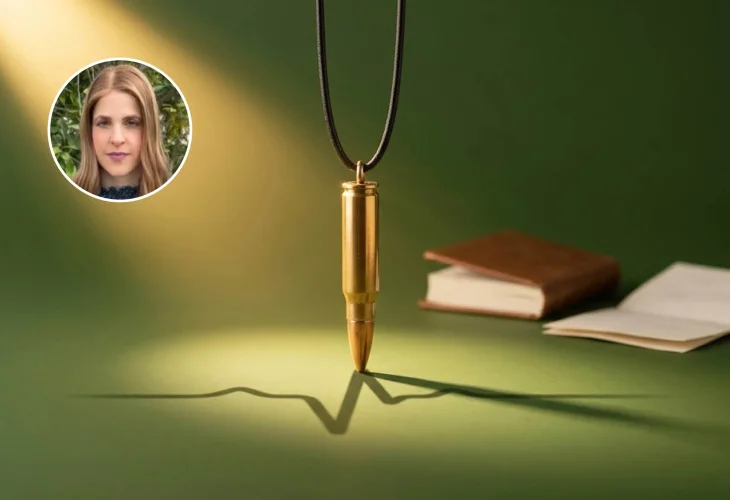
There are people who wear gold chains. Others choose pendants engraved with something personal. And then there is one man I recently met who wears a bullet.
He was critically wounded in the war. An RPG struck the tank he was in, leaving his body filled with hundreds of pieces of shrapnel. Doctors fought to save his life, and after five days, he woke up in intensive care. Following a long recovery, doctors were able to remove a bullet from his arm that had been causing him considerable discomfort.
Instead of throwing it away, he decided to wear it as a reminder of the miracle he had experienced.
Every morning, when he looks in the mirror, it reminds him of one simple fact: I am alive. I might not have been here, but I am.
Ever since I met him, one question has refused to leave me: What is my “bullet”?
Not a metal bullet, of course, but something that will remind me that my life should never be taken for granted. I should not have to stand between life and death to understand that every breath is a gift. As long as I open my eyes in the morning, Hashem has decided that I still have a purpose to fulfill in this world.
You Are Standing Today
Parashat Nitzavim begins with the words, “You are standing today, all of you, before Hashem your God.”
We often read this verse as describing a single historic moment. Moshe Rabbeinu gathered the Jewish people before they entered the Land of Israel. But there is something deeply personal in his words as well: You are standing today.
Not yesterday. Not tomorrow. Today.
The very fact that you are standing here today is already a gift. There are people who expected to wake up this morning and did not. Plans have been interrupted, lives have changed without warning, and journeys have ended unexpectedly. And we? We are standing here.
Sometimes we become so consumed by what is missing from our lives that we forget to marvel at the most basic gift of all: we are here.
Two Small Commitments
That encounter inspired me to take on two small practices. They may be small in action, but they carry enormous meaning.
The first is to recite Mizmor LeTodah, the Psalm of Thanksgiving, every morning after the morning blessings. I want to say thank you not only for the miracles that have already happened, but also for the ones that will happen today, including those I may never even recognize. We live surrounded by hidden kindness.
The second practice is to study the beginning of chapter 41 of Tanya every morning, until the words “the King.” There, the Alter Rebbe teaches that it is not enough to awaken the natural love for Hashem that exists within the heart of every Jew. We must also awaken yirah, an awareness and reverence that comes from recognizing that we are standing in the presence of the King of kings.
Because if I am not a servant of Hashem, I may find myself becoming a servant to something else: my mood, my fears, my impulses, my phone, or other people's opinions of me.
The question is not whether I will serve something. The question is whom I will serve.
Gratitude and Accepting Hashem’s Kingship
It seems to me that these are the two pillars upon which our spiritual work rests in the days leading up to Rosh Hashanah: gratitude and accepting the yoke of Heaven.
The first reminds me that everything I have is a gift, and the second reminds me of what I am supposed to do with that gift.
Perhaps this is also part of the deeper meaning of the words, “You are standing today.”
A person can truly stand when holding tightly to both of these truths. In one hand is gratitude for the gift of being alive. In the other is the acceptance of Hashem’s kingship and the responsibility to use that life for the purpose for which it was given.
We may not have a bullet hanging around our neck to remind us that we are alive, but perhaps we do not need one. Every morning that we open our eyes is reminder enough.
We are here. We are standing today. And today itself is a gift.

