

Personal Stories
He Couldn’t Choose His Challenge, But He Chose How to Live
Born with severe kidney disease, Yinon Yulis refused to let his limitations define him. His remarkable life, faith, compassion, and tragic death offer a powerful lesson about choosing how to respond to the challenges we are given.
- Moriah Luz
- | Updated
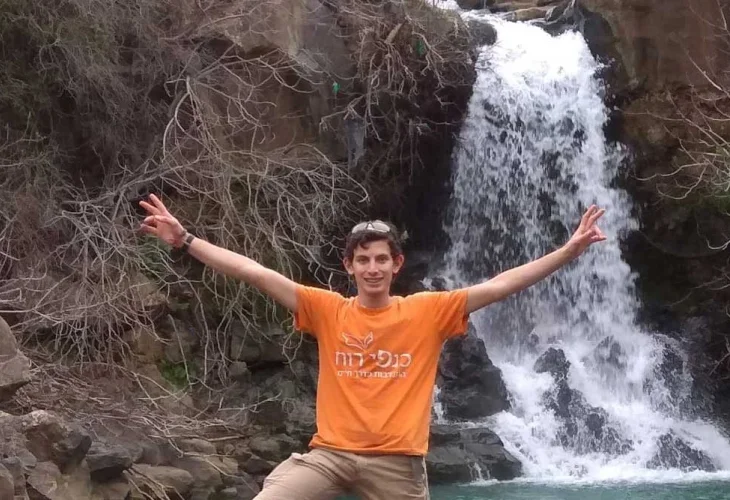 Yinon Yulis, z"l
Cubes of chicken breast were threaded onto skewers and placed on the grill alongside kebabs and slices of tomato. The class challenge had been completed successfully, and the boys were receiving what they had been promised: an evening barbecue.
It was hard not to notice the thin teenager overseeing the operation, making sure everything was done properly. What none of the other boys knew was that, just as on previous occasions, he would not taste any of the tempting meat he was helping to prepare.
Yinon Yulis had lived with severely impaired kidney function from the day he was born. Yet he refused to allow his limitations to overcome his joy for life or his sensitivity toward others. His parents, Avi and Shimrit Yulis, share the remarkable way their son faced his illness, his sudden death in a car accident, and the choice they made about how to continue living after losing him.
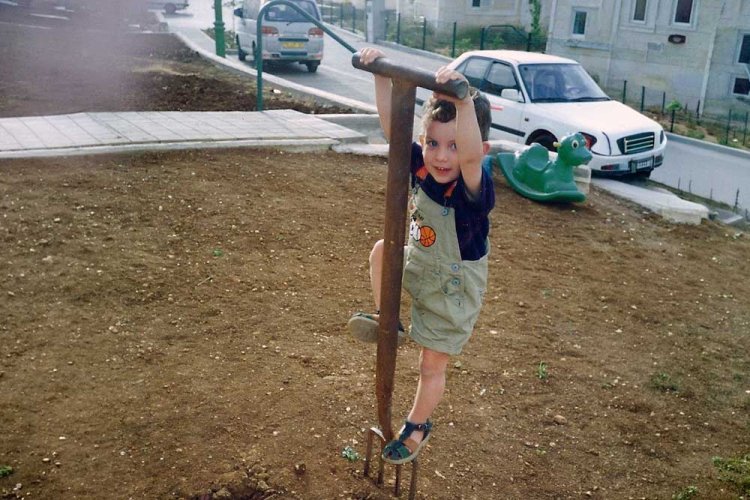 As a toddler - with 35 percent kidney function
“There’s No Way He’s Sick”
During Shimrit's second pregnancy, doctors discovered that her unborn baby had hyperechogenic kidneys. A blood test performed after his birth revealed that his two kidneys together were functioning at only 35 percent.
“When I asked the doctors what we should expect, they told me that by the age of three he would probably undergo his first transplant,” Shimrit recalls. When she questioned the words “first transplant,” doctors explained that a transplanted kidney typically lasts for a limited number of years. “They told me about someone who had already received five kidney transplants.”
Shimrit heard the grim predictions but refused to resign herself to them.
“I decided that I wasn't going to simply accept that this was what would happen to my child. I began looking into different alternative approaches, trying to preserve his kidney function for as long as possible. Despite all our efforts, I never could have imagined that he would make it to twenty and a half without a transplant.”
Avi recalls several incidents that demonstrated just how extraordinary Yinon's condition was. Shimrit and Yinon shared the same blood type, so she began the process of preparing to donate a kidney to her son.
“We arrived at Beilinson Hospital, which has a major kidney transplant center. The medical staff looked at the three of us and asked, ‘Which one is the patient who needs the kidney?’ These were professionals who knew exactly what kidney patients usually looked like, and they were convinced Yinon was the donor.”
Another incident occurred just one month before Yinon died. Rabbi Yeshayahu Heber, founder of Matnat Chaim, an organization dedicated to facilitating kidney donations, visited their community for a thanksgiving celebration following a local kidney donation.
“Yinon had just returned from the army, and we asked Rabbi Heber to meet him. The rabbi asked where he was, and I said, ‘Right here, standing next to you.’
“He looked around, confused. ‘What do you mean, standing next to me?’
“Yinon was standing there, six feet tall, in uniform, with a huge backpack on his back and the Four Species in his hand. Rabbi Heber knew kidney patients extremely well, and he told me emphatically, ‘There's no way he's a kidney patient.’”
How did the doctors explain it?
“They told us they had no idea how it happened,” Avi says. “When Yinon was killed at twenty and a half, his kidney function was down to 12 percent. First of all, it was clearly a miracle and a gift from Heaven. Only Hashem knows how he managed for so many years without a transplant.
“If we try to explain any part of it naturally, the credit belongs to Shimrit. She fought for him like a lioness. She went from one alternative practitioner to another and repeatedly adjusted his diet as his kidney condition worsened. At a certain point, even the doctors acknowledged what she had accomplished.”
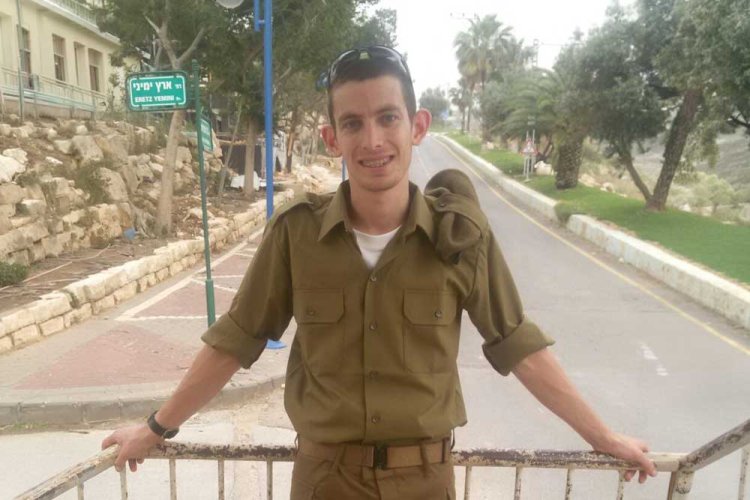 Yinon as a soldier
“But He’s Only Eight”
From childhood, Yinon approached his medical condition with unusual maturity and responsibility.
“From the age of eight until fourteen, he received growth hormone injections,” Shimrit recalls. “Before we started, a nurse came to teach us how to administer them and brought a doll for us to practice on. Avi practiced, and I practiced. Then I said, ‘Okay, now it's Yinon's turn.’
“The nurse stared at me in shock. ‘What do you mean? He's only eight!’
“I explained that I was there to support Yinon, but ultimately he was the one who had to live with this and learn how to handle it.”
Yinon practiced giving the injection, and within a month he was administering it himself consistently.
As he grew into a teenager, the dietary restrictions became especially challenging. Shimrit describes him with a smile as “a boy who would happily have eaten meat all day.” Together with the professionals guiding them, the family decided that he should eat no more than two servings of protein each week. Yinon chose to save those servings for Shabbat.
“On Friday night he would eat a portion of trout, which was relatively low in protein. He loved it because nobody else in the house got trout except him,” Shimrit says with a laugh.
“The restrictions never stopped him from doing anything,” Avi emphasizes.
Yinon participated fully in social events and often helped organize them, even when he could not eat the food he had worked so hard to prepare. After his death, many people around him were stunned to discover that he had suffered from kidney disease. Even the few who knew about it had not understood how serious his condition was.
The Boy Who Refused to Leave a Friend Behind
One of Yinon's most striking qualities was his sensitivity to the people around him.
When he was in fourth grade, his class organized a Lag BaOmer bonfire. During the preparations, Yinon discovered that one boy did not want to attend because some classmates had hurt him.
Yinon gathered several friends, and together they went to the boy's house. They told him that unless he came, they would not attend either, even if it meant there would be no bonfire at all. Eventually, the boy agreed to join them.
Another incident occurred while Yinon was studying in yeshivah. On Shabbat Zachor, the rosh yeshivah's young grandson became ill and had to be taken to the hospital. Yinon immediately ran after the ambulance and made sure the family had food and wine for Kiddush.
Later that Shabbat, the rosh yeshivah tried to teach something to the students. The boys were uncooperative, and eventually he left the dining room angrily.
Yinon climbed onto a table in front of 400 students and confronted them. How could they behave that way after everything their rabbi had just experienced with his grandson? He told them they should be ashamed of themselves and demanded that everyone quiet down and behave respectfully while he went to bring the rabbi back.
Shimrit adds an important detail. “At that time, Yinon himself was actually in conflict with the rosh yeshivah and was close to leaving. But his personal disagreement had nothing to do with the fact that the students were behaving improperly at that moment.”
Standing Firm for What He Believed
Avi also remembers his son's uncompromising commitment to truth and principle.
During the process of joining the army, Yinon was once summoned to an unmarked building in Ramat Gan.
“He told me, ‘Dad, I don't know what this is. It sounds like the Shin Bet or Mossad.’ I drove him there, and it really was a completely anonymous-looking building.
“When he came out, I asked him how it had gone. He told me that during the interview they asked what he would do if he were required to desecrate Shabbat.
“Yinon answered, ‘I'll ask a rabbi.’
“The interviewer said, ‘But we have a rabbi.’
“Yinon immediately replied, ‘It depends which rabbi.’”
Yinon was not prepared to assume that every rabbinic authority would necessarily permit him to violate Shabbat under the circumstances.
“That,” Avi says, “was the end of the very short career he might have had in the intelligence services.”
Yinon faced difficult restrictions throughout his childhood and adolescence. Did he ever become angry? Did he ever ask Hashem why he had been chosen to face such a difficult challenge?
“When he was nineteen, at the end of his first year in yeshivah, he went through a major crisis,” Avi says. “He came to us and asked, ‘Why did Hashem put this burden on me? What did I do wrong?’”
Yinon listed everything he had been forced to deal with: the strict diet, the struggle to receive permission to enlist in the army, and the frustration of going on trips with friends who could buy whatever treats they wanted while he had to head for the vegetable section. Even the amount of water he drank had to be carefully calculated.
“We tried to explain things to him, but we could see that our answers weren't enough,” his father recalls.
They suggested that he speak with Rabbi Shai Winter, who was then his teacher at the yeshivah and later became the rabbi of their community.
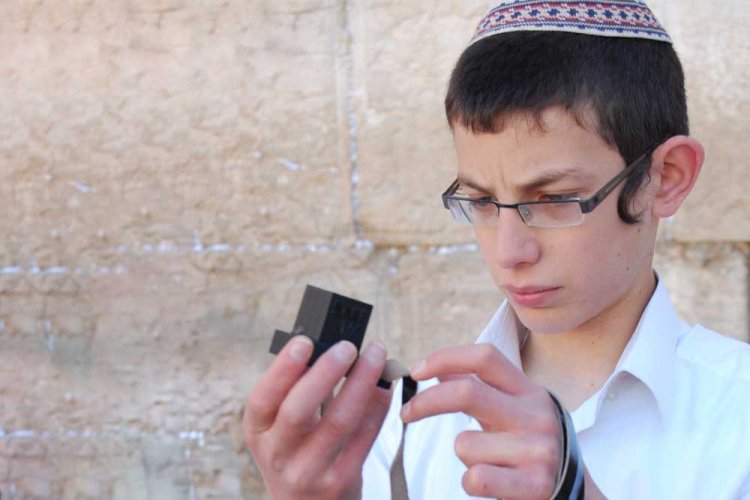
Rabbi Winter began studying Rabbi Joseph B. Soloveitchik's The Lonely Man of Faith with Yinon every Shabbat afternoon. During their learning, Rabbi Winter encouraged Yinon to change the question he was asking. Instead of asking only “Why?”, he encouraged him to ask “What for?”
“You may never receive an answer to why,” the rabbi explained. “This is how Hashem brought you into the world. But you can ask a different question: What can you do with the circumstances you have been given? How can you make the world better from the place where you are?”
Avi says that this transformed Yinon's entire outlook on life. “From that moment on, he simply blossomed.”
A Struggle Between Heaven and Earth
Seven and a half years ago, on a Saturday night when Yinon was home from the army, he planned to travel from his parents' home in Talmon to a friend's engagement party in Jerusalem.
Another friend was supposed to pick him up but became stuck in traffic and said he could no longer come. “He came to us terribly disappointed,” Shimrit recalls. “He sat down on the bed and said, ‘Mom, I have no way to get there.’”
Seeing how upset he was, Shimrit offered him the family car. Both parents emphasize that Yinon was an exceptionally cautious driver, and they trusted him completely.
Yinon said goodbye and left. Fifteen minutes later, he was involved in a devastating accident.
On a dark stretch of road, a truck was standing with its lights off as it prepared to turn onto an unauthorized road that had been cut through a nearby field. Yinon saw the truck only at the last moment and did not have enough time to stop.
“The traffic investigator described it as a death trap,” his parents say. Yinon suffered a severe head injury and remained unconscious for five days.
“The amount of prayer was unbelievable,” Avi recalls. “People were saying Tehillim, learning Torah and taking on good deeds for his recovery. It felt as though Hashem was saying: I know how this will end, but during this final week you will lift so many more people spiritually.
“We felt as though there was a struggle between Heaven and earth. Heaven was pulling him upward, and we were pulling him back from below. I am certain those five days created an extraordinary spiritual impact. But apparently the decision was that Heaven wanted him more.”
Early Friday morning, while Shimrit went to rest and Avi remained beside his son, reading Tehillim and occasionally dozing, Yinon's condition suddenly collapsed.
For two hours, the medical team attempted to resuscitate him. “We could see the graphs on the monitors. He was fighting,” Avi says. “After we said Vidui, I went over to him and said, ‘We're not angry with you. We understand that you're suffering, and we give you permission to go.’
“One minute later, the machines went silent.”
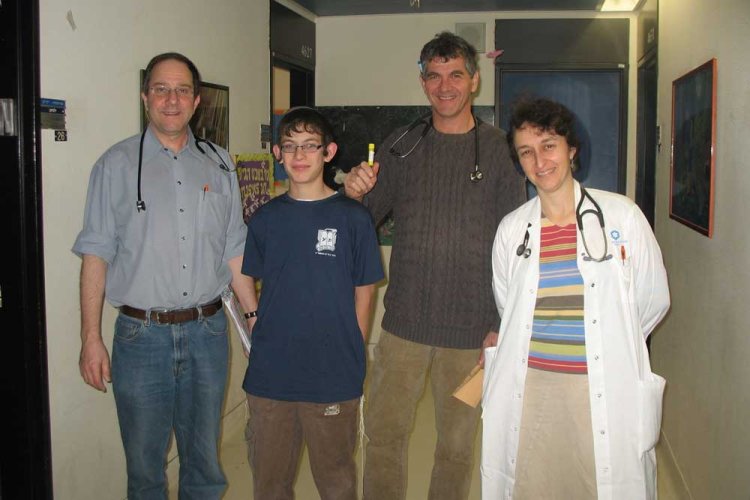 With nephrology doctors at Shaare Zedek - Professor Frischberg, Rachel Cohen and Dr. Honi Rinat
A Blow and a Caress
Yinon passed away early Friday morning. That Shabbat, Avi and Shimrit chose to remain at home with their daughters.
Shimrit spoke openly with them about the painful emotions that accompanied such a sudden loss. She explained that grief, anger and pain can exist alongside faith in Hashem. Experiencing those emotions does not mean that faith has disappeared.
She also told her daughters that now, after Yinon's death, each of them carried “a little Yinon” within herself. It was their responsibility to make sure that his special qualities continued to have a presence in this world.
Two and a half years after Yinon's death, Shimrit, then 47, gave birth to a son. They named him Matania. “The brit was on Shabbat,” Avi recalls. “On Friday, some of Shimrit's relatives stopped by to wish us mazal tov and asked what we were going to name him.
“I told them, ‘I'm not going to tell you what we're naming him, but I'll tell you what we're not naming him. Nothing that reminds us of Yinon. This child is not going to grow up as a replacement for his brother. He did not come to fill the hole Yinon left behind. He will grow up as a soul in his own right.’”
Avi describes the experience in deeply personal terms.
“I felt that two and a half years earlier, Hashem had thrown me into a desert and given me a blow that I still don't know how to absorb. But now, alongside that, came a caress from the attribute of mercy.”
Today, they describe Matania, now five years old, with a smile. He is mischievous, energetic and full of life, and is close friends with his niece, who is the same age and also lives in their community.
“I Received a Gift for Twenty Years and Seven Months”
“I received a gift for twenty years and seven months,” Avi says. “If someone had told me before Yinon was born, ‘You can have him for twenty years and seven months. Do you want that gift or not?’ Of course I would have said yes.”
Today, Avi and Shimrit give a talk together called U'Vacharta BaChaim, “Choose Life.” They offer the talks free of charge, viewing them as a personal mission.
For Shimrit, the central lesson of everything they have experienced comes back to one fundamental choice. “What happens to us, happens,” she says. “But what remains in our hands is the choice of what we take from it and how we choose to look at it.”
Perhaps that is the lesson Yinon himself learned when he stopped asking only, “Why did this happen to me?” and began asking, “What can I do with what I have been given?”
We cannot always choose the circumstances that enter our lives. We cannot always understand why they happen. But even within circumstances we would never have chosen, there remains a space in which we are free.
We can choose what we do with them.

