

Magazine
Exploring Unique and Record-Breaking Synagogues Across the Globe
From Israel’s busiest and largest synagogues to ancient Torah scrolls, unusual architecture, and a synagogue brought from Italy to Jerusalem, discover the remarkable stories behind Jewish houses of prayer
- Michal Arieli
- | Updated
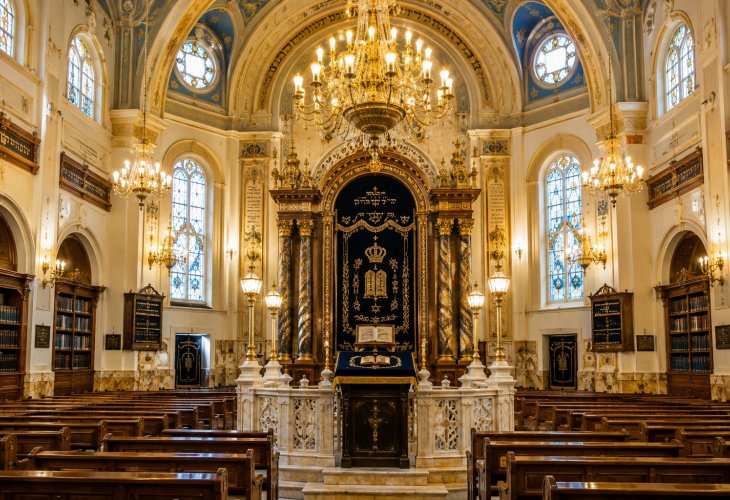
How many synagogues are there in Israel? Which synagogue may be the busiest in the world? Which synagogue was once a mosque, and which one was transported in its entirety from Italy to Jerusalem? Following are ten fascinating facts about synagogues, from extraordinary Torah scrolls and magnificent buildings to accessibility, architecture, and the enormous costs involved in building and maintaining them.
1. How Many Synagogues Are There in Israel?
There are more than 15,000 synagogues in Israel, although no official source records the precise number.
Jerusalem leads the country with approximately 3,000 synagogues, followed by Bnei Brak with about 1,000 and Tel Aviv with around 600. Safed, despite being one of Judaism's holy cities and a major tourist destination, has only about 115 synagogues. Interestingly, only around ten of Safed's synagogues are considered ancient; the rest were built after the establishment of the State of Israel.
The busiest synagogue in the world is said to be the Itzkovitch Synagogue in Bnei Brak. The three-story building contains a large beit midrash with a women's section on the third floor, six prayer rooms on the middle floor, and seven prayer rooms on the lower floor. More than 20,000 worshippers reportedly pass through it every day.
2. From a Mosque to a Synagogue
Many synagogues originally established for a particular community or prayer tradition have changed character over the years.
One synagogue in Upper Tiberias, for example, was originally founded for Holocaust survivors and followed the Ashkenazi prayer rite. As the original worshippers grew older and passed away, the congregation changed, and today it serves a Bukharian community. Yet the memorials, Torah ark, and Torah scroll retain their Ashkenazi heritage.
An even more dramatic transformation took place at the Geulat Yisrael Synagogue in Ness Ziona. The building originally served as a mosque before eventually becoming a synagogue. Even today, its exterior retains the rounded architectural features associated with its original design, while its interior has been transformed into a Jewish house of prayer.
3. A Synagogue With 70 Torah Scrolls
The Belz synagogue in Jerusalem may hold the record for the largest collection of Torah scrolls in a synagogue, with approximately 70. This was reportedly a goal established by the community when the synagogue was built. The Torah scrolls are stored lying horizontally rather than standing upright, in accordance with the opinion of Rabbeinu Tam.
A synagogue in Bat Yam reportedly has more than 50 Torah scrolls. The congregation developed a special computer program to determine which scroll should be used at a particular time, choosing one whose dedication or memorial date is closest to the date of the Torah reading.
The Western Wall also contains a large number of Torah scrolls, estimated to number in the dozens.
Some synagogues are distinguished not by the number of Torah scrolls they possess but by their age. During the period of Yitzhak Rabin's government, Saddam Hussein reportedly released three centuries-old Torah scrolls from Iraq. Written on deer hide, they were brought to Israel and distributed among three synagogues.
Another remarkable Torah scroll is associated with the Abuh family of Safed. In 1833, on the eve of Lag BaOmer, a Torah scroll given to Rabbi Shmuel Abuh was carried for the first time in a procession from the Abuh home toward the tomb of Rabbi Shimon bar Yochai in Meron. The tradition has continued for generations, with the Torah scroll carried to Meron for Lag BaOmer and later returned to its ark in Safed.
4. Israel’s Largest and Most Impressive Synagogues
It is difficult to rank Israel's largest synagogues, but the enormous centers of the Belz and Ger Hasidic communities in Jerusalem undoubtedly rank among the country's most impressive.
Although the Belz synagogue is widely known for the immense size of its building, the Ger synagogue has more seats concentrated within a single prayer hall. Belz has a very large number of seats as well, but they are distributed throughout different areas of the complex.
The Belz synagogue is far more than a place for prayer. It functions as an extensive communal center, with a main sanctuary containing more than 3,000 seats, galleries, large study halls, halls for Hasidic gatherings, a mikvah, a matzah bakery, guest accommodations, and numerous other facilities.
Hundreds of millions of shekels have reportedly been invested in the complex over the years, including approximately 15 million shekels on furnishings alone.
Other Hasidic communities have also undertaken ambitious building projects. These include Vizhnitz in Bnei Brak, Ger in Jerusalem, and Boyan in Jerusalem.
5. Synagogues Inspired by Communities Abroad
Israel is home to many unusual and magnificent synagogues, each with its own character.
One particularly elaborate example is the Caucasian synagogue in Tirat Carmel. Its interior reflects a significant investment in craftsmanship and design, incorporating gold, silver, marble, wood, stained glass, and numerous decorative elements.
Other synagogues are remarkable for entirely different reasons. At Kibbutz Neve Eitan in the Beit She'an Valley, an ecological synagogue was constructed using natural materials. Its Torah ark was built from mud using a specialized construction technique, and even the wall coverings incorporate earth-based materials.
Israel also has synagogues modeled after famous houses of prayer from Jewish communities abroad. In Ofakim, there is an impressive reproduction of Tunisia's historic El Ghriba Synagogue.
The famous 770 building in Kfar Chabad is modeled after the headquarters of the Chabad movement at 770 Eastern Parkway in New York. Similar replicas can also be found in Jerusalem's Ramat Shlomo neighborhood, Mitzpe Ramon, and Zichron Yaakov.
Another fascinating example is the synagogue of the Cochin Jewish community in Moshav Nevatim near Beersheba. It is a replica of a synagogue from Cochin in southwestern India and features colorful wood carvings.
One unusual feature is a second prayer platform on the upper floor near the women's section. On occasions such as the High Holy Days, when the synagogue is crowded and the women have difficulty hearing the cantor, he can lead the prayers from this elevated location.
6. A Synagogue Brought From Italy to Jerusalem
While some Israeli synagogues are replicas of buildings abroad, one synagogue was actually transported from overseas and reconstructed in Israel.
The Italian synagogue originally came from Conegliano Veneto and today stands at 25 Hillel Street in central Jerusalem.
The synagogue was established in the early eighteenth century and served Jews living in the region near Venice. During the nineteenth century, the town's Jewish population dwindled, and the synagogue eventually fell out of use.
In 1952, the synagogue was rededicated in Jerusalem after its interior was brought to Israel and reconstructed. Most of those attending the dedication ceremony were Italian Jews who had immigrated to Israel.
Among them, however, stood an elderly man wrapped in a tallit whom the other worshippers did not recognize. He was visibly overwhelmed with emotion and had tears in his eyes.
When asked why he was so moved, he explained that as a young officer in the Austro-Hungarian army during World War I, he had arrived in Conegliano with his soldiers shortly before the High Holy Days. He immediately organized the Jewish soldiers so they could pray in the local synagogue, and they even took a photograph there before the holiday.
He had never imagined that Jews would one day pray in that same synagogue again, this time in Jerusalem.
The man was Rabbi Dishon. From then on, he regularly prayed near the synagogue's Torah ark. His children and grandchildren have continued visiting the synagogue and preserving his story.
7. Accessibility and Sensitivity
Israeli law requires public buildings to meet accessibility standards for people with disabilities. As a result, most newer synagogues are designed to be accessible. Some older buildings have also undergone renovations as their communities aged and more worshippers began using wheelchairs or requiring other accommodations.
The need for accessibility is clear, but implementing it can be difficult. Renovations can be extremely expensive, and some older buildings cannot easily be adapted. This remains a particular challenge for small neighborhood synagogues and synagogues in older communities.
Smaller private synagogues may not be legally classified as public buildings for accessibility purposes and therefore may not be subject to the same requirements.
Security presents a similar challenge. Following terrorist attacks on synagogues, questions have repeatedly been raised about the need for greater protection. But small congregations often lack the financial resources necessary to employ permanent security personnel, just as they may struggle to finance accessibility renovations.
8. The Art of the Parochet
No discussion of synagogue design would be complete without mentioning the parochet, the decorative curtain covering the Torah ark.
It may appear to be a relatively simple synagogue furnishing, but producing an elaborate parochet can involve tremendous artistry and expense.
Many synagogues own three: one for ordinary weekdays and Shabbatot, another for the High Holy Days, and a third for festivals. In some congregations, however, many worshippers wish to donate a parochet, so the curtain may be changed every few months. Such synagogues sometimes have a dedicated room where the curtains can be hung neatly rather than folded away.
A relatively simple parochet with limited embroidery and a short inscription may begin at around 2,000 shekels. More elaborate designs can cost 20,000 shekels or more, while handcrafted pieces incorporating expensive stones and high-quality materials may reach approximately 90,000 shekels.
Size also affects the cost. The parochet at Rachel's Tomb, for example, measures approximately 20 meters by two meters and costs tens of thousands of shekels.
9. What Does It Cost to Build a Synagogue?
Building a synagogue does not necessarily require an astronomical budget. A massive complex containing a sanctuary, daily study hall, event spaces, and other facilities can obviously cost a fortune. But when an existing building simply needs to be converted into a synagogue, the expense can be far more manageable.
Some major synagogues cost around 10 million shekels to construct, with another million spent on furnishings. But many synagogues in Haredi communities may spend roughly 200,000 to 300,000 shekels adapting a building and another 300,000 shekels on furniture.
Some communities ask each family to contribute toward construction, with contributions in smaller communities sometimes reaching tens of thousands of shekels. Others charge monthly membership fees, often between 50 and 150 shekels, to help cover expenses.
In some cities, municipal planning has included designated buildings or land for synagogues from the outset. This can make an enormous difference. Where such provisions do not exist, communities may find themselves praying in courtyards, parking areas, or other temporary spaces.
Hasidic communities sometimes have another source of assistance: wealthy supporters, often living abroad, who contribute toward major projects. Even then, ordinary members of the congregation generally share in the financial burden, particularly because maintaining large synagogue complexes remains costly long after construction is complete.
10. Beyond Israel’s Borders
Synagogues outside Israel are often built with larger budgets.
One example mentioned in the article is a Biala Hasidic synagogue in London, whose furnishings and Torah ark were made from high-quality European cherry wood.
A synagogue in Manchester was also renovated and expanded in a contemporary style, incorporating modern gray tones, glass, and printed laser elements.
In Toronto, another unusual project involved reconstructing a Torah ark dating from the Holocaust era. The original ark was one of the surviving remnants of a synagogue belonging to a Jewish community in Poland, and it was recreated using old black-and-white photographs.
Elaborate renovations and historically inspired furnishings are particularly common in larger Jewish centers in Western Europe and North America. Smaller and more remote communities often face greater difficulty maintaining and renovating their synagogues.
In such places, Chabad and other Jewish organizations often raise funds to help ensure that even isolated communities can maintain dignified and welcoming houses of prayer.
From tiny neighborhood prayer rooms to enormous Hasidic complexes, from buildings made of natural materials to synagogues carried across continents, each synagogue tells part of the story of the Jewish community that built it.
The buildings may differ dramatically in architecture, size, customs, and resources, but their purpose remains the same: to provide a place where Jews can gather, pray, learn, and sustain Jewish life from one generation to the next.

