

Torah Personalities
Remembering a Sage: The Life and Legacy of Rabbi Chaim Kanievsky
Discover the extraordinary life of Rabbi Chaim Kanievsky, from his legendary devotion to Torah study and remarkable stories to his influential Torah works, leadership, and lasting legacy
- Yonatan HaLevi
- | Updated
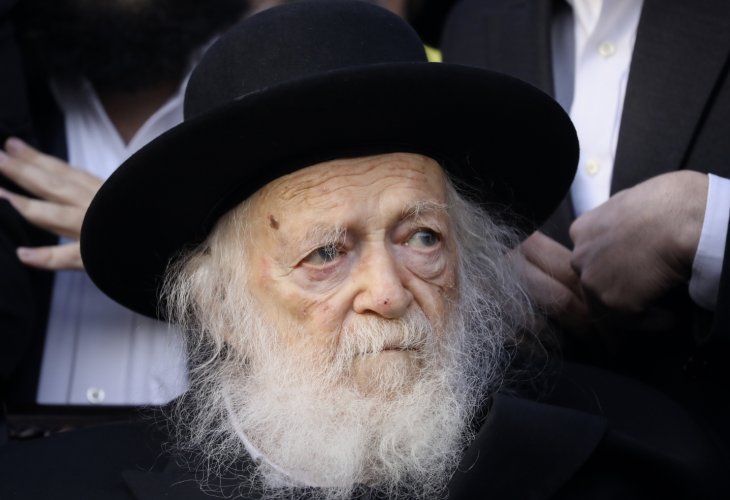 Rabbi Chaim Kanievsky (Photo: Flash 90)
Rabbi Chaim Kanievsky was one of the most revered Torah scholars and spiritual leaders of his generation. Known affectionately simply as “Reb Chaim” and widely honored with the title Sar HaTorah, the “Prince of Torah,” Rabbi Kanievsky was a leading halachic authority, a prolific author, and a central figure in the Haredi community. He passed away on Shushan Purim, March 18, 2022, at the age of 94.
Rabbi Shmaryahu Yosef Chaim Kanievsky was born in 1928 in Pinsk. He was the eldest son of Rabbi Yaakov Yisrael Kanievsky, the legendary Steipler Gaon, and Rebbetzin Pesha Miriam, sister of the Chazon Ish. In 1934, when Rabbi Chaim was still a young child, the family immigrated to Eretz Yisrael and settled in Bnei Brak.
From those early years emerged a life that would become almost synonymous with Torah study.
A Life Built Around Torah
Rabbi Kanievsky's devotion to learning was extraordinary even by the standards of the greatest Torah scholars. His vast knowledge encompassed virtually every area of Torah literature, and he was renowned for his remarkable command of the teachings of Chazal and countless Midrashim. His approach to learning drew on an immense breadth of knowledge, comparing sources and using one passage to illuminate another.
Beginning in his twenties, he followed an intensive annual learning program. Much of this schedule was completed during the quiet hours of the night, from midnight until sunrise. It included the Babylonian Talmud, Jerusalem Talmud, Tosefta, Rambam, Tur, Shulchan Aruch, Tanach, and Zohar.
The scope of his daily learning was staggering. He studied eight pages of the Babylonian Talmud each day, together with the corresponding passages in the Jerusalem Talmud, as well as five pages of the Tur and Shulchan Aruch. On Fridays, in addition to his regular schedule, he studied the weekly Torah portion, together with the biblical commentaries and the halachic Midrashim associated with the parashah.
His learning never paused. When he completed one tractate, he immediately began the next. His daily schedule also included an extraordinary range of smaller tractates and works, including Eduyot, Pirkei Avot, Avot DeRabbi Natan, Masechet Soferim, Semachot, Derech Eretz, Kallah, and Kallah Rabbati. During a Jewish leap year, when the additional month gave him extra time in his annual learning cycle, he would use that time to write another Torah work.
It was this relentless devotion to Torah that ultimately earned him the title by which he became known throughout the Jewish world: “Prince of the Torah”.
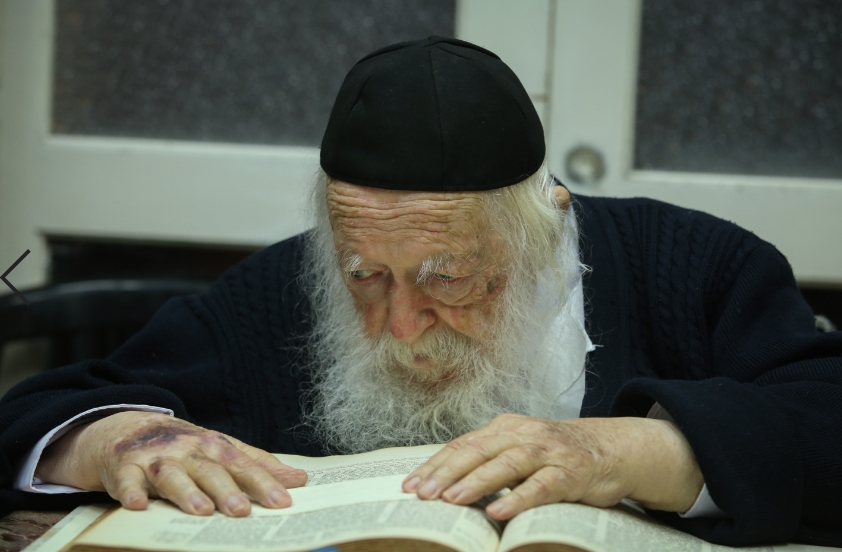 Photo: Flash 90
The Door That Remained Open
Remarkably, Rabbi Kanievsky's intense learning schedule did not prevent him from making himself available to others. His modest home on Rashbam Street in Bnei Brak became a destination for people from every walk of life.
Day after day, people entered seeking a blessing, guidance, encouragement, or an answer to a difficult question. Despite the value he placed on every minute of Torah study, he devoted many hours to receiving those who came to him.
Over the years, countless stories circulated about unusual events connected with his advice and blessings. Some became widely repeated accounts of the extraordinary spiritual stature attributed to him.
Rain for a Mikvah
One such story took place after Pesach, while a new mikvah was being constructed in Bnei Brak. Rainwater was needed to fill its reservoirs, but although a small amount of rain had fallen, it was nowhere near enough.
Bnei Brak mayor Rabbi Avraham Rubinstein approached Rabbi Kanievsky with an unusual question: Was it permissible to pray for rain at that time of year?
Rabbi Kanievsky replied that one should not pray for rain after Pesach, since rain during that season is traditionally regarded as an unfavorable sign. But then he surprised those present.
There was no reason to worry, he told them. More rain would fall, and the mikvah would be filled. According to the account, that is precisely what happened. Despite the season, significant rain fell in Bnei Brak, filling the mikvah's reservoirs.
The Prayer for 21 Couples
Another remarkable story involved 21 couples who had been waiting to be blessed with children.
In a rare departure from Bnei Brak, Rabbi Kanievsky traveled to the traditional burial site of the Shunammite woman in Shunem, near Afula. He had not visited the site for approximately 25 years. The location has long been associated with prayers for children because of the biblical account in which the prophet Elisha blessed the Shunammite woman with a son and later restored the child to life. Rabbi Kanievsky's father, the Steipler, had also recommended praying there.
Rabbi Kanievsky prayed at the site for 21 couples. According to the account, within a month, the first couple received the news they had been waiting for. Then came another report, and another.
Whenever Rabbi Kanievsky heard the good news, he reportedly responded with a single word: “Shunem.”
Exactly two years after his visit, the final couple was reportedly blessed with a child. All 21 couples for whom he had prayed had received the news they had long hoped to hear.
“Do You Work on Chol HaMoed?”
Another story concerned several employees at a bank who suddenly began suffering from severe pain in their legs. Doctors were unable to identify the cause. Even more puzzling was the fact that several women working in the same place were experiencing the same unexplained symptoms.
Eventually, they turned to Rabbi Kanievsky.
“Do you work on Chol HaMoed?” he asked them.
“Yes,” they answered.
Rabbi Kanievsky pointed out that the festivals are called regalim, a Hebrew word that also means “legs.” He urged them to stop working on Chol HaMoed. According to the story, once they accepted this upon themselves, the pain disappeared.
“Do You Honor Your Parents?”
A physician associated with Rabbi Kanievsky related another incident involving a woman who was suffering from severe abdominal pain. She was sent to the hospital and underwent extensive testing, but doctors could find no explanation for her condition. Even after she remained under observation, the cause of the pain remained a mystery.
In her distress, she turned to Rabbi Kanievsky.
“Do you honor your parents?” he asked.
The woman burst into tears. For various reasons, she admitted, she found it extremely difficult to honor them.
“Honor them, and you will be healthy,” Rabbi Kanievsky told her.
According to the account, she did so and recovered.
The Tumor That Receded
Dr. Hart related another incident that he witnessed in Rabbi Kanievsky's room. A young man from abroad came seeking guidance after doctors discovered a dangerous tumor in his breastbone.
“Study the laws of Chol HaMoed,” Rabbi Kanievsky told him.
The young man took the instruction seriously. He studied the subject diligently and eventually published a booklet containing his Torah insights on the laws of Chol HaMoed. According to the account, the tumor subsequently receded.
Several years later, however, it returned. The young man once again came to Rabbi Kanievsky, who instructed him to publish another edition of the booklet. According to the story, the tumor then stopped progressing.
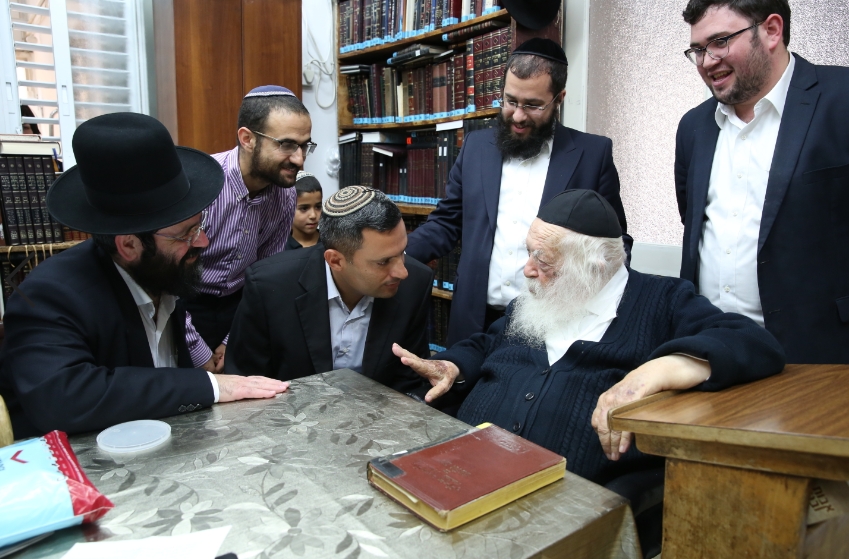 Photo: Flash 90
“Why Aren’t You Wearing Tzitzit?”
A young groom once came to Rabbi Kanievsky shortly before his wedding to ask for a blessing. Rabbi Kanievsky looked up at him and asked an unexpected question:
“Why aren't you wearing tzitzit?”
The young man was confused. Beneath his suit, he was most certainly wearing tzitzit.
“Rabbi, I am wearing tzitzit,” he replied respectfully.
Rabbi Kanievsky gave him the blessing he had requested and returned to his learning.
But after leaving the room, the groom could not dismiss the question. Why would Rabbi Kanievsky look at a yeshivah student, whose entire appearance suggested that he was observant, and ask why he was not wearing tzitzit?
He stepped aside and carefully examined the garment. Then he discovered something astonishing. Several of the strings had torn without his realizing it, rendering the tzitzit invalid.
Only then did he understand Rabbi Kanievsky's question.
The Books He Left Behind
The remarkable stories told about Rabbi Kanievsky were only one aspect of his legacy. At its heart was an enormous body of Torah scholarship.
He authored works across a remarkable range of subjects. Among his best known is Derech Emunah, a five-volume work on the laws of the agricultural mitzvot connected to Eretz Yisrael, arranged in a format similar to the Mishnah Berurah. Shoneh Halachot presents concise rulings based on the Mishnah Berurah and Chazon Ish, while Orchot Yosher focuses on ethics and character development, drawing primarily on Chazal, the Rishonim, and Acharonim.
His other works include Derech Chochmah on the laws of Kodashim, Shaarei Emunah on Mishnah Zeraim, Siach HaSadeh, Nachal Eitan on the laws of eglah arufah, Shekel HaKodesh on Shekalim and Kiddush HaChodesh, and Ta'ama D'Kra on Tanach.
He also authored Kiryat Melech, providing source references for the Mishneh Torah; Yishuv HaDa'at, addressing questions raised by the Maharsha; L'Mechaseh Atik, dealing with difficult biblical passages explained by Chazal; and commentaries on several of the minor tractates.
His commentary on the Jerusalem Talmud, edited by his son-in-law Rabbi Zelig Braverman, was printed alongside the text in published editions. His teachings and responses were also preserved in collections such as Derech Sicha, Kol Mishalotecha, and Sham'ah Tefillati.
These works reflect not only the breadth of Rabbi Kanievsky's knowledge, but a lifetime in which learning and writing Torah were woven into the fabric of every day.
From Torah Scholar to Communal Leader
Following the passing of Rabbi Yosef Shalom Elyashiv in 2012, Rabbi Kanievsky stood alongside Rabbi Aharon Yehuda Leib Shteinman in the leadership of much of the Lithuanian Haredi community. After Rabbi Shteinman's passing, Rabbi Kanievsky became increasingly involved in guiding the community.
His influence reached far beyond formal communal decisions. Hundreds of people came to his home each day seeking guidance on marriage, children, health, livelihood, education, and countless other areas of life. He also served as president and spiritual patron of numerous educational institutions and charitable organizations.
Even as his public responsibilities grew, his personal center remained unchanged. He was, first and foremost, a man of Torah.
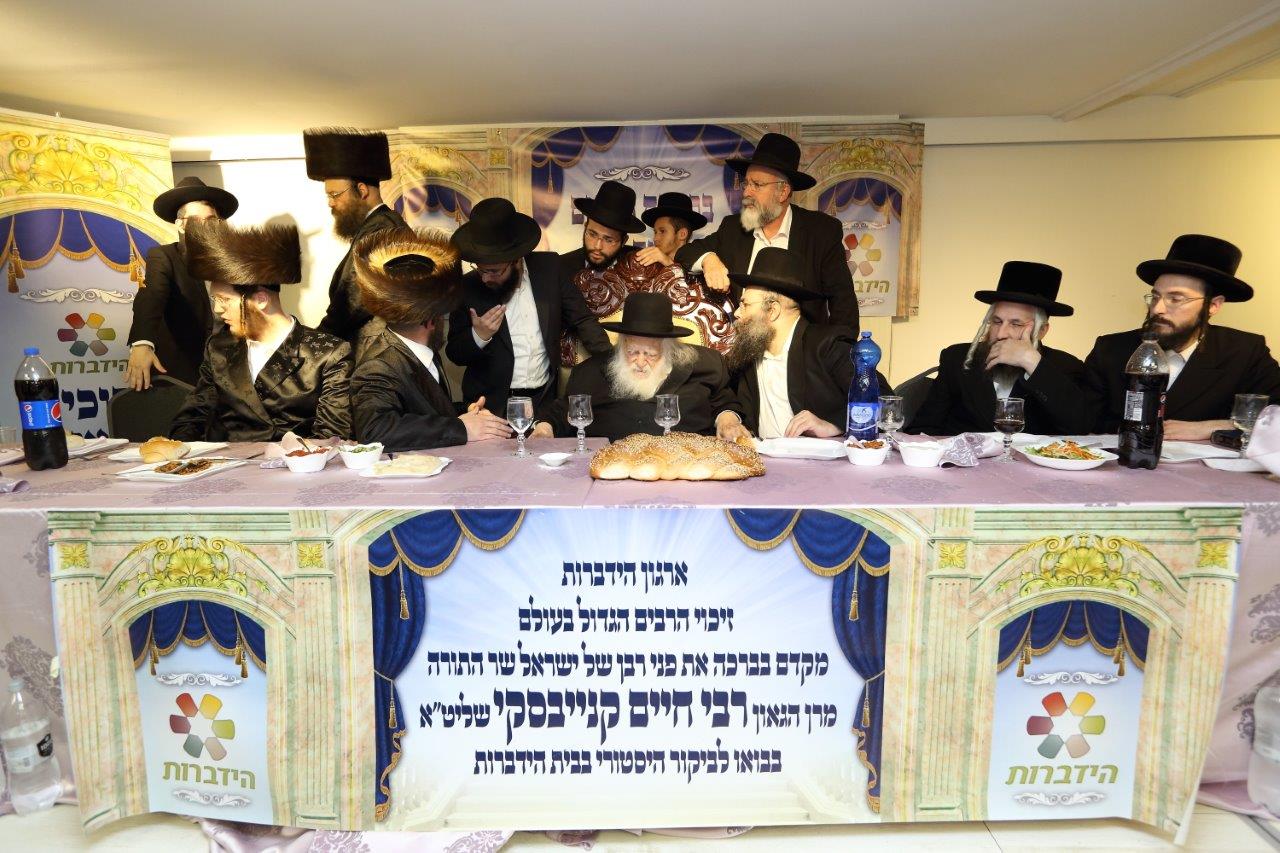 Rabbi Chaim Kanievsky on his historic visit to Hidabroot
A Remarkable Torah Dynasty
Rabbi Kanievsky's life was rooted in an extraordinary Torah family. His father, Rabbi Yaakov Yisrael Kanievsky, the Steipler, was among the great Torah scholars and communal leaders of the generation following the Holocaust. After the Steipler's passing in 1985, Rabbi Elazar Menachem Shach famously said that he had “left behind a son like himself.”
Rabbi Chaim was also the nephew of the Chazon Ish, his mother's brother, with whom he shared a particularly close relationship. The Chazon Ish was even involved in arranging his marriage.
Rabbi Kanievsky married Rebbetzin Batsheva Esther, the eldest daughter of Rabbi Yosef Shalom Elyashiv. Rebbetzin Kanievsky became a beloved and influential figure in her own right, receiving hundreds of women who came to her for blessings, guidance, and encouragement. She passed away suddenly during Chol HaMoed Sukkot in 2011.
Together, they raised a family that continued the Torah traditions of the distinguished families from which they came, with their children and descendants becoming deeply involved in Torah learning, education, and communal life.
Supporting the Spread of Torah
Rabbi Kanievsky was known for his support of Hidabroot and its work of spreading Torah and strengthening Jewish identity.
In a handwritten letter, he described the organization as saving souls and bringing thousands upon thousands of Jews closer to their Father in Heaven. He wrote that those who participate in its work acquire an enormous merit and blessed them with abundant blessing.
In 2018, Rabbi Kanievsky made a special visit to Hidabroot's offices in Petah Tikva. Such a trip was highly unusual for someone whose daily routine revolved so intensely around his learning. He made the visit in order to strengthen and encourage those working to spread Torah to hundreds of thousands of Jews.
A Funeral That Brought Bnei Brak to a Standstill
Rabbi Chaim Kanievsky passed away at his home on Friday, March 18, 2022, approximately two hours before Shabbat. His funeral was scheduled for Sunday, March 20, rather than immediately after Shabbat, in part to allow the authorities to make the extensive preparations necessary for the enormous crowds while avoiding unnecessary Shabbat desecration.
On the day of the funeral, Bnei Brak effectively came to a standstill. Schools throughout the city closed, businesses suspended operations, and an immense crowd poured into the streets to accompany Rabbi Kanievsky on his final journey.
Israel Police estimated that approximately half a million people attended. The Bnei Brak Municipality placed the number even higher, at around 750,000, making the funeral one of the largest ever held in Israel.
Approximately 3,000 police officers were deployed, along with hundreds of barriers to regulate the crowds and prevent dangerous congestion. Emergency organizations stationed hundreds of medics and paramedics throughout Bnei Brak, supported by nearly 100 ambulances and dozens of emergency motorcycles.
The extraordinary turnout testified to the place Rabbi Kanievsky had come to occupy in the hearts of countless Jews. Yet perhaps the deepest measure of his life cannot be found in the size of the crowds that came to his door, the stories told about his blessings, or even the hundreds of thousands who accompanied him at his funeral.
It can be found in the quiet hours of the night, when most of the city was asleep and Rabbi Chaim Kanievsky was sitting over another page of Torah.
For decades, day after day and year after year, he built his life around the conviction that no moment was more precious than a moment devoted to Torah. Another page of Gemara, another halachah, another Midrash, another passage of the Jerusalem Talmud: this was the rhythm of his life.
It was that extraordinary devotion that transformed the scholar in the modest home on Rashbam Street into the figure an entire generation came to know simply as the Prince of the Torah.

