

Magazine
A Russian Jew's Journey: Finding Faith and Home in Israel
Yaakov Solganik grew up with almost no connection to Judaism, but an unexpected move to Israel led him to the yeshiva world, Torah observance, and a lifelong mission to help Russian speaking Jews reconnect with their heritage
- Michal Arieli
- | Updated
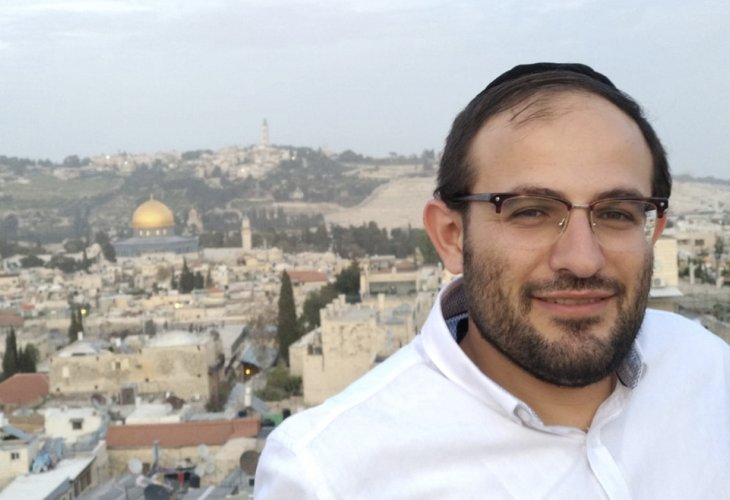 Yaakov (Yasha) Solganik
If you ask Yaakov “Yasha” Solganik what made his parents decide to immigrate to Israel over 30 years ago, he has no simple answer. “We lived in Azerbaijan, in the former Soviet Union, and we had absolutely no desire to move to Israel,” he recalls. “We never even spoke about it. Israel simply wasn’t part of our consciousness. My father likes to tell how, when he and his friends would drink a l’chaim, they would add, ‘Next year in Jerusalem,’ and then burst out laughing because the idea seemed so impossible.”
What ultimately drove the family to leave was a bloody conflict that erupted where they lived. Israel was not necessarily their preferred destination, but their options were limited. “It wasn’t that we specifically wanted to go to Israel,” Solganik explains. “We simply couldn’t get into other countries without the proper authorization. The choices available to us were America or Israel. We weren’t accepted to America, so we decided to move to Israel.”
“I Ended Up in Yeshiva Almost by Accident”
Like many families from the former Soviet Union, the Solganik family had observed virtually no Jewish religious practices while living there. Yet after arriving in Israel, they happened to settle in the Haredi neighborhood of Romema. In an unexpected turn of events, young Yaakov was sent to a Talmud Torah, where he studied alongside children from Haredi families.
“My dream as a child was simply to be like everyone else,” he recalls. “That became my mission in life. During those years, I felt as though I was playing a kind of game. At home I behaved one way, while outside I tried to look and act differently.”
What hurt him most was being called “Russian” by neighborhood children. “They didn’t mean to hurt me, but to me it was like an arrow straight to the heart. Throughout my years in Russia, I had been harassed because I was Jewish. When my parents told me we were moving to Israel, they promised me, ‘When we get there, you’ll see that everyone will be Jewish, just like us.’ So imagine my shock when I arrived and discovered that now I was ‘Russian.’ It was the very identity I had always tried to escape. I would tell the other kids, ‘But I hate Russians,’ and they would insist, ‘You were born in Russia, so you’re Russian.’”
After eight years in a Talmud Torah, Solganik made another surprising choice: he decided to continue to a yeshiva. “On the outside, I looked like an ordinary Haredi teenager. I knew how to dress and how I was supposed to look. But underneath, I was missing basic concepts that everyone else seemed to take for granted, and I had to learn them from scratch.”
“I would hear friends saying, ‘This is what we do in our family,’ and then they would turn to me and ask, ‘What do you do in your house?’ I had to improvise and come up with an answer that sounded convincing. I knew I couldn’t make a mistake, because if I did, they would immediately understand the kind of background I came from.”
Why Did He Choose Yeshiva?
Surprisingly, the decision did not come from his parents. “My parents would actually have preferred to send me somewhere else,” Solganik explains. “Going to a yeshiva was my decision.”
Part of the inspiration came from his older brother, who had become religious and was studying in a yeshiva. But there was another, far more unusual reason. “As a child, I was addicted to the news, current events, and newspapers. I mean obsessively addicted. Again and again, I heard politicians talking about how the Haredim were ‘eating up the state budget’ and receiving thousands of shekels in government allowances. And I completely believed them.”
“I was 100 percent convinced that if I became a kollel student, the government would support me for the rest of my life. I thought, why should I be a sucker and give up such an amazing opportunity when it is right there in front of me? So I enrolled in yeshiva thinking I was making the smartest and most profitable decision possible.”
Even more surprising was that he was accepted into a highly regarded Haredi yeshiva. Anyone familiar with the admissions process knows that a prospective student’s family and background are often carefully considered. Solganik came from a non-Haredi home, making his acceptance far from obvious.
But teachers at his Talmud Torah connected him with a young man who prepared him for the entrance examination. Solganik still remembers studying Tractate Makkot. When he appeared before the examiners, he demonstrated enough knowledge to impress them. Years later, a staff member told him there had been considerable debate over whether to accept him because of his family background. Eventually, the staff decided to try something unusual: for once, they would accept a student based solely on his knowledge rather than his family background.
And so, on his first day in yeshiva, Solganik sat down beside his assigned study partner and began studying the famous opening discussion of Bava Metzia: “Two people are holding a garment.”
There was only one problem. Solganik had no idea what the Gemara was talking about. “I couldn’t understand why two people needed to hold a tallit,” he recalls with a smile. “A tallit is something you wear, not something you hold. And why was there only one? Weren’t there enough tallitot for everyone?”
He asked his bewildered study partner these questions. “My chavruta couldn’t understand why they had stuck him with someone like me. After all, he was a good kid! And I was just as shocked. Only then did I realize what I had gotten myself into. But by that point, it was too late. That was how I began my life as a yeshiva student.”
Discovering Encouragement and Meaning
Yeshiva changed Solganik in ways his parents could never have imagined. “My parents raised me with a very strict Soviet approach to education, based on the idea that the more criticism you give a child, the more he will grow and improve. That was how I was raised. When I entered yeshiva, it was the first time I discovered that people could actually compliment and encourage me. And I discovered that it felt pretty good. It made me flourish.”
There was another discovery that proved even more profound. Growing up in the Soviet Union, Solganik had learned not to ask too many questions about life and its meaning.
“When I would ask my grandmother, who raised me, ‘Why was I born? Why will I die? And what am I supposed to do in between?’ she would tell me, ‘For your own good, don’t ask questions that have no answers.’ So I learned to remain silent.”
“In yeshiva, I was amazed to discover that you were allowed to ask questions. In fact, you were encouraged to ask them. A large part of Gemara study itself is built around questions.”
The transition was not easy. Solganik says he was not an exceptionally gifted student, and his achievements required sustained effort. But for the first time, he felt that his life had meaning.
As for the generous government benefits he had expected to receive as a future young man, reality quickly corrected that misconception. “To this day, I’m still waiting for the government to give me the 8,000 shekels they talk about in the secular media,” he jokes.
The money never materialized. His commitment to yeshiva life, however, did. After completing elementary yeshiva, he continued to Beit Midrash Elyon, a prominent yeshiva in Bnei Brak.
He was the only student of Russian origin there. “On my first day, I sat next to a student who had heard that I had immigrated from Russia. He told me excitedly, ‘This is the first time I’ve ever spoken to a Russian.’ By then I had become much more confident, so I replied, ‘I’m excited too. This is the first time I’ve ever met someone who is meeting a Russian for the first time.’”
Understanding Russian Speaking Israelis
Solganik is no longer the young immigrant struggling to fit into the yeshiva world. He is now married and has raised a large Haredi family. But he has never forgotten his own experience, and he retains a particular sensitivity toward Jews who immigrated from the former Soviet Union.
That personal background also shapes his perspective on Israeli politics and, in particular, the political appeals made to Russian speaking voters. “Every election, when I hear rhetoric aimed at Russian speakers that pits them against the Haredi community, it hurts me deeply,” he says. “Unlike many others, I also understand what this tension is built on. I think there is an explanation for it.”
“The children of Russian immigrants are thirsty for a sense of belonging,” he says. “They want to feel part of a larger tribe.”
He finds it painful when that search for identity stops with cultural traditions inherited from the Soviet environment rather than going further back into the family’s Jewish history. “When a Jew begins searching for his tradition, how can he discover that his parents celebrated Novy God in Russia and conclude that this is what he should celebrate in Israel in order to feel connected to them? Why not keep searching and ask what his grandparents and great-grandparents did, and what lies at the foundation of his family as part of the Jewish people?”
For Solganik, this is not merely a political issue. He sees it as an opportunity for personal Jewish outreach. “It isn’t too late,” he says. “Our responsibility is to open our eyes. If there is someone around us who is distant from Judaism, we should simply show him and bring him closer to things that are genuinely connected to Judaism.”
Searching for Jewish Belonging
Asked how many immigrants from the former Soviet Union had become part of the Haredi community, Solganik said it was difficult to know precisely. His rough estimate was that tens of thousands of Russian speaking Israelis had become religiously observant and joined the Haredi community, with many becoming so thoroughly integrated that their origins were no longer obvious.
He also expressed strong views about immigration from Russia and Ukraine, the Law of Return, and the halachic status of some immigrants. These comments reflected his concerns about the Jewish character of the state and his belief that immigration policies had created complex questions of Jewish identity.
Ultimately, however, Solganik returns to the experience he knows personally: the search for belonging. He believes that Russian speaking Israelis may sometimes appear confrontational toward the Haredi community, but that beneath the surface there is often genuine curiosity.
“They want to listen,” he says. “Many times, they are genuinely interested. As I said, they are searching for their roots and for somewhere to belong.”
For the boy who once desperately wanted to stop being seen as “Russian,” the question of identity has come full circle. The answer he eventually found was not in escaping his past, but in discovering a deeper layer beneath it.
His journey began almost accidentally: a family fleeing conflict, an unexpected move to Israel, a home in a Haredi neighborhood, and a child sent to a Talmud Torah despite knowing almost nothing about religious Jewish life. What began as an attempt to fit in eventually became something much more profound. In the yeshiva world, Solganik found not only a community, but a place where questions were welcomed, effort was encouraged, and life itself could be examined for meaning.
Today, he hopes to help others from backgrounds like his discover that same sense of connection to their Jewish heritage.

