

Magazine
Dancing on Prosthetic Legs: Elkana Levy’s Remarkable Journey of Faith and Recovery
After losing both legs in a devastating injury in Gaza, Elkana Levy endured months of rehabilitation and learned to walk again, culminating in a moving celebration of life, gratitude, faith, and the strength of the Jewish people
- Michal Arieli
- | Updated
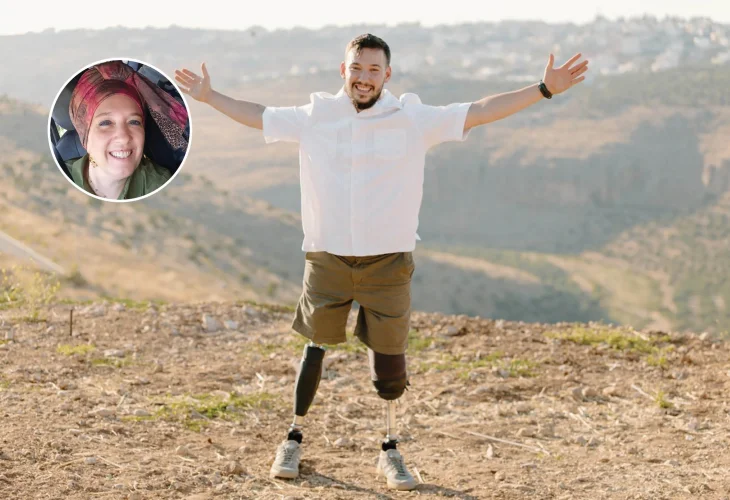 Elkana Levy (Photo: Gavriel Strock). Inset: his mother, Orit Levy
The most moving moment at Elkana Levy’s thanksgiving celebration came when he stood in the center of the dancing circle on the two prosthetic legs that now carry him. It was a moment of triumph, the culmination of an entire year of surgeries, treatments, and rehabilitation. That year had begun with a devastating injury in Khan Younis and ended with an extraordinary recovery.
“There were many difficult moments that came before this one,” says Elkana’s mother, Orit Levy. Since the outbreak of the war, three of her sons have been wounded, each facing his own long road to recovery.
“When the war began, on Simchat Torah itself, our oldest son, Rachamim Yishai, was injured. He was a Golani soldier serving near Gaza and suffered severe injuries to his face and jaw. He was hospitalized for a long period. Eight months later, our second son, Yedidya, who was serving as an officer in Gaza, was wounded. And then Elkana was injured a year and two months ago.”
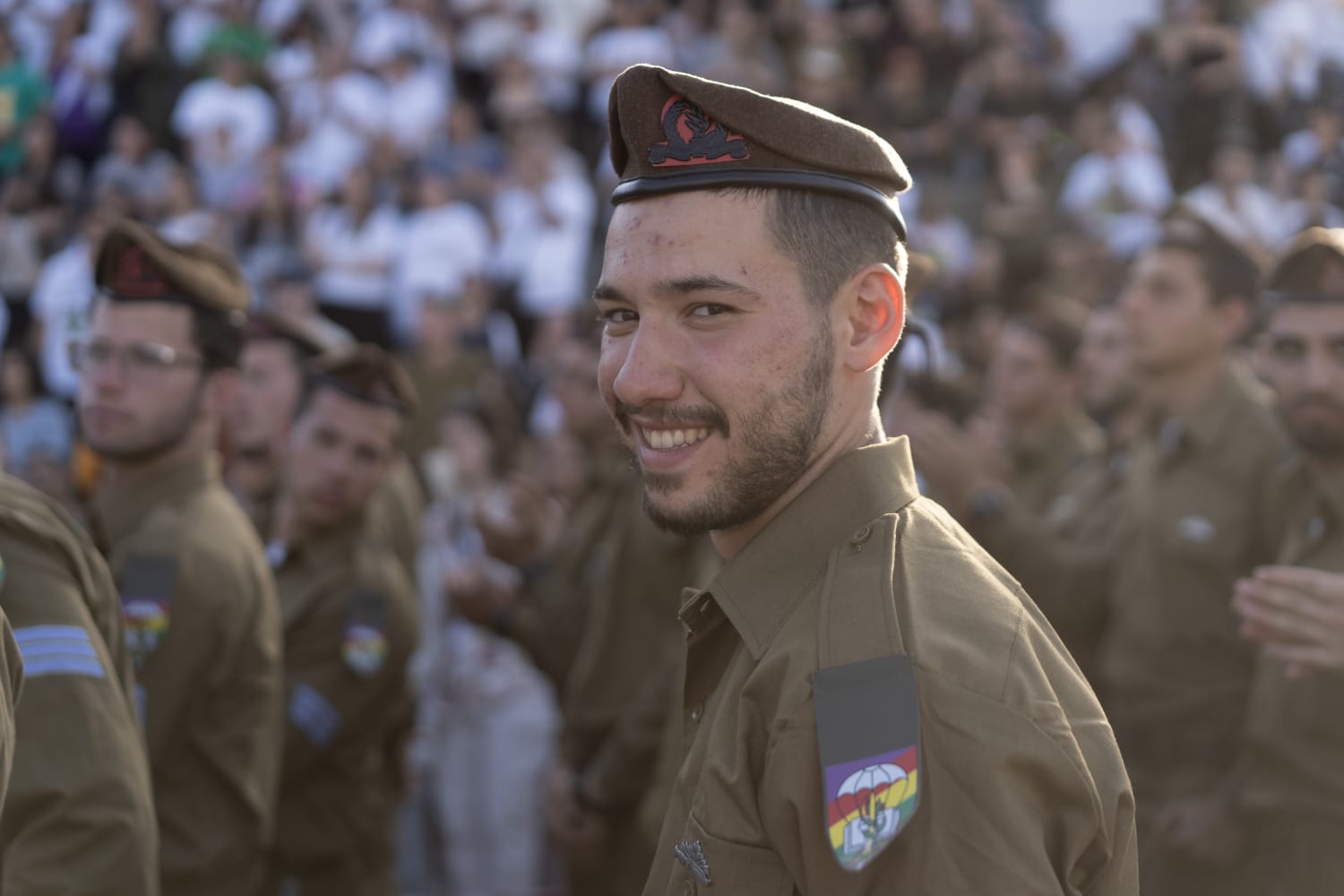 Photo: IDF
Fighting for His Life
Elkana, the youngest son, suffered the most severe injuries of the three.
“It happened during a relatively quiet period of the war,” Orit recalls. “A woman called me and introduced herself as ‘Natasha from the army.’ I answered, ‘Hi, Natasha, how are you?’ because when Rachamim Yishai and Yedidya were hospitalized at Ichilov, there had been a medical officer named Natasha who was in contact with us, and I thought it was her.
“She replied, ‘This is not the Natasha you know.’
“At that moment, I understood, and I began screaming.
“She continued, ‘Elkana has been seriously wounded. Casualty officers and a taxi are waiting outside your home to take you to Soroka Hospital.’”
By the time the family reached the hospital, Elkana had already been in surgery for hours. They waited anxiously until the surgeon finally emerged with a grave expression.
“I’m sorry to tell you,” he said, “but Elkana has lost both of his legs.” The doctor went on to describe additional serious injuries, though these were expected to heal. He also explained that, fortunately, Elkana had retained one knee.
“At the time, I didn’t understand why that was so significant,” Orit says. “Later, when they fitted him with prosthetics, I realized that having a knee is a real game changer. It makes an enormous difference in maintaining balance while walking on prosthetic legs.”
After surgery, Elkana was transferred to intensive care. “Another doctor received us there,” Orit recalls. “He prepared us for the possibility that Elkana would remain sedated and on a ventilator for four to six weeks. Then he added, ‘Our job as the medical team is to be pessimistic. Your job is to be optimistic.’
“So we tried to be optimistic, but it was an enormous blow.” Orit admits that standing beside a son who is unconscious and on a ventilator is an experience that is almost impossible to describe.
“But even in that terrible situation, in all the helplessness, I had a deep sense of trust that with Hashem’s help, things would be all right and that Elkana would live a good life. I worried that when he woke up, he would be in tremendous pain. But I wasn’t afraid of the future. I believed in Elkana’s strength, and of course I believed in the Creator.”
That optimism gave the family strength. Yet even they were astonished when, less than 48 hours later, Elkana opened his eyes.
Beforehand, the doctors had warned the family that he might not even realize he had lost his legs. But as soon as Elkana woke up, he spoke about pain in his residual limbs, making it clear that he understood exactly what had happened.
Then he asked whether the funeral of Amit Cohen had already taken place. Amit had been one of Elkana’s soldiers and had been killed in the same incident in which Elkana was wounded.
Orit told him that the funeral had already taken place. Elkana began to cry.
“You must be in so much pain,” she told him. Elkana answered, “It’s not my legs that hurt. It’s Amit.”
During that same conversation, he urgently wanted to know whether he had suffered a head injury. He was visibly relieved when his mother told him that the doctors had said his head was fine.
Not long after Elkana regained consciousness, moments of laughter began appearing in his hospital room as well. He quickly asked for his brothers and began joking with them, displaying the same sense of humor he had always had.
“We stood there crying and laughing at the same time,” Orit says. “On the one hand, we were in such pain for Elkana. On the other, he was the one using his sensitivity and unique sense of humor to make everyone else laugh.”
Asked what gave the family strength during such an overwhelming ordeal, Orit begins with the circumstances surrounding her son’s injury.
“We understand that he was in an important place, doing something meaningful for the Jewish people. Beyond that, strength comes only from Above. Every day I pray to the Creator to give us strength, and I genuinely feel Him pouring it upon us.
“In those days, we felt it very tangibly through the embrace of the Jewish people. Hundreds of people came to Soroka Hospital, and I am not exaggerating. They came to hug us, to bring fruit platters, cakes, letters, and chocolates. It gave us tremendous strength.”
The pain, however, never disappeared. “There are still moments when I suddenly absorb what happened and realize that life is going to look different, that the loss of his legs is real. As a mother, it is very difficult to think that I gave birth to a healthy, whole child and now he has no legs. It hurts me deeply.
“But at those moments I take a deep breath and focus on the fact that, thank God, Elkana is alive. I have to be grateful for that with all my strength. He is alive in every sense of the word. He is full of life. That is something we can never take for granted.”
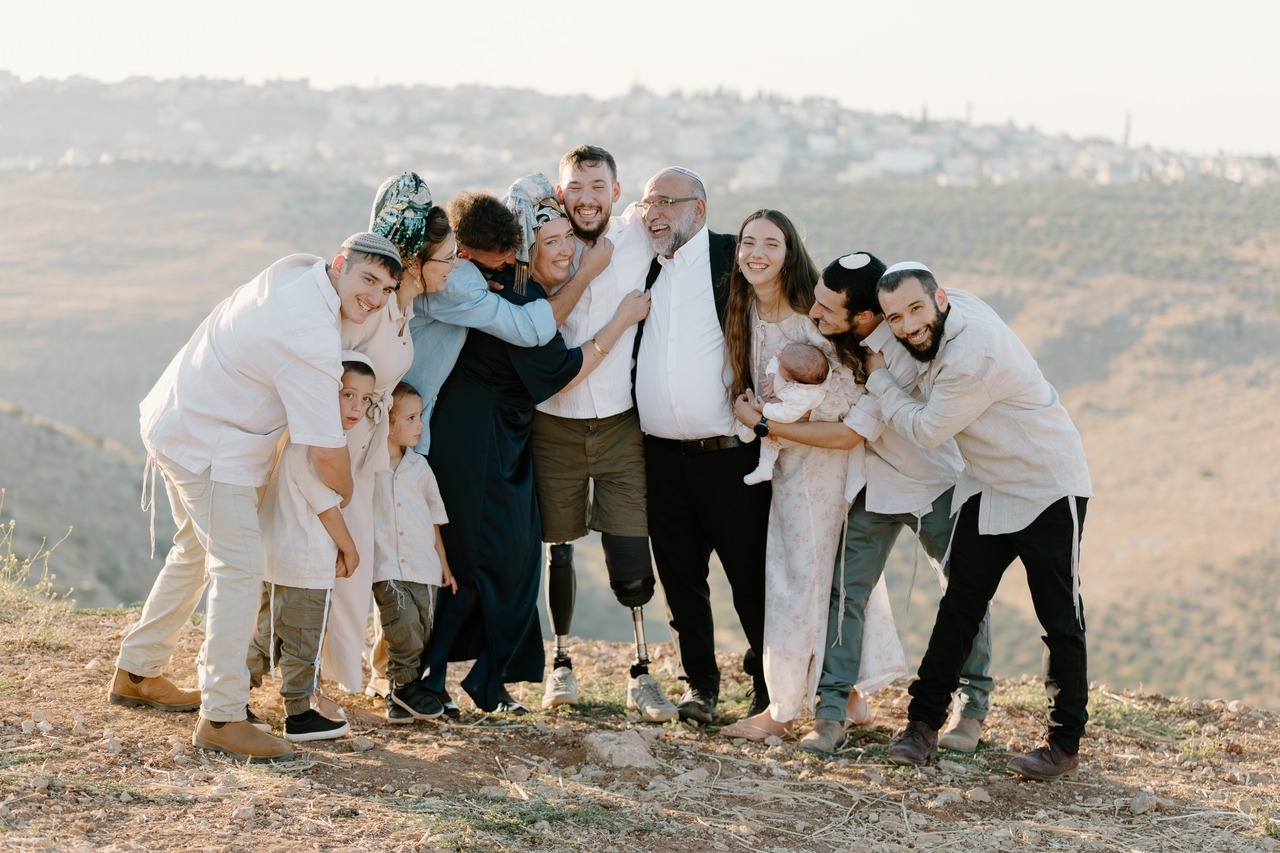 Thanksgiving celebration (Photo: Gavriel Strock)
Part of the Story of the Jewish People
People often ask Elkana himself what enables him to remain so optimistic.
“The truth is, I don’t think my response is particularly unusual,” he says. “At no point did anyone stand me at a crossroads and ask, ‘Which option would you like to choose?’ I was simply thrown into a reality and required to deal with it.”
But there is another idea that shapes his outlook.
“I believe that a person is formed by the landscape of his homeland and by everything he experiences throughout life. Every person encounters both good and difficult experiences, and from those experiences he develops habits and ways of looking at the world.
“My perspective comes from my home. It is clear to me that we are part of a much larger story, a story that began thousands of years ago. It passes through King David, the First and Second Temple periods and exiles, two thousand years of exile, my grandfather who survived the Holocaust and immigrated to Israel, and my grandmother who fled Arab villages near Aleppo.
“All of those stories came together on one morning, Simchat Torah 5784, when all of us were given a mission whether we wanted it or not, and we were required to rise to it. The Levy family is only one of countless individuals and families who were given extraordinary inner strength. Like the rest of Israel, we stood up and did what was required of us. In our case, that meant four combat soldiers. From there, we simply made the choices that felt natural.”
For Elkana, there is another crucial part of the story. “If someone had asked me ten minutes before I was injured what I wanted from life, I would have answered that I wanted to be exactly where I was.
“When I decided to become a combat soldier, I understood that there was risk involved. I knew I might be killed or wounded, and I went to war with that awareness.
“That is different from someone who is driving to work and loses his legs in a traffic accident. In my case, the circumstances of the injury make coping with it easier. Just as I knew ten minutes before I was wounded that I was in the right place, I felt the same way afterward.”
Elkana’s desire to continue serving has not disappeared. “Just recently, I received approval from an occupational physician allowing me to return to the army. With Hashem’s help, I will return to meaningful service next week. It comes from that same strong desire to remain part of the larger story of the Jewish people.”
Ten Months of Rehabilitation
After his hospitalization at Soroka, Elkana was transferred to Sheba Medical Center at Tel Hashomer, where he spent ten months in rehabilitation.
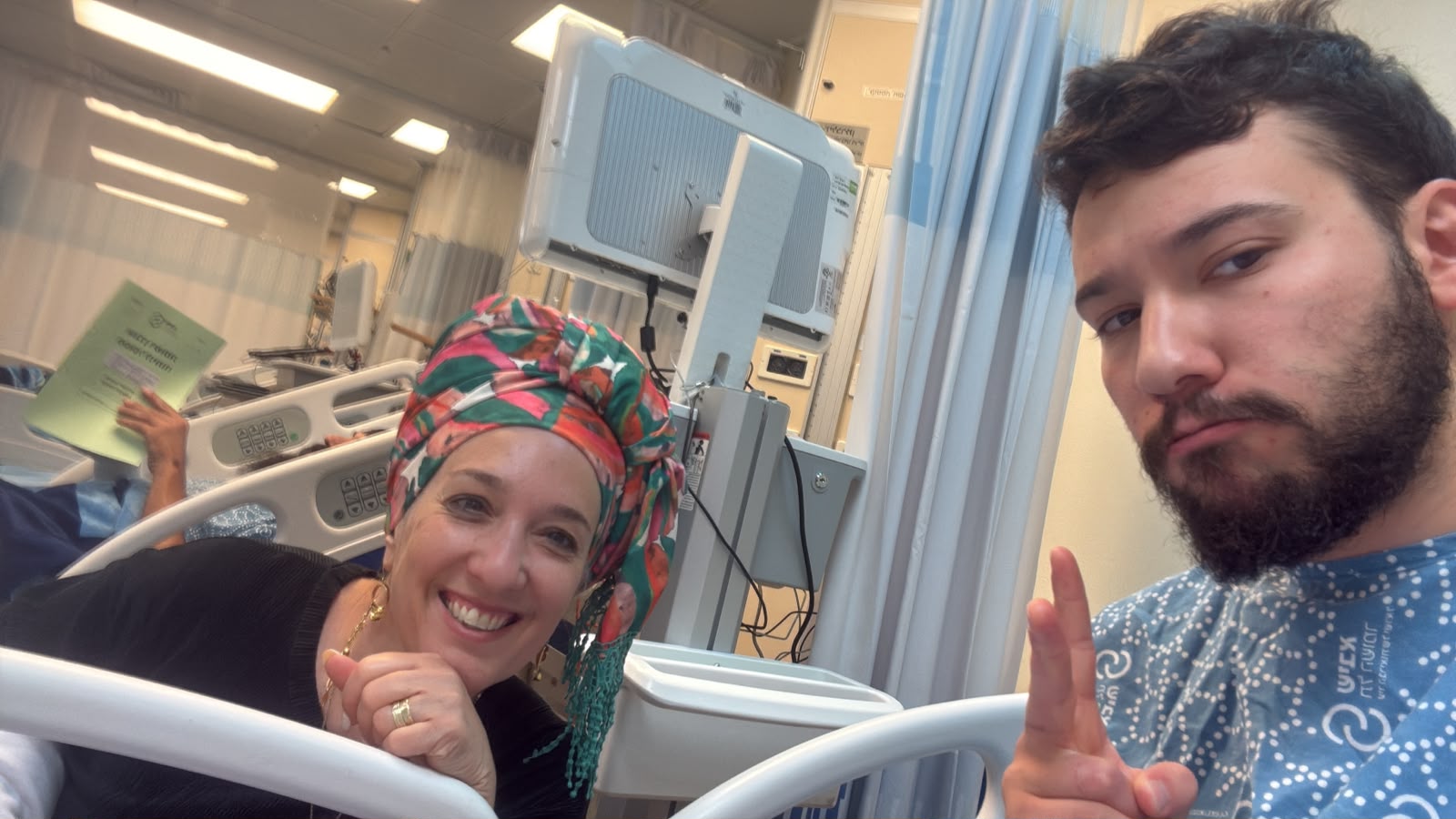
“The rehabilitation was full and intensive,” Orit explains. “It included physiotherapy, occupational therapy, and everything needed to give him as much independence and functionality as possible.”
During the same period, the family also had to move to a different home because their previous house had stairs and was not sufficiently accessible for Elkana. “That became another major task that consumed our time,” Orit says.
Her own life changed dramatically as well. Before Elkana’s injury, she had worked full time as an interior designer. “After he was wounded, I decided not to return to work. It was clear to me that although every member of the family was helping wherever needed, there had to be one person during this period who had no other obligations and could focus entirely on his care and rehabilitation.
“My husband had established a yeshiva gedolah in Herzliya about two years earlier, and it was important to me that he be able to return fully to the yeshiva, so I took on this role. I am very happy with the decision I made at this point in my life, and I believe I will return to work in the future.”
A Celebration of Gratitude
Ten months after his injury, Elkana was discharged from the hospital and was already walking with prosthetic legs. One dream, however, had been burning within him for months: to hold a large thanksgiving celebration.
“He first brought up the idea around Pesach,” Orit recalls. “We were sitting on the balcony during Chol Hamoed, and he told us he wanted to hold a thanksgiving celebration and express gratitude for being alive.”
But before making plans, Elkana wanted to speak with the Cohen family, the parents of Amit, the soldier who had been killed in the incident in which he was wounded. The proposed date coincided with the anniversary of Amit’s passing.
“The parents are wonderful, noble people,” Orit says. “They explained that they were planning to hold the memorial marking eleven months at a different time and that they were completely comfortable with us holding the celebration on that date. From then on, we began planning in earnest.”
For Elkana, the thanksgiving celebration fulfilled a dream that had already begun taking shape during his earliest days in intensive care.
“I remember myself lying there in all that pain and difficulty, looking around and seeing this enormous circle of giving,” he recalls.
“I thought to myself, this entire event is filled with circles, circles of giving and circles of difficulty, and there are so many good people in this world. Then suddenly I had a thought: I’m going to say all of this at my thanksgiving celebration. That will be my opportunity to thank everyone.”
From that point onward, Elkana began consciously “collecting thank-yous” throughout the year so that he would remember everyone who had helped him.
The celebration also gave him an opportunity to share something deeper. “We hear so many traumatic and negative stories about the war,” he says. “I want to offer a different perspective and say that this story is a good story.
“Good does not mean what Hollywood movies have taught us to think it means. Good can contain pain. I am not trying for even a moment to blur or minimize that pain.
“The past year was one of the best years I have ever experienced in my life, and there is no question that it was also the most painful. But I understand that the more space I give to the fact that the year was painful, the more space I can also give to all the good that appeared in our lives. And that good was enormous.”
More than 600 people attended the celebration. “Thank God, I am here to say thank you, and that is something I never take for granted,” Elkana says. “Everyone who came to the celebration was unequivocally part of my journey. Because of them, I am here today, physically and mentally.
“Of course, the heart of my gratitude was directed toward my family. From the moment I was wounded, they unquestionably placed me at the center of their lives. My parents spoke at the celebration, and while they were speaking, I cried in a way I hadn’t cried in a very long time.”
Elkana wanted the celebration to be filled not only with gratitude but with genuine joy. “It was important to me that it be a happy celebration, that the joy itself be moving and powerful. I wanted good music and plenty of dancing, and I danced too. It was incredibly emotional when they lifted me onto their shoulders while I was wearing my prosthetics.
“And joy also means plenty of meat and wine. As the saying goes, ‘There is no joy without meat and wine.’ That was something I wanted to invest in as well.”
Since the celebration, positive reactions have continued to pour in. “I know it isn’t because I was at the center,” Elkana emphasizes. “It was because of the atmosphere and what the event represented.
“People are accustomed to hearing how terrible and traumatic things are in our country, how everything is a failure and how badly mistaken we have been. I am not trying to erase the failures or the difficulties.
“But for a few hours, that celebration allowed people to feel the genuine good that exists, to thank the Creator for it, and to thank all the wonderful messengers He sent to help us along the way.”

