

Raising Children
“Mom, Are You Sad?”: A Mother’s Emotional Journey With Autism
Michal Tehila thought being a strong mother meant holding back her tears. One difficult night with her son Moshe taught her that strength can look very different.
- Erez Navon
- | Updated
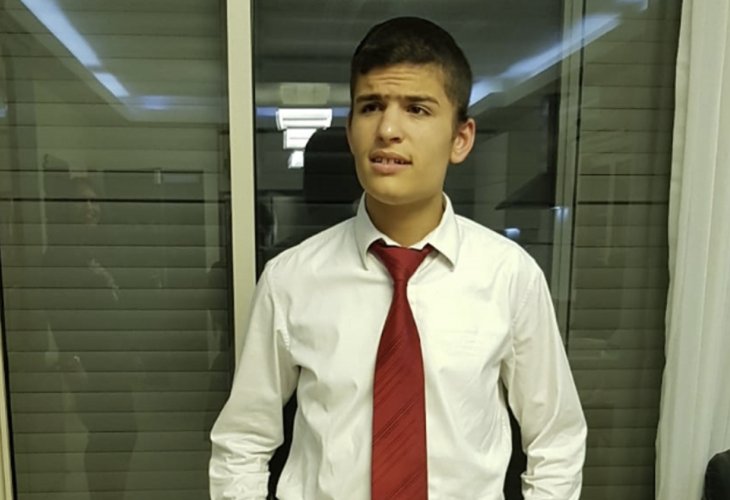 Moshe Tehila (Photo: Private Album)
We often see them out in public, sometimes with a parent or caregiver. Our reactions vary. Sometimes we look away. Sometimes we offer a kind word. And sometimes, unfortunately, people make comments that can cut deeply.
Parents of children with autism often become accustomed to the looks, judgments, and remarks of strangers. But what does life behind those brief encounters actually look like?
A deeply personal post by Michal Tehila, mother of 18-year-old Moshe, who has autism, offers a glimpse into that reality.
“Is crying when things are hard a sign of weakness?” Michal asks.
“After a few emotionally intense days, I want to share what we are going through right now. We’re experiencing a challenging period with our Moshe. We’re trying to manage his behavior with medical cannabis oil. It’s a process of trial and error that can take up to three months until the right balance is found.
“We’ve only just begun, and the first oil caused the exact opposite reaction from what we had hoped for. So we’re taking a break before trying again, with hope for Hashem’s help.”
A Frightening Night
“Last Shabbat, Moshe began behaving strangely. On the one hand, he seemed calm, but on the other, he was quietly aggressive. He would pinch and then caress as though nothing unusual had happened.
“On Saturday night, everything escalated.
“He woke up at 1 a.m., which is something that happens from time to time, but this time was different. He was laughing uncontrollably, yet at the same time he was agitated and aggressive. He was hitting and throwing things out of the window.
“Before I fully understood what was happening, he became violent toward me. It isn’t easy for me to say this, but he bit me on the head, pulled my hair with his teeth, and slapped me.
“My heart broke seeing him in that state. To hurt the person he loves so much? It was heartbreaking.
“I tried to calm him, but nothing worked. He was breathing heavily and speaking to himself in the third person: ‘Moshe, what’s happening to you? Why are you hitting Mom?’
“I began crying out of compassion and helplessness. I couldn’t bear it.”
Michal quietly called her husband, who was in the next room, afraid that shouting might further agitate Moshe.
“I felt completely helpless. I raised my eyes and prayed for Hashem to help Moshe calm down and to show me what to do.
“In the middle of my silent prayer, Moshe walked into the bathroom fully clothed and turned on the shower. When I tried to get him out, he lunged at me again and slapped me hard.
“This time I screamed, and my husband came in and immediately understood that something serious had happened.”
Her husband tried to calm Moshe and prepare a bath for him, but Michal decided that she wanted to do it herself.
“I thought to myself that I wouldn’t want to be there at the moment he fully realized what he had done.
“After the bath, I hugged him and he finally calmed down, although he still struggled to sleep.”
The next morning, Moshe went to school early.
As he waited for his ride, he looked up toward the window of their home.
“Mom, are you sad?” he asked. “I’m sorry. I love you.”
Michal burst into tears.
“How could I not blow him a kiss, smile, and tell him, ‘I love you’?”
Then Moshe boarded the bus.
Michal barely had time to process the night before she had to prepare for her own work as a coach in Kfar Saba. When she arrived, she found herself sharing what had happened with her class.
“Crying Means I’m Human”
The experience left Michal shaken both physically and emotionally, but it also forced her to reconsider something she had believed for years.
“I went through an experience that shook me,” she says. “Physically and emotionally.
“It made me realize that tears are not a sign of weakness.
“For a long time, I thought crying meant weakness because I was the ‘strong woman,’ the one who could handle everything. But today I understand that crying means I’m human.
“It’s okay to cry. It’s okay to release what I’m feeling. That, too, is part of my growth and my connection with Hashem.”
Despite the difficulty of what she and her family had endured, Michal ended her reflection not with anger, but with gratitude and prayer.
“I thank Hashem even for these challenging moments, for the privilege of being a mother to such a sweet soul.
“I pray that Hashem continues to give strength to my beloved husband and daughters so that together we can support Moshe in every way.”
Her words offer a glimpse into a reality strangers on the street may never see: the fear, exhaustion, love, patience, and resilience that can exist behind a single encounter.
And perhaps they are also a reminder that strength does not always mean holding back the tears. Sometimes, strength means allowing them to fall.

