

Torah Personalities
“Tomorrow You Will Speak”: The Remarkable Story of the Kretchnif Rebbe
From a boy who mysteriously regained his voice to countless stories of blessings and salvation, discover the extraordinary life and legacy of the Kretchnif Rebbe.
- David Freed
- | Updated
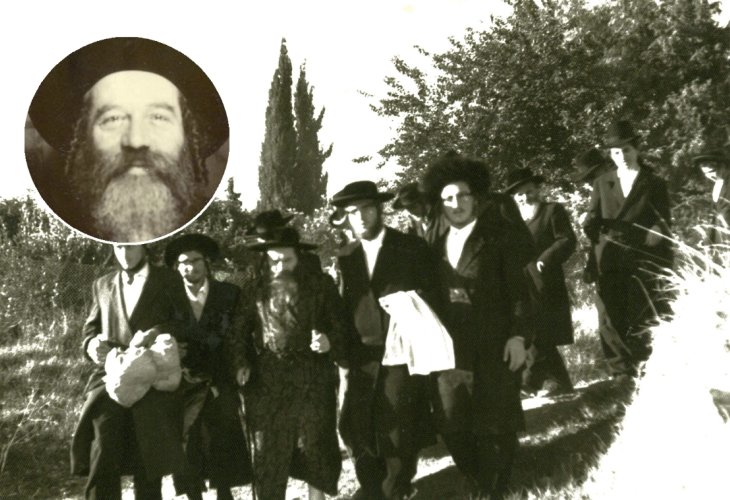 (Inset: Rabbi of Kretchnif zt"l)
The image of the young boy struggling to speak astonished the doctors. They gathered around him, each trying to understand the rare condition that had suddenly left him unable to utter a word.
“One day, my voice simply disappeared,” recalls Rabbi Ephraim Rubinstein, describing the frightening experience of his youth. “I will never forget that day. It happened during the daily study session at Yeshivat Hadarom in Rehovot, where I was studying. Shortly after the session began, my voice started growing weaker. At first, I tried to continue reading the verses of the Chumash, but soon I couldn’t make a sound. My voice was gone.”
“I wasn’t particularly worried,” says Rabbi Rubinstein, who later became an educator and lecturer. “But the yeshiva staff quickly realized that it needed to be investigated, so I was sent home to my parents in Tel Aviv.”
His parents, Holocaust survivors who had already endured unimaginable suffering, began taking their son from one medical facility to another. At first, ordinary doctors attempted to treat him, but nothing helped. Eventually, he was referred to Tel Hashomer Hospital, where doctors identified the problem: according to Rabbi Rubinstein’s account, his vocal cords had become disconnected.
The young student underwent a series of treatments in an attempt to restore his speech.
“They administered an electric current to my throat, hoping it would move the cords and reconnect them. When that failed, I had to take various medications for a time, but nothing helped. I endured two months of agony and pain until the doctors gave up. But it was precisely from that despair that salvation emerged.”
Rabbi Rubinstein’s father worked at a modest Tel Aviv post office. One day, amid the machinery and equipment of the early postal system, he met an acquaintance who had heard about the family’s ordeal.
“Listen to me,” the man told the worried father. “Near the yeshiva where your son studies lives a great tzadik and miracle worker. Surely he can bring healing and salvation to your son.”
The family decided to go.
When they arrived in Rehovot, they joined the crowds waiting to receive a blessing from Rabbi David Moshe Rosenbaum, the Kretchnif Rebbe. The hours passed until, at 1:30 in the morning, the family was finally admitted into the rabbi’s humble room.
The ordeal had taken a tremendous toll on Rabbi Rubinstein’s mother.
“I went through the terrible Holocaust with all its suffering,” she cried. “Now I have only two children. How can I bear this agony too?”
Silence filled the room.
The rabbi remained quiet, deep in thought. Then he lifted his eyes toward Heaven and said:
“Master of the Universe, she’s right. How much suffering can one endure?”
He turned toward the boy.
“Go home, and tomorrow morning you will start speaking.”
“Everything Is From Above”
The family returned to Tel Aviv late that night, their hearts filled with hope and prayer.
“The next morning, we went to the small synagogue near our home for Shacharit,” Rabbi Rubinstein recalls. “It was a neighborhood where everyone knew everyone, and everyone knew that I had lost my ability to speak.
“We entered for prayer, full of tears and pleas, when suddenly I felt my mouth obeying me. The words I spoke echoed throughout the synagogue.”
The people around him immediately understood that something extraordinary had happened.
“You must have been to the Rabbi of Rehovot,” they remarked. “Only with him are such things possible.”
Later, when Rabbi Rubinstein met the Kretchnif Rebbe again at his Shabbat table, the rabbi called him over.
“Remember, Ephraim, everything is from Above! Everything is from Above!”
He repeated the words several times, Rabbi Rubinstein recalls, making it clear that he did not want the young man to attribute what had happened to the rabbi’s own power.
“What struck me was that when the rabbi’s gabbai approached me at the rabbi’s instruction, he didn’t ask whether I had started speaking again. There was no question. To him, it was obvious that I could speak.”
A Rare Light
Rabbi David Moshe Rosenbaum, the Kretchnif Rebbe, passed away at just 44 years old during a journey to visit the graves of his ancestors in Romania. Despite his young age, he left behind countless people who remembered the warmth with which he drew Jews closer to their Father in Heaven, along with extraordinary stories of blessings and salvation.
“This is not a figure you can find nowadays,” says Rabbi Yosef David Glickzahn, an educator who was still a young boy when his mentor passed away.
“The rabbi treated everyone with extraordinary warmth, making each person feel as though he were an only child. He embraced everyone without favoritism. It’s difficult to explain to someone who never saw him who the rabbi really was. His image and penetrating gaze remain engraved in my memory, and in the memories of many others who were privileged to see him.”
Rabbi Shmuel Chaim Hershkowitz, an educator who served for many years as a supervisor at the yeshiva founded by the rabbi, first encountered the Kretchnif Rebbe almost by chance.
“In 1965, I studied at a yeshiva near the rabbi’s home in Rehovot. One Shabbat, a friend suggested that I come see the rabbi’s Shabbat table.
“It was a wintry Shabbat. In those days, Rehovot was full of orchards, and the area was partially dark. The rabbi’s beit midrash was dimly lit. Yet the darkness did nothing to diminish the spiritual light coming from the rabbi’s home.
“From outside, we could hear the rabbi making Kiddush over the wine with tremendous fervor and a powerful voice. I realized that I was about to see someone unlike anyone I had ever met. Moments later, I saw him for the first time, and with a single glance I knew that he was the person whose shadow I wanted to remain in.”
What do you remember most about him?
“The rabbi welcomed every Jew,” Rabbi Hershkowitz replies. “Just as he drew me close, he embraced every Jewish person who came to him.
“In his reception room, you didn’t find only strictly observant Jews. People came from every background, including those who had put on a kippah only moments before entering his room. He greeted everyone with a radiant face and a smile. That is how he received me too, and it left a deep impression on me.
“His service of Hashem was extraordinary. I remember the first time I visited him as a young boy. There were barely two minyanim around the table. The rabbi entered and began singing ‘Kol Mekadesh’ with tremendous excitement and longing, as though hundreds of people were present.”
“Neither This World nor the Next”
Rabbi Chaim Shalom Segal, a Chabad emissary in Afula, came to know the Kretchnif Rebbe while studying in his yeshiva.
“As a devoted Chabad chassid, my teacher and rabbi was, of course, the Lubavitcher Rebbe. But as a student in the Kretchnif Rebbe’s yeshiva, I also had the privilege of witnessing his light and extraordinary personality.”
Rabbi Segal would visit the rabbi from time to time to share his concerns and seek his advice and blessing. One particular conversation remained etched in his memory.
“The rabbi turned to me and said, ‘I have neither this world nor the next.’
“He explained: ‘I don’t have the World to Come because I can’t toil in Torah as I wish. I want to open a book, but there is a Jew at the door seeking a blessing and salvation, so I cannot open the book.
“‘But I don’t have this world either, because I listen to the troubles of Jews for hours, and afterward I can’t even enjoy the food placed before me.’”
The rabbi then told him:
“You are a Lubavitch chassid. I do exactly as your rabbi says. Someone comes to me seeking a blessing for children, and I tell him to observe the laws of family purity, and naturally he will be blessed. Someone comes seeking a blessing for livelihood, and I tell him to put on tefillin, and through this he will see blessing in his work.”
Stories of Extraordinary Salvation
People traveled from across Israel and beyond to knock on the rabbi’s door in Rehovot.
“The miracles unfolding in the rabbi’s courtyard were renowned,” Rabbi Glickzahn recalls.
Rabbi Segal remembers one particularly extraordinary event: the Kretchnif Purim gathering known as the “Wine Feast.”
“The rabbi used to play the violin during the holy table. There, the rabbi did not bless those attending. He simply distributed: to one he gave children, to another livelihood. Quite literally.”
Rabbi Segal remembers a Vizhnitz chassid who had been childless for many years. During one such gathering, the Kretchnif Rebbe turned to him and declared:
“Next year you will have a child.”
“No one in the room doubted that it would happen,” Rabbi Segal says. “And indeed, a year later, he had a child.”
Rabbi Hershkowitz recalls another story involving a man named Yaakov Stern, who came to the rabbi pleading for a blessing for his daughter, whose eyesight was deteriorating.
According to Rabbi Hershkowitz’s account, doctors believed she was approaching blindness. The rabbi blessed her, and her eyesight returned.
“I remember that this story became known throughout the country,” he says. “Even the general public discussed it extensively.”
Yet those who knew the rabbi say he often tried to conceal his role in such stories.
Rabbi Glickzahn recalls that when people came seeking blessings, the rabbi would sometimes instruct them to take practical, seemingly ordinary steps.
In one case, a man came to him whose wife was bedridden and severely paralyzed. According to Rabbi Glickzahn, doctors had despaired of finding a cure. The rabbi instructed the husband to obtain a particular medication for her. Soon after she began taking it, she recovered.
“There were many stories like this,” Rabbi Glickzahn says, “where the rabbi directed Jews to follow seemingly natural paths, but it was clear that the salvation was beyond nature.”
Rabbi Rubinstein relates another extraordinary account that became famous among the rabbi’s followers.
He says he heard it directly from the son of the man involved.
A Jew named Neiman, who lived in Moshav Beit Gamliel, became seriously ill. After testing, doctors determined that he had an aggressive disease. His condition deteriorated until, according to the account, doctors no longer believed they could help him, and his family brought him home.
Shortly afterward, his condition worsened further. Doctors who were called to the home pronounced him dead, his family covered him with a tallit, lit candles, and began preparing for the funeral.
Sometime later, the Kretchnif Rebbe arrived.
According to Rabbi Rubinstein’s account, the rabbi entered the room and stood there briefly. Then, before the astonished family, the man lifted the tallit covering him and returned to life.
Rabbi Segal also remembers the story because he personally knew the man and had seen how gravely ill he had been.
“I once gathered the courage to ask the doctor about his condition, and she replied, ‘It’ll be a matter of hours or days until he leaves this world.’
“In the end, he lived for another five years in robust health.”
The Journey From Which He Never Returned
The last time Rabbi Rubinstein saw his mentor was shortly before the rabbi traveled to Europe to visit the graves of his ancestors.
It was a journey from which he would never return.
Before Rabbi Rubinstein left the room, the rabbi called him back.
“When I am no longer here, consult with my son to guide you on the path you should take,” he told him, referring to the son who would eventually succeed him in leading the Rehovot community.
“At the time, those words weren’t clear to me,” Rabbi Rubinstein recalls. “I didn’t understand why he suddenly mentioned his son. A few days later, when I heard the terrible news, I understood what he had meant.”
Rabbi Segal recalled another statement that only seemed to make sense after the rabbi’s passing. At the conclusion of Yom Kippur during the final year of his life, the Kretchnif Rebbe reportedly remarked that the following year his sons would replace him at the prayer leader’s stand.
At the time, no one understood the cryptic words.
How did you feel when you heard that he had passed away?
“The community felt orphaned,” Rabbi Hershkowitz recalls. “There was an enormous sense of loss and emptiness. It was clear to all of us that everything we had known until then would never be the same.”
Rabbi Hershkowitz learned of the rabbi’s death unexpectedly while passing the Vizhnitz community in Bnei Brak.
“I heard the rebbetzin rush to the rabbi and tell him, ‘The Rabbi of Kretchnif has passed away.’
“It hit me like a thunderclap.”
Because the rabbi was so young and there had been no obvious warning of his imminent death, many found the news almost impossible to believe.
“Even his sons refused to believe it,” Rabbi Segal recalls. “As soon as I read about the rabbi’s passing, I hurried to Rehovot, even before the casket arrived. I met members of the rabbi’s family who simply could not accept the terrible news.”
“It’s simply unbelievable,” one of his sons said.
“It was an enormous loss,” Rabbi Segal concludes.
The rabbi’s casket was brought from Romania to Rehovot on a special flight. Crowds were already waiting, stunned and grief-stricken.
“The many mourners walking behind the casket wept bitterly,” Rabbi Glickzahn recalls.
When the casket was placed in the center of the synagogue, there were no formal eulogies. Instead, one of the prominent chassidim, Rabbi Baruch Huminier, stood and cried out:
“We have lost a diamond.”
The entire community broke into sobs.
During the funeral, the rabbi’s son was appointed to succeed his father. In the years that followed, the Kretchnif community continued to grow, with flourishing institutions and hundreds of families across Israel.
“The strength with which the rabbi led the community continues to this day through his successor,” Rabbi Glickzahn concludes. “And this is our comfort.”

