

Facts You Didn't Know
Do Birds Have Names? How Parrots Recognize Each Other by Sound
Spectacled parrotlets develop unique vocal signatures that help their flock identify them. Discover how these personal calls are learned from family and shaped by their social environment.
- Tehila Cohen
- | Updated
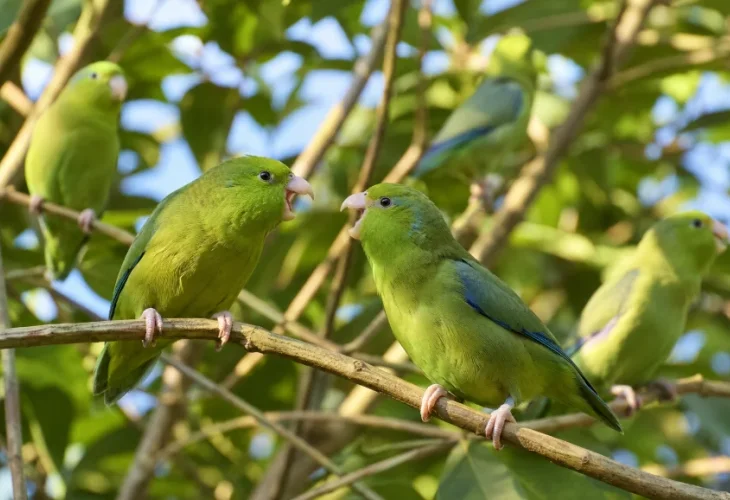
Spectacled parrotlets have a unique contact call, a kind of vocal signature that allows other birds to recognize them. This call is shaped not only by the characteristics a chick is born with, but also by its parents and the environment in which it grows up.
Spectacled parrotlets are small, social parrots that live in South America. They travel in flocks and use contact calls to communicate, even when they cannot see one another. Each parrotlet has a call with slightly different characteristics.
Much like recognizing a familiar human voice, these vocal signatures allow other birds to identify who is nearby and who is trying to communicate with them. It is a distinctive sound associated with a particular bird. When it calls, the others can recognize who is making the sound.
Vocal Identity Is Learned in the Nest
A chick’s individual call is influenced by the parrots that raise it. While in the nest, it repeatedly hears its parents’ calls, imitates some of their sounds, and gradually develops a vocal signature of its own.
This suggests that vocal identity is not purely an inborn characteristic. It also develops through the chick’s relationship with its family and the social environment in which it grows up.
Why Do They Need Individual Calls?
In an environment where many birds are flying, searching for food, and calling at the same time, being able to recognize individuals by their voices is extremely useful. It can help parents locate their chicks and allow members of the flock to recognize who is calling them, even from a distance.
Their calls may also communicate information about family and group membership. Parrotlets are capable of modifying aspects of their vocalizations and adapting them to their social environment, making their communication far more complex and flexible than a fixed chirp.
Of course, the parents do not consciously choose a name for their chick in the way humans name their children. Instead, the chick learns from its family how to identify itself through sound. When it produces its individual call, other members of the flock can recognize it.
The next time you hear a flock of parrots calling overhead, remember that what sounds like noise to us may sound very different to them. They may know exactly who is speaking.

