

World News
Far-Right AfD Scores Historic Win in German State Election
Exit polls in Germany show the AfD winning 44.5% of the vote in Saxony-Anhalt, while Chancellor Friedrich Merz’s party fell to just 18.5%.
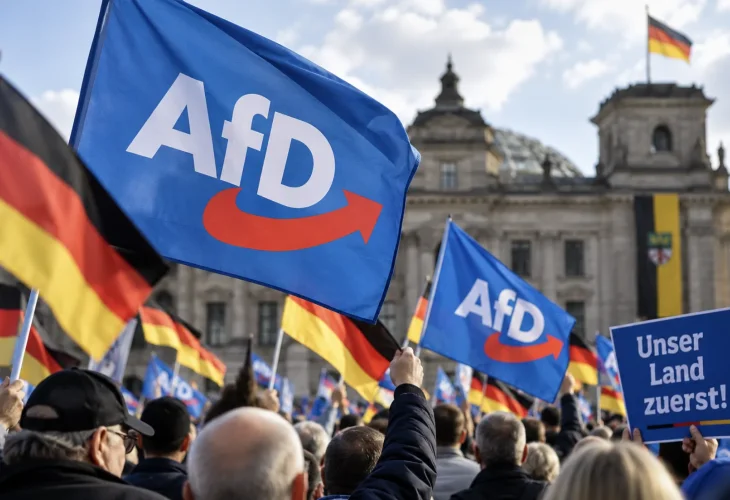 Illustration
The far-right Alternative for Germany party (AfD) scored a historic victory today (Sunday) in elections in the eastern German state of Saxony-Anhalt. According to exit polls by the ARD network, the party won 44.5% of the vote, more than double its result in the previous election in 2021, when it received 20.8%. By contrast, the Christian Democratic Union (CDU), which holds power in the state, fell to just 18.5%.
The result is also a blow to Chancellor Friedrich Merz. But despite the AfD’s sweeping victory, it remains unclear whether it will be able to form a government, since most other parties have ruled out cooperating with it.
Alice Weidel, one of the AfD’s leaders, said that “the party has a clear mandate to form a government after the election; we will hold talks with all the other parties.” The CDU, however, made clear that its boycott of the party would continue: “We will not cooperate with far-right parties or far-left parties.”
The Social Democratic Party also expressed concern over the results. Lars Klingbeil, the party’s co-leader, said that “the election results in Saxony-Anhalt are a signal to the government in Berlin.”
At the center of the election campaign was 35-year-old Ulrich Siegmund, the AfD’s candidate for minister-president of Saxony-Anhalt and one of the party’s rising stars. Siegmund, who was previously a member of the CDU, gained significant popularity on social media. Throughout the campaign, he expressed confidence that his party could win an absolute majority.
Still, Siegmund has already said that he will seek to become minister-president only if the AfD wins an absolute majority. If the party does not reach that threshold, the CDU and other parties may try to form a government that keeps it out of power. That possibility depends, among other things, on how many smaller parties manage to clear the electoral threshold.
The AfD’s growing strength in Saxony-Anhalt is also raising concerns because of the local branch’s positions and its attitude toward Germany’s Nazi past. In its election platform, the party calls for abolishing the right to asylum and advancing a selective deportation operation for migrants. It also seeks to make changes to school curricula. One of its members described the desired direction with the words, “more Bismarck, less Hitler”, meaning reducing the centrality of studying the rise of Nazism and the Holocaust, while expanding the focus on other chapters of German history.
Those concerns are compounded by the conduct of senior party officials over the years, after AfD figures previously used Nazi slogans. The Saxony-Anhalt branch is also associated with hardline nationalist views on immigration and German identity. Leaders of the local Jewish community have warned against changing the way the country’s Nazi past is taught.
Maria Schubert, a member of the Jewish community in Magdeburg, told the British “Guardian” that the possibility of the AfD coming to power is, in her view, “unthinkable.”

