

Rosh Hashanah
How to Prepare Your Prayers for Rosh Hashanah
A meaningful approach to preparing for Rosh Hashanah by reflecting on what we need, what we hope to change, and the blessings we want Hashem to continue
- Efrat Barzel
- | Updated
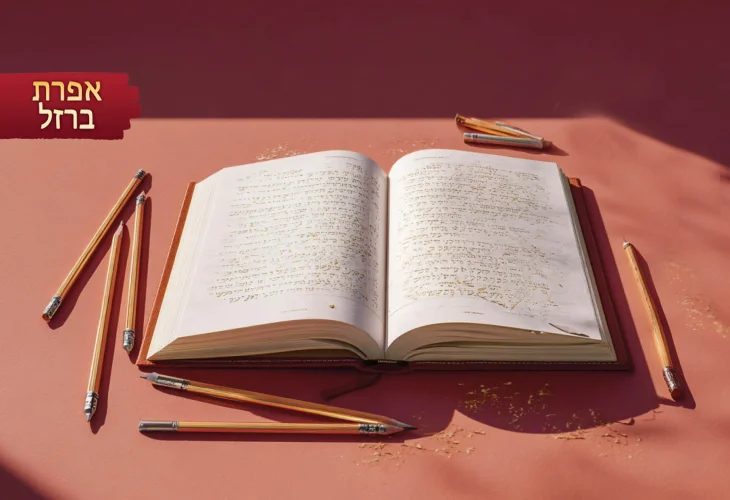
A group of us, mostly friends, recently got together to prepare for Rosh Hashanah. Not to plan the menu, arrange flowers, organize sleeping accommodations, or even reserve seats in the synagogue. We got together to prepare our prayers.
It may sound unusual, but why? We devote so much thought to preparing everything else for the holiday. We set the table, cook the meals, arrange where everyone will sleep, and make sure we have a place to pray. Why not devote some preparation to the prayers themselves?
If we have truly absorbed what we have been taught about Rosh Hashanah, we know how precious its prayers are. This is the day on which the world stands in judgment, a day on which we turn to Hashem for everything we hope the coming year will bring. Surely that deserves thought and preparation.
Preparing for the Prayers Themselves
I learned this lesson last year, when a friend called me after Rosh Hashanah with a complaint: “Why didn’t you tell me beforehand?”
She had heard from some of the other women that we had prepared notes before the holiday with things we did not want to forget during our prayers. These were not simply lists of names. We had written down different requests, things we wanted to thank Hashem for, and thoughts we wanted to keep in mind.
She was a little annoyed. Actually, not a little. “Why didn’t you tell me before Rosh Hashanah?” she wanted to know.
So this year, we came prepared. We brought notebooks and writing supplies and approached the evening seriously. I even brought along a package of simple pencils that I had recently asked my husband to buy me as a gift.
Why pencils? I had read about the value of writing by hand when we are trying to process our thoughts, express our emotions, grow, or make changes in our lives. There is something different about putting words onto an actual sheet of paper rather than typing them onto a plastic keyboard.
And I wanted real pencils. Not mechanical pencils with their perpetually breaking leads and little buttons that have to be clicked every few minutes. Just ordinary pencils, the kind you sharpen.
That is exactly what my husband bought. Fortunately for him, my gift request was not particularly expensive.
Don’t Only Ask for What You’re Missing
We began by making lists, but not only of the things we wanted to change or receive.
Every year, I remind myself of an important idea about Rosh Hashanah: with each new year, a new spiritual energy enters the world, something that has never existed before.
A new year can bring new possibilities. It can bring the things we have been missing and longing for. But there is another side to that idea. The arrival of something new does not mean that everything we received in previous years should be taken for granted.
And so each of us began taking stock of what was already present in her life: in her physical life and her inner world, in her home and in the home of her heart. We wrote down the blessings Hashem has already given us and that we want to continue accompanying us into the new year.
If you have been blessed with talents that bring you joy and that you are able to use, ask Hashem to let you continue using them. If you are grateful for the home you finally managed to buy, ask Hashem to preserve that blessing in the coming year.
If there is a melody in your life, a job you value, a quality you cherish, a peaceful atmosphere in your home, or a character trait you worked hard to develop, pray for its continuation.
Rosh Hashanah is not only a time to ask for what we do not yet have. It is also a time to recognize how much we already have and to ask Hashem, with gratitude, to allow those blessings to continue.
Praying for the Ability to Pray
In a sense, that evening we were praying about our prayers.
It is a little like giving thanks for the ability to give thanks. Learning how to learn. Asking how to ask. Talking about how to talk. Writing about how to write.
Or, as one of my children recently suggested, “Mom, maybe you should replace the garbage can in the kitchen with a different garbage can?” Apparently, they are not very fond of the one I chose. I suppose that would be something like throwing the garbage can into the garbage.
But beneath the humor lies something important. Prayer deserves precision and attention, and perhaps nowhere is that more true than during the Yamim Noraim.
Avinu Malkeinu, our Father and our King, is waiting for us. He wants to hear what lies in the deepest, most delicate places of our hearts. And sometimes, I think, He even helps us find the words.
The Prayer I Thought I Had Gotten Wrong
I experienced this recently in a very personal way.
In the information we received about the young woman who would eventually become our daughter-in-law, we read that her name was Tzipora Avigail and that her mother’s name was Chana.
During the recent bein hazmanim, while the young couple were still meeting, I found myself one morning in Mitzpe Ramon, praying at sunrise. I stood overlooking the crater as the sun rose in the east, with ibexes wandering nearby, and I cried because I wanted so deeply for everything to work out as it should.
I said to Hashem: “If Tzipora Avigail bat Chana is good for Yehonatan Chaim ben Efrat Sharon, and if Yehonatan Chaim ben Efrat Sharon is good for Tzipora Avigail, then please build a new home of Torah here.”
The match was made. Later, when we met the bride’s parents in all the excitement that followed, I discovered something that startled me: her mother’s name was not Chana.
“Oh no,” I thought. “But that’s the name I used when I prayed!”
Then, during an excited phone conversation with the bride’s grandparents, they mentioned their daughter’s full name: Chana Tova.
Suddenly, I smiled. I thought back to my prayer at the crater and remembered exactly how I had phrased it: “If Tzipora Avigail bat Chana, tova, for Yehonatan Chaim…”
In Hebrew, tova means “good.” I had intended to say, “If Tzipora Avigail, daughter of Chana, is good for Yehonatan Chaim.” But without realizing it, I had also spoken her mother’s full name: Chana Tova.
I had thought I was missing part of the name. Somehow, the words of the prayer had supplied it. For a moment, it felt as though our Father in Heaven had gently corrected my prayer for me.
The Prayers We Don’t Know We Need
It reminded me of the old story about a simple Jew who could not read. He desperately wanted to pray, but he did not know how to form the words. So he offered Hashem the letters he knew and asked Him to arrange them into the right words and intentions.
There is something deeply comforting in that image. We should prepare for prayer. We should think carefully about what we want to ask for and notice what Hashem has already given us. We can bring our notebooks, sharpen our pencils, examine our lives, and try to put the deepest desires of our hearts into words.
But after all that preparation, perhaps one of the most important prayers remains the simplest: Hashem, help me pray for what I need, including the things I do not even know to ask for.

