

Raising Children
A Bar Mitzvah Like No Other: 600 Celebrate Teen With Angelman Syndrome
Unable to speak or read from the Torah, 13-year-old Mendy Cooper celebrated his bar mitzvah with a Torah scroll written in his honor and delivered his message using his eyes, offering a powerful lesson about belonging and the value of every Jew
- Shira Dabush
- | Updated
 Illustration
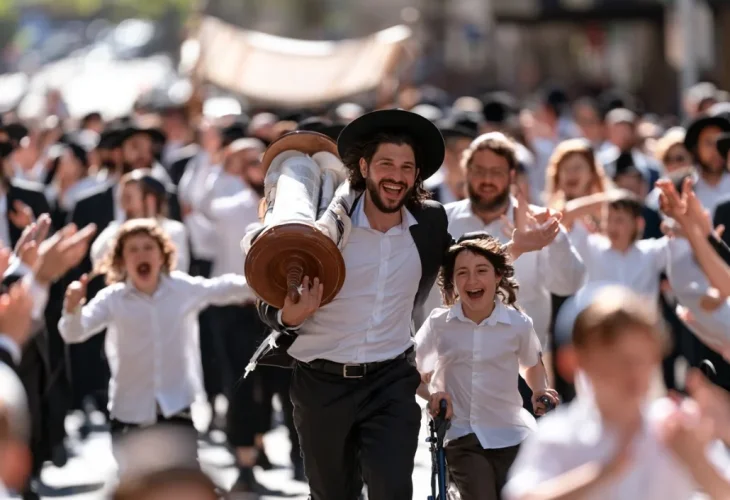
The quiet streets of Malvern in Melbourne, Australia, are not accustomed to seeing hundreds of people dancing and singing in the middle of a Sunday. But in early August, an extraordinary scene unfolded as some 600 Jews from communities across the city gathered to accompany one young boy on his way to the local Chabad House, following a specially commissioned Torah scroll.
The Torah scroll was dedicated in honor of the bar mitzvah of 13-year-old Mendy Cooper. Using his walker, Mendy made his way alongside his father, Rabbi Reuvi Cooper, who carried the Torah that had been written especially in his son’s honor.
For years, Mendy’s parents had wondered what the day their son turned 13 would look like. Mendy cannot read from the Torah or deliver a bar mitzvah speech in the way other boys might, but his parents were determined that his disabilities would not leave him on the sidelines of a day meant to celebrate him.
Eventually, they arrived at an idea that captured everything they wanted the occasion to represent: rather than trying to fit Mendy into a conventional bar mitzvah, they would create a bar mitzvah that fit Mendy.
A Diagnosis at Seven Months Old
Mendy is the fourth child of Rabbi Reuvi and Menucha Cooper, who are active in Melbourne’s Chabad community. The pregnancy and birth were uneventful, but within the first few months of his life, the family began noticing that his development seemed different.
When Mendy was about six months old, the family traveled to Israel. Seeing him alongside a relative who was almost the same age made the developmental differences much more apparent. After returning to Australia, his parents sought medical evaluation.
At seven months old, Mendy was diagnosed with Angelman syndrome, a rare genetic disorder that affects speech, movement, and development, among other areas.
Mendy is nonverbal, lives with epilepsy, and requires significant assistance with everyday activities. He receives nutrition through a feeding tube, uses a wheelchair and walker, and is accompanied by a support worker during the day.
One of the greatest challenges for his family is when something hurts and he cannot explain what is wrong. “When a child cannot tell you in words what is bothering him, even a simple pain can become unbearable,” his parents explain.
On one occasion, however, Mendy was able to communicate that his teeth were hurting through an eye-tracking communication system.
“It was a breakthrough for him, not only technically but emotionally,” his parents said. “For the first time, he was able to tell us what was happening to him and what he was experiencing, and we were able to show him that we understood.”
Seeing the Person Before the Disability
Early on, Mendy’s parents made another important decision: they did not want his diagnosis to be the first thing people saw when they looked at him.
Over the years, Menucha Cooper has become an advocate for the inclusion of people with disabilities and gives lectures and workshops on the subject. She describes Mendy as a joyful child and repeatedly encourages others to see the person before seeing the disability.
For years, she has also participated in Chabad initiatives promoting the inclusion of people with special needs and emphasizing the importance of giving every person a genuine sense of belonging within the community.
One of the most significant choices Mendy’s parents made was to enroll him in a Jewish educational setting alongside children his own age.
A Torah Scroll Instead of a Traditional Aliyah
Nearly a decade before Mendy’s bar mitzvah, Menucha began carrying an idea in her heart: to commission a Torah scroll in his honor.
The choice was deeply intentional. Mendy might not be able to read the weekly Torah portion in the conventional way, but his parents wanted the Torah scroll to express a simple and powerful message, that the Torah belongs to him, too.
More than 200 people joined the project, contributing toward letters, chapters, and portions of the new Torah scroll. Mendy’s parents dedicated its crown in honor of his four siblings, who, they say, surround him with love and are an enormous source of support for the entire family.
When the long-awaited celebration finally arrived, Mendy walked beside his father with the help of his walker as hundreds of people danced and sang around them, celebrating both the Torah and Mendy.
When the procession reached the Chabad House, the other Torah scrolls were brought out to welcome the new one. The new Torah was then placed inside the Aron Kodesh.
Mendy Delivers His Bar Mitzvah Message
But the celebration was not over.
That evening, Mendy’s family gathered for his bar mitzvah celebration. His grandfather read a letter from the Lubavitcher Rebbe addressed to bar mitzvah boys, while his brothers recited a Chassidic discourse connected to the dedication of a Torah scroll.
Then it was Mendy’s turn.
There was hardly a dry eye in the room as the teenager, who cannot speak, delivered his message through a communication system controlled by his eye movements. Before his family and friends, Mendy shared a message about the eternity of the Torah.
A video shown during the celebration highlighted an idea that was impossible to miss that day: a Torah scroll is not complete if even a single letter is missing. Every letter has its place. Without even one of them, the entire scroll cannot be used as a Sefer Torah.
The symbolism spoke for itself. Every person has a place. Every person matters. And a community is not truly complete when one of its members is left outside.
Afterward, Menucha said that other parents of children with disabilities approached her to tell her how much hope the celebration had given them. For some, the sight of hundreds of people leaving their homes to dance and celebrate with a child like Mendy was every bit as meaningful as the Torah scroll itself.
On a day built around the message that no letter in the Torah is dispensable, Mendy’s bar mitzvah offered an equally powerful reminder: neither is any member of the Jewish people.

