

Rosh Hashanah
Why Do We Blow the Shofar on Rosh Hashanah?
Discover the deeper meaning of the shofar, its connection to the creation of Adam, Mount Sinai, and Mashiach, along with practical halachot for reciting Shehecheyanu on both nights of Rosh Hashanah
- Hidabroot
- | Updated
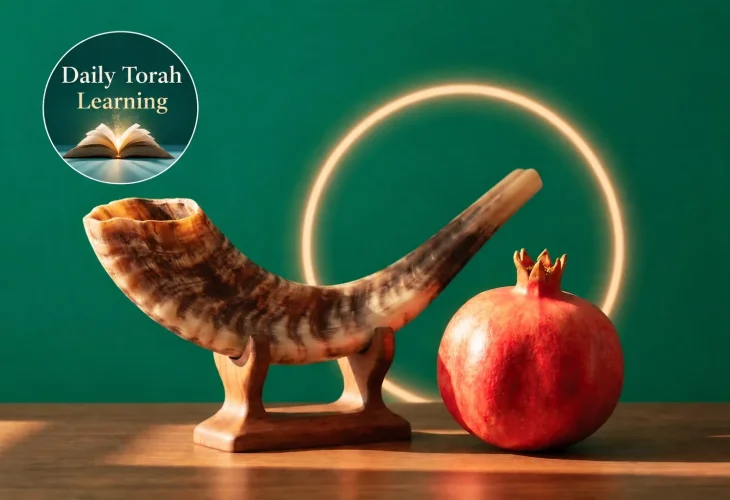
Two daily halachot from the book BeHalacha U’BeAggadah, based on the rulings of Maran Rabbi Ovadia Yosef.
Is Shehecheyanu Recited on the First Night of Rosh Hashanah?
Women should not recite the blessing of Shehecheyanu when lighting the Yom Tov candles, since the blessing will be recited later during Kiddush on the first night of Rosh Hashanah.
Reciting Shehecheyanu at candle lighting may also raise a concern of an interruption between the blessing of Lehadlik Ner Shel Yom Tov and the actual lighting of the candles. Therefore, women who have the custom of reciting Shehecheyanu when lighting should be gently encouraged to discontinue the practice. The Yaavetz and other authorities write that this custom has no basis in halacha and originated in error.
A woman who nevertheless recites Shehecheyanu when lighting candles on Yom Tov eve should be careful not to answer “Amen” to the Shehecheyanu recited during Kiddush. Doing so could constitute an interruption between the blessing over the wine and drinking it.
If she did answer “Amen,” however, she does not need to drink from the Kiddush cup, since she is not otherwise obligated to taste the wine.
Is Shehecheyanu Recited on the Second Night of Rosh Hashanah?
There is a disagreement among the halachic authorities as to whether Shehecheyanu should be recited during Kiddush on the second night of Rosh Hashanah.
It is therefore preferable to have a new fruit on the table during Kiddush. When reciting Shehecheyanu, one should intend for the blessing to apply to the new fruit as well. If no new fruit is available, one may wear a new garment instead.
Nevertheless, even if neither a new fruit nor a new garment is available, Shehecheyanu should still be recited.
The Daily Mitzvah: Blowing the Shofar
The central mitzvah of Rosh Hashanah is hearing the sound of the shofar. What makes the shofar so significant, and what should we be thinking about as we listen to its blasts?
When the Torah speaks about Rosh Hashanah, we might expect it to tell us that this is the Day of Judgment, when the fate of every individual is determined. We might expect it to speak about crowning Hashem as King or describe the spiritual work demanded of us on such a momentous day.
Yet the Written Torah emphasizes the central feature of sounding of the shofar.
In Bamidbar, the Torah commands: “In the seventh month, on the first day of the month, you shall have a sacred occasion; you shall do no laborious work. It shall be a day of sounding the shofar for you.”
Similarly, in Vayikra, regarding the first of Tishrei, the Torah states: “Speak to the Children of Israel, saying: In the seventh month, on the first of the month, there shall be a rest day for you, a remembrance through the sounding of the shofar, a sacred occasion.”
The Torah’s explicit description of Rosh Hashanah thus centers on the sound of the shofar.
Returning to the Moment of Creation
The mitzvah of shofar is the defining mitzvah of Rosh Hashanah, for both men and women.
Rabbi Moshe Schoenfeld explains that this mitzvah is unique in that it is performed through blowing breath. This parallels the creation of Adam on the first of Tishrei, when the Torah says, “He breathed into his nostrils the soul of life.”
Through the breath used to sound the shofar, we express the point of connection between ourselves and our Creator, the Divine element within each of us. In doing so, we crown Hashem as King.
As we listen to the shofar, we return in our minds to that first moment of human existence, the moment when Hashem breathed life into Adam. Adam opened his eyes and encountered his Creator. Everything was clear. He stood and proclaimed, “Come, let us sing joyfully to Hashem,” and together with all of creation, he crowned Hashem as King.
Every year, on the anniversary of the creation of humanity, we recreate that experience. We accept Hashem’s sovereignty over ourselves and over the entire world, beginning from the deepest and most fundamental point of our existence.
From the Shofar of Sinai to the Shofar of Mashiach
The Mussaf prayer of Rosh Hashanah contains a section known as Shofarot. It includes ten verses connected to the shofar and recalls the giving of the Torah at Mount Sinai, which took place amid the sounds of the shofar and the dramatic revelation of Hashem.
Through these verses, we renew our acceptance of the Torah precisely on the day when we are seeking extraordinary mercy and merit.
It can be compared to subjects of a king who declare their willingness to accept the laws of the kingdom. Even if they have not always observed those laws faithfully in the past, their renewed commitment can awaken the king’s compassion and willingness to forgive their previous failures.
Through the Shofarot we ask that we soon merit to hear the great shofar heralding the arrival of Mashiach, who will come and bring our redemption speedily.

