

Shabbat
A Knock on the Door That Created New Light
A simple request about a motion sensor sparked an unexpected journey back to Judaism, transforming a couple’s relationship with Shabbat and culminating in the blessing they had waited years to receive
- Inbal Idan
- | Updated
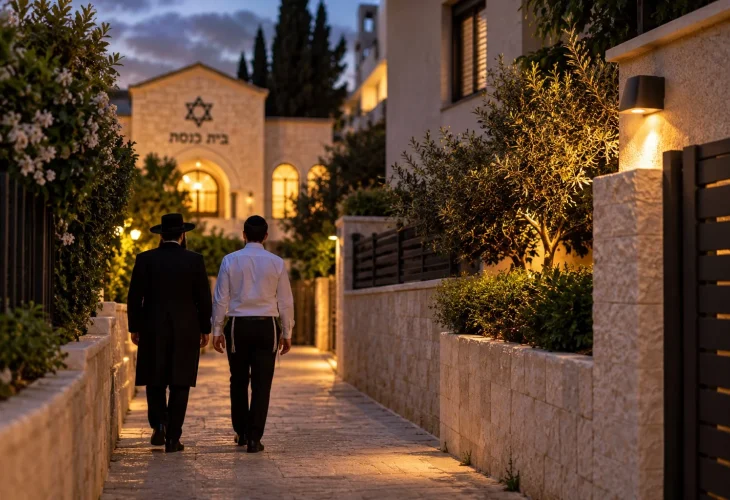
I live in a mixed neighborhood. Thank God, life here is peaceful and harmonious. Haredi, secular, and religious Jews, people of every kind, live side by side, like the tribes of Israel. The fabric of the neighborhood has developed with a remarkable sense of harmony. Everyone contributes in their own way, less through words and more through actions. There is a warmth and spirit here that brings hope.
One of the neighborhood’s active synagogues can be reached by a shortcut, a pathway connecting two parallel streets that runs alongside several homes. It cuts the walk considerably, and many of us use it on our way to shul.
One day, we noticed that a resident whose yard bordered the path had installed an outdoor light with a motion sensor. The moment it detected movement, the light switched on. One of my friends immediately pointed out the problem this could create on Shabbat: whenever we walked along the path, our movement would trigger the light.
We wondered what to do. The shortcut was genuinely useful, and without it, reaching the synagogue required a detour that added about ten minutes to the walk. We decided that the simplest solution was to knock on the neighbors’ door and politely ask whether they would be willing to disable the sensor on Shabbat and Jewish holidays, or replace it with another system. We would, of course, cover any expense involved.
It seemed like a perfectly reasonable request, especially in our neighborhood. People here talk to one another and find ways to work things out. We had no reason to expect a problem.
The Door Slams Shut
A friend and I went to the apartment and knocked. A tall, broad man opened the door. We smiled, introduced ourselves, and explained the situation. His wife was sitting on the living room sofa behind him, listening to the conversation.
He was very direct and asked what we wanted. We explained that as Shabbat-observant Jews, the new motion-activated light prevented us from using the path. Would he consider turning it off on Shabbat and holidays or replacing it with something else? We would arrange everything and pay for it. All we needed was his consent.
His eyes narrowed as he looked us over, and I could sense a storm brewing. “So you want to take care of the electricity inside my house too?” he replied sarcastically. “Maybe you’d like to install a Shabbat timer for me while you’re at it. Any other recommendations?”
That was the moment I realized it was time to retreat. My friend, however, kept trying. He explained again, almost pleading with him. Suddenly, the man’s wife stood up and came to the door.
“What would it involve?” she asked.
Her husband stared at her in disbelief. My friend began explaining the possibilities, but the man abruptly cut him off. “There’s nothing to discuss. Get out of here.” And he slammed the door.
We understood that our solution was probably not going to come from there.
Back at the synagogue, we told everyone that we had tried. There seemed to be no choice but to take the longer route each week. Later, we learned that several other congregants had approached the man as well, and each received essentially the same response: an angry dismissal and a slammed door.
We had not expected that. Even if the answer was no, surely there was a more respectful way to say it. Still, we did not want to judge another Jew harshly. Besides, this kind of reaction was so unusual in our neighborhood, where people generally looked for ways to accommodate one another rather than the opposite.
An Unexpected Message Before Yom Kippur
All of this took place toward the end of the summer. Gradually, the days grew shorter, a cool breeze began to blow, and the High Holy Days approached. Soon it would be Yom Kippur.
One afternoon, before Mincha, a friend pulled me aside at the synagogue. “You must hear what happened to me,” he said.
He had been walking along the path opposite the synagogue when he saw a woman standing in the yard. She came over and asked him when Yom Kippur began. He told her, and then she surprised him.
“Tell your friends that on Yom Kippur they can walk through here. The automatic light won’t go on.”
He was stunned. He thanked her and continued on his way, unsure what to make of the encounter.
On the afternoon before Yom Kippur, we decided to check for ourselves. We were hesitant to rely on her statement alone, so we walked toward the path and passed the house a few times. Normally, by that hour, well before sunset, the sensor would already have been operating. This time, the light remained off.
We looked at each other and smiled. She had meant it.
Throughout Yom Kippur, people once again used the shortcut to and from the synagogue. On a fast day, when every extra step can feel significant, those saved minutes made a real difference. Silently, we thanked her. It felt like a small, warm ray of light emerging from what had seemed like an enormous wall of alienation.
Something Was Changing
Days passed, followed by Shabbatot and holidays. Gradually, I noticed something strange. During the week, the light continued switching on and off as usual. But on Shabbat, it remained on continuously, meaning that walking past it no longer activated anything.
I mentioned it to my friend and asked whether he had noticed. His answer surprised me even more. The previous week, someone had held a memorial gathering at the synagogue, and my friend had seen the man from the house there.
He was wearing a kippah. I stared at him. “Are you sure?”
“He’s not exactly someone you can miss,” my friend replied. “It was definitely him. Same man, with one small addition on his head.”
I let out a whistle. “I wonder what happened.”
We did not have to wait long for another clue. One of the congregants stopped me and said the woman had approached him again while he was walking along the path during the week. She asked him to tell his religious friends that their light no longer caused a problem on Shabbat. They could use the path freely. Then she asked for the neighborhood rabbi’s phone number.
We realized that something much bigger was happening. Over the following months, we began seeing her husband more and more frequently in the synagogue, particularly on Friday nights. The change was remarkable. After a while, it became difficult to believe this was the same man who had once sent us away so coldly.
The Story Behind the Change
Then one day, a notice appeared announcing a brit milah. The family name looked familiar. It was the family from the pathway.
They were holding their son’s brit in the synagogue hall and invited all the congregants to attend. The meal would be strictly kosher, they emphasized, even posting the caterer’s kosher certification at the entrance. The neighborhood rabbi would serve as sandak.
During the meal, the rabbi asked the new father whether he would like to say a few words. He was hesitant at first, but eventually stood up and began telling the story from the beginning.
Until that knock on his door, he said, there had been almost nothing positive in his relationship with Judaism. Instead, there was cynicism, anger, and a deep hostility he could not really explain. When he married his wife, he knew that she came from a traditional Jewish home, but she had moved far away from observance over the years, so religion had never become an issue between them. They had a good marriage.
Then we knocked on their door. He admitted that he had been stunned by what he perceived as our audacity. In his mind, we had appeared at his home and told him what to do with his own property. He reacted before even stopping to think. What surprised him most, however, was his wife’s reaction.
When she suddenly asked us what changing the light would involve, he could not understand where it had come from. But after he slammed the door in our faces, he noticed that she withdrew into herself. Something had changed.
The Knock That Awakened Something
Only later did he discover what had happened. Our knock on the door had awakened something inside her.
Our request brought her back to memories of the traditional home in which she had grown up. Her conscience stirred, and her husband’s harsh response to people who simply wanted to walk to synagogue on Shabbat disturbed her deeply. Then she remembered that Yom Kippur was approaching.
She found out when the fast began and decided that, at the very least, the automatic light would not operate on Yom Kippur. Without telling her husband, she disabled the electrical system so the sensor would not work. That was why we had been able to use the path.
Afterward, however, something else began troubling her. She did not want to make changes behind her husband’s back. At the same time, she wanted the religious Jews in the neighborhood to have an unobstructed path to the synagogue.
She finally spoke to him openly. She told him what had awakened inside her, admitted what she had done to the light, and apologized for doing it without his knowledget She also made a request for the future: she wanted the motion sensor disabled on Shabbat and Jewish holidays.
He was furious. He could not understand where this sudden change had come from. Those were difficult days for both of them, but she remained firm. Eventually, he agreed.
He disabled the sensor and saw how happy it made her. And then, he said, something inside him began to soften. He could not explain exactly why, but when a friend later invited him to a memorial gathering at the synagogue, he went on his own. And he put on a kippah.
A New Light in Their Home
The process continued for his wife as well. She grew increasingly connected to Judaism and contacted the neighborhood rabbi, who guided and supported the couple. Over time, both husband and wife became fully Shabbat observant.
But that was not the end of their story.
They had been married for several years but had not been blessed with children. Medical tests and treatments had not brought the result for which they had hoped. Then, a year after the encounter that began with the light on the pathway, they received the news they had been waiting for: they were expecting a child.
And now we were sitting in the synagogue celebrating the brit of their newborn son.
They had turned off a light for the sake of Shabbat, and the Holy One, blessed be He, had brought a new light into their home and into their lives.

