

Magazine
From Machu Picchu to the Louvre: Lina Hazan’s Journey Back to Judaism
A search for meaning took artist Lina Hazan across South America and ultimately back to Torah, Israel, and her passion for art, culminating in an extraordinary opportunity to exhibit her paintings at the Louvre
- Miriam Solomon
- | Updated
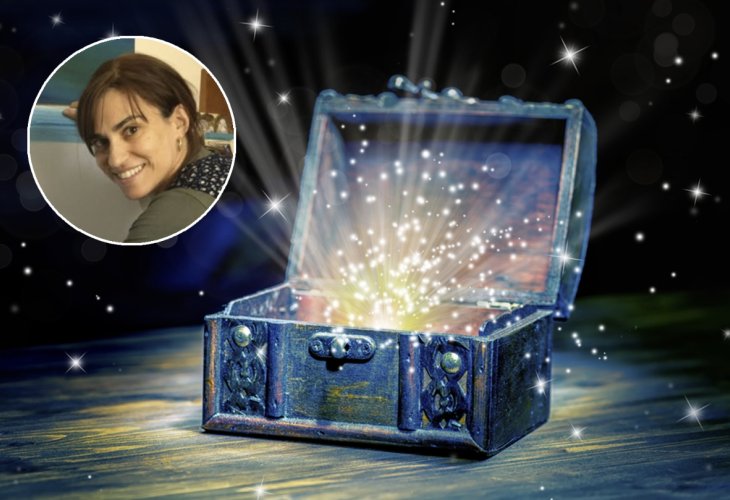 (Inset: Lina Hazan)
“I grew up in a home that was considered traditional, although in practice we were secular,” says artist and painter Lina Hazan as she begins the story of her life. “I attended secular schools and dreamed of becoming an artist. Yet I always had an inexplicable attraction to faith and mitzvot.”
She remembers being about nine years old when, shortly before Sukkot, her father announced that he did not have the energy to build a sukkah that year. Lina refused to accept that. She went to the storage room herself, pulled out the metal poles, and began building. “The sukkah came out a little crooked and wobbly, but I didn’t care. I started covering the uneven walls with beautiful fabrics. When my father saw how determined I was, he couldn’t ignore me anymore. He came over, took it apart, fixed everything, and rebuilt it beautifully and securely. I was so happy. I didn’t really understand what a sukkah was or why we built one, but I loved the mitzvah with all my heart.”
Another childhood memory stayed with her as well. During a third-grade class discussion about belief in God, Lina stood in front of the class and confidently argued that logic itself pointed to God’s existence. When she finished, some of the students applauded, including the teacher. Others stared at her in surprise. “We didn’t know you were religious,” they told her. “The truth is,” Lina recalls, “neither did I.”
Searching for Something More
Lina grew up with this undefined inner pull, finished high school, and enlisted in the army, where she served as an education NCO. It was after completing her military service that the deeper questions began to surface. Until then, she felt that society and the state had largely defined what she was supposed to do. Now, for the first time, she stood alone before her future and had to decide what kind of life she wanted.
“I wondered whether I should simply be like everyone else and follow the accepted path: travel after the army, university, marriage, children, grow old, and die. ‘Like everyone else’ was the key phrase. But something inside me kept bothering me. I thought, ‘Fine, we live like everyone else and die like everyone else. But what is all of this for? Just because everyone else lives this way? Maybe there is another reason. Maybe there is meaning to this life.’”
Without answers, Lina joined a group of young travelers heading to South America. Their plan was to begin in Peru, travel across the continent, and finish with the carnival in Brazil. She joined them eagerly, hiking through mountains, discovering unfamiliar landscapes, and experiencing the wild beauty of the region.
Then, while the group was hiking along a remote mountain trail near Machu Picchu, something extraordinary happened. A local Peruvian man in traditional clothing approached them and asked in Spanish, “Are you Israelis?”
Lina, who spoke Spanish, was stunned. There was nothing about their clothing or appearance that identified them as Jewish or Israeli. She asked how he had known. He simply shrugged. “I don’t know. I had a feeling you were Israelis.” Then his expression changed. “Something happened in Israel,” he told them. “Come with me.”
Shocking News in the Mountains
The man led them to a remote inn in the mountains, where a tiny television was mounted on the wall. Several Peruvians were gathered around watching the news. The Israeli travelers joined them and stared at the flickering screen.
Then they heard the announcement: Israeli Prime Minister Yitzhak Rabin had been assassinated by an Israeli Jew.
“It felt like a bomb had fallen on us,” Lina remembers. “How could something so terrible happen? And how had this news managed to pursue us all the way to the deserted mountains near Machu Picchu? I felt that it wasn’t for nothing that this man had found us and brought us there to see the news.” The group left the inn and continued the trail in a heavy silence. No one knew what to say.
Soon afterward, Lina separated from the group. The trip had lost its appeal, and she no longer wanted to continue to Brazil. She realized that even the most spectacular places in the world could not quiet the sense that something essential was missing inside her.
She remained alone in Peru, wandering without a clear destination as increasingly urgent questions filled her mind. “What do I want to do with my life? What do I really love? If I can do anything I want, why does nothing satisfy me? Is there something specific I am supposed to accomplish and I simply don’t know what it is? Who put me here in this world? And what does He want me to do?”
The Answers Were Waiting in Venezuela
During those days of searching, Lina remembered that her mother had mentioned that they had relatives in Venezuela. She had never met them and had no intention of visiting them, but suddenly she felt a powerful urge to go.
She left Peru and traveled to Venezuela, where her relatives welcomed her warmly despite the differences between her secular lifestyle and their religious one. Her aunt introduced her to relatives around her age, and during a meeting at a café, the conversation unexpectedly turned to Judaism. They told Lina about a seminar they had attended with Dr. Batash, an Arachim lecturer.
Lina began asking questions. Many questions. Rather than dismissing or avoiding them, her relatives answered thoughtfully. “I felt as though all my questions were finally being answered and everything was beginning to make sense, both intellectually and emotionally. Everything that had happened to me and to the Jewish people, the values that felt right to me, the upheavals of life, the meaning of existence, it all spoke directly to the burning emptiness I had been carrying inside.”
After only a week in Venezuela, Lina made a decision to return to Israel. The treasure she had traveled so far to find, she realized, was waiting for her at home.
On the journey back, she had an eight-hour stopover in London. She spent the time reading a book her cousin had given her about science and faith by Rabbi Kellerman. She became so absorbed that the hours disappeared. “Already there in the airport, it became clear to me that this was the truth. I decided to change the direction of my life. I wanted to live according to it.”
Trying to Find Her Way
Returning to Israel with a conviction was one thing, but knowing how to translate it into everyday life was another.
“There was no Hidabroot website then, no internet, no Haredi radio, and no pamphlets everywhere explaining Torah and mitzvot. I didn’t know what I was supposed to do or where I could go to study Torah. I was alone in a secular environment with this desire, but I had no idea how to move forward.”
Her family encouraged her to follow the conventional path and enroll in university. When she explained that she wanted to study Judaism, they suggested she study it there. So Lina enrolled in art history and Jewish thought. Almost immediately, however, she realized that academic Jewish studies were not what she was seeking. She did not merely want to learn about Judaism. She wanted to know how to live it.
Her lack of practical knowledge sometimes led to amusing mistakes. After buying her first siddur, she discovered Birkat Hamazon and assumed that the entire prayer was supposed to be recited before eating. “Before anything I ate, even a cookie or a piece of fruit, instead of saying the appropriate blessing, I would sit down and recite the entire Birkat Hamazon, including all the additions for Shabbat, Purim, and Chanukah.”
She laughs about it today, but at the time it was frustrating and painful. She knew she needed someone to teach her how a Torah life was actually lived. She simply did not know where to find that guidance.
Discovering the Treasure at Home
A year later, help arrived from an unexpected source. The cousin she had met in Venezuela, the same cousin who had given her the book about faith and science, came to Jerusalem to study in yeshiva. When he visited Lina, he realized that despite her strong desire to become observant, she had struggled to make progress.
He introduced her to young women from Venezuela who had come to Israel to study at a Haredi seminary in Jerusalem for South American women becoming religious. They invited Lina to attend a class.
In the very first lesson, the teacher told the familiar story of a man who traveled far from home searching for treasure. He failed to find it, only to discover that the treasure had been buried beneath his own home all along.
Lina could hardly believe what she was hearing. “It felt as though the story had been told specifically for me. I had traveled all the way to South America searching for a treasure and discovered that it was here, in my own home. That treasure was Torah, which gives us meaning and direction in life.”
She began attending the seminary regularly. For the first time, she had teachers and friends who could answer her questions and support her new path. A year later, she left university and moved into the seminary dormitory. “I was so excited to have the privilege of studying Torah and Judaism all day. That was when I could finally begin truly observing Torah and mitzvot.”
Brazil, After All
Lina studied at the seminary for three years before being introduced to a young man from Brazil. They married, built a home together, and, in an unexpected twist, moved to Brazil a year later.
“It felt like closing a circle. My journey toward teshuvah had begun during a trip I cut short when I decided not to continue to Brazil. And now I found myself finally ‘completing’ the journey and arriving there after all.”
But this time, Brazil was not a vacation. At 27, Lina had to build a new life in a foreign country without her family nearby. The culture and mentality were very different from Israel, and the adjustment was difficult. Yet it was precisely during those challenging years that she rediscovered her childhood dream of becoming an artist.
“I felt that if I couldn’t live in my own country, I needed to give myself something I truly loved. At first, I painted flowers and landscapes, and through the paintings I expressed the feelings and experiences inside me. Gradually, I found myself painting primarily Jewish subjects and the beautiful values Torah had given me.”
Her faith increasingly entered her artwork. One painting was inspired by the Talmudic teaching that when a husband and wife are worthy, the Divine Presence dwells between them. Lina translated the Hebrew symbolism of the teaching into colors and imagery, using fiery reds and oranges alongside a radiant light representing purity and holiness.
Painting Her Longing for Jerusalem
Among Lina’s most meaningful works from those years was a painting she called Jerusalem, Light of the World. She painted it in Brazil at a time when she did not know whether she would ever return to Israel.
“I poured all my longing onto the canvas. These paintings became extremely important in my life because they expressed so much of what I was feeling.”
After 13 years in Brazil and the birth of their three children, Lina and her husband finally decided to return to Israel. But their journey home coincided with Operation Protective Edge, leaving the family temporarily stranded in Turkey. Amid the confusion, all the luggage from their move disappeared, including Lina’s beloved painting of Jerusalem.
Eventually, the family made it safely to Israel. Six months later, after considerable effort, Lina managed to locate the missing painting. It had been damaged by everything it had endured, and she worked with another artist to restore it.
When the restoration was complete, she called a professional to frame it. He looked at the painting and remarked, “Wow, this painting has been through a lot.”
Lina nodded. “Like Jerusalem.”
“To this day,” she says, “that painting symbolizes my own journey as well as the journey of Jerusalem, the holy city and the site of the Temple, which has endured exile and destruction.”
A Smile From Hashem at the Louvre
Seven years after returning to Israel, Lina was living in Karmiel with her family in a Haredi community. Her children were studying in Talmud Torah schools and yeshiva, and the art that had once been an emotional outlet had become her profession.
“Thank God, I established an art studio and an international online store. At one time, I worried that becoming Haredi meant giving up the possibility of a career, but that fear proved completely unfounded. It wasn’t an easy or quick journey, but I see tremendous Divine assistance in everything that happened. Today my paintings are sold around the world, and I have even received two international art awards.”
One of the most meaningful milestones in her career came when she was invited to exhibit her paintings at the Louvre in Paris. For Lina, the opportunity carried special significance. Over the years, she had received invitations to international exhibitions but repeatedly turned them down when they conflicted with Shabbat, Jewish holidays, or her responsibilities as the mother of young children.
Then came another invitation to exhibit at the Louvre. This time, the exhibition coincided with Chol Hamoed Sukkot and Simchat Torah. Once again, Lina prepared to decline. She was not willing to leave her family during such important days.
That same day, however, a businessman who knew her husband visited their home and heard about the invitation. When Lina explained why she planned to turn it down, he challenged her not to give up so quickly. “Think. Ask questions. Find a solution.”
His words prompted her to contact the gallery director organizing the exhibition. She explained that she wanted her paintings to participate but could not personally attend. To her surprise, he told her that he could display the works on her behalf. Lina sent the paintings securely, and exhibition organizer Heinz Playner of an Austrian art gallery presented them for her at the Louvre.
The exhibition brought her significant exposure and many responses, but for Lina, its deepest meaning had little to do with professional recognition.
“More than anything, I was moved by the fact that the possibility had opened for me at all. I felt that when a person walks with Hashem through all the difficulties and continues trying to do His will, eventually the Holy One, blessed be He, helps that person fulfill their dreams.
“As I learned, ‘Make His will your will.’ And then Hashem helps you with your own desires as well.
“For me, it was a great smile from Hashem.”

