

Raising Children
Stop Doing Everything for Them: The Simple Secret to Raising Capable Kids
Before you pick up that sock or clear your child’s plate, consider what they could learn by doing it themselves. Here’s why household chores matter.
- Avinoam Harsh
- | Updated
This week, while scrolling through something called “Daily Motivations,” I came across an insight that made me stop in the middle of the day’s rush.
It discussed a fascinating Harvard University study, a rare longitudinal study that followed hundreds of people over many decades and sought to understand what helps predict success, independence, and happiness in adult life.
If you asked most parents today, the answers would probably revolve around high grades, IQ, exceptional talent, or enrichment programs. But one of the ideas associated with this research points in a very different direction.
Something much simpler, and something many of us in the 21st century may expect less and less from our children: Do they regularly take part in household chores?
The idea is that giving children meaningful responsibilities at home can help them develop qualities that serve them later in life, from a strong work ethic and independence to cooperation and a willingness to contribute.
And when you think about it, the reason runs deep.
Why Chores Matter More Than We Think
Household chores give a child something no classroom lesson can fully replace: a sense of belonging, value, and real responsibility. When children help maintain the home, they receive a subtle but crucial message: “We trust you. You are needed, and this home is your responsibility too.”
This is where habits of self-discipline can begin to grow. Children learn that effort sometimes comes before reward, that not every task is exciting, and that being part of a family means giving as well as receiving.
Yet in recent years, out of tremendous love and a desire to protect our children and spare them frustration, we can sometimes become parents who serve instead of guide. We pick clothes up off the floor, set and clear the table, make the bed, and ask only that they “sit down and study.”
But when we consistently do everything for our children, we may make life easier for them in the moment while depriving them of opportunities to discover what they are capable of doing for themselves.
Start With Small Responsibilities
So what should we do? It is much simpler than it might sound, and it does not require a major overhaul of family life. Start with small, age-appropriate responsibilities.
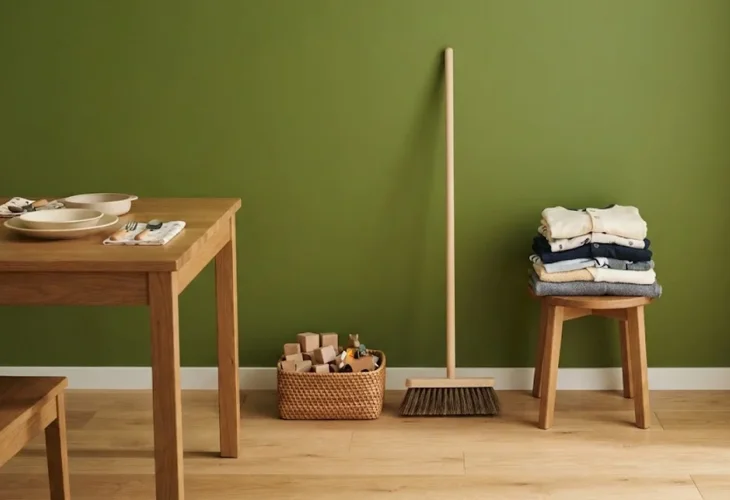
A child can help set the Shabbat table, get into the habit of making their bed in the morning, return toys and belongings to their proper places, or help fold the family laundry.
The particular chore matters less than the underlying message: You are part of this family, and your contribution matters.
How do you put this into practice without turning the house into a battlefield? The key lies partly in changing our language and perspective.
Instead of saying, “Do me a favor and help me,” try: “We are a team, and this home belongs to all of us.”
When children understand that they are genuine partners in family life rather than simply following orders, the experience of effort can begin to change.
Expect Some Resistance
Initial resistance is completely natural. Children may grumble, complain, or test boundaries. Our challenge as parents is not to become alarmed by that friction or give in and complete the task ourselves out of exhaustion. Instead, we can maintain the expectation with kindness and consistency.
At the same time, praise the effort rather than demanding perfection. Say, “I saw how much effort you put into clearing the table,” instead of immediately pointing out the stain left on the counter.
Give children room to make mistakes, learn, and try again. The sense of capability and pride that comes from completing a real task can be far more valuable than having everything done perfectly for them.
Do not look for flawless work. Look for consistency. The goal is not to raise a child who folds every shirt perfectly or never leaves a toy on the floor. It is to raise someone who understands how to take responsibility, contribute, persevere, and cope with tasks they may not particularly enjoy.
Ultimately, the principle may be much simpler than we realize: A child who learns to hold a broom in childhood may also be learning how to take responsibility for their own life in adulthood.
So the next time you are tempted to pick up another sock from the floor or clear your child’s plate for them, stop for a moment. Household chores are not merely tedious tasks that need to get done. They can also be a practical school for life.
Our role as parents is not to remove every difficulty from our children’s path, but to give them the strength and skills to travel that path themselves. Let them contribute. Let them struggle a little. Let them discover that they are needed, capable, and valuable.

