

Israel News
Drone Swarms and Battlefield Robots: Israeli Tech Already in Use by the IDF
A day after the IDF announced a new branch for unmanned systems, Elbit’s FUSE unveiled autonomous combat formations that a single operator can manage. The developments include drone swarms, ground robots and systems that can operate without GPS.
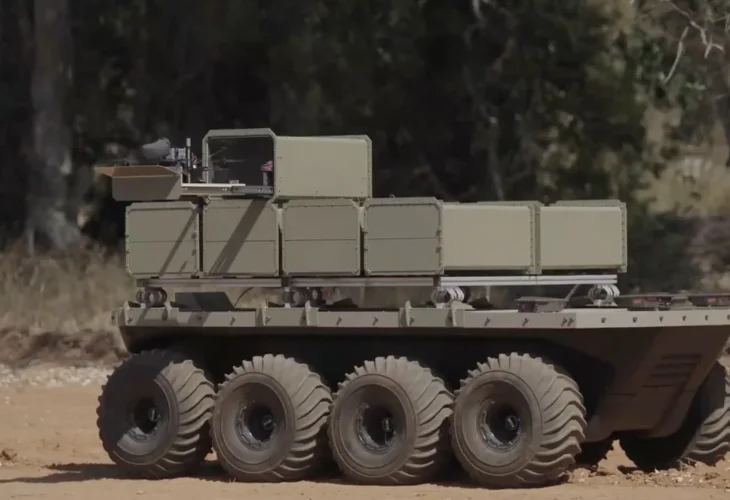 Autonomous weapons systems by FUSE, Elbit (Photo: Elbit Systems)
A day after IDF Chief of Staff Lt. Gen. Eyal Zamir announced the creation of a new IDF branch focused on unmanned systems, robotics and artificial intelligence, Elbit Systems’ FUSE division today (Wednesday) unveiled a range of autonomous combat systems. During a visit to the company’s factories and testing complex, it displayed attack and intelligence-gathering drones, launchers for dozens of drones, ground robots and a system that enables a single operator to manage a large number of platforms simultaneously.
At the heart of these developments is the One2Many concept: Rather than assigning a separate operator to every drone or robot, a person defines the mission and the computer distributes it among the platforms, plans their movement and manages them in real time. According to Elbit, the system can already operate dozens of platforms simultaneously, and even more in certain missions. The concept fits into the IDF’s plan to establish a dedicated branch in the field, which will be inaugurated during Chanukah.
FUSE CEO Eyal Dahan explained: "We are essentially establishing autonomous combat formations, robotic forces." Among the systems unveiled were Terminathor for attacks and dropping munitions, ManiTude for observation and intelligence gathering, and MagniXor for tactical missions, alongside an autonomous docking station and ground platforms. The systems are also designed for laser target marking, carrying munitions and conducting attacks.
One of the central capabilities is intended to allow drones to operate in disrupted environments and without GPS. Some are connected to the operator via fiber optic cable, and in certain configurations can switch to an alternative communications channel if the fiber is cut. In some scenarios, AI can assist in continuing the search for the target, though the company emphasizes that the final decision to strike remains, at this stage, in human hands.
Another platform can carry five to six M66 munitions, which Dahan said are three times more lethal than fragmentation grenades, and use wind calculations to predict the impact point. Drones from the same family can carry observation equipment and a laser designator to guide precision munitions such as "Steel Sting," and operate both day and night.
Another unusual solution is disguised as a rock and contains a large drone stored in a cooled compartment. It can remain that way for years along a border or in enemy territory, until it receives a command that opens the compartment and sends it out on a mission. Each compartment is independent, so damage to one does not disable the others. Large drones can also carry smaller drones deep into an area and launch them from there.
The company also presented an array of trucks with launchers for dozens of attack drones, managed from a command truck by a small number of operators. "In practice, we are talking about four to five drones in each swarm, with minutes, if not seconds, between one wave and the next," Dahan said. Alongside them operate autonomous ground robots equipped with thermal cameras and a laser beam, which identify obstacles and decide how to bypass them.
Despite the autonomy, the company emphasizes that the systems are not intended to replace fighters: "I don’t think a robotics corps is supposed to replace soldiers," Dahan said. According to him, the idea is to send a robot first on missions that endanger human lives: "If something gets hit, let it be a robot, a drone or a robotic dog, not a soldier."
One system that has already entered operational use is THOR, a multirotor drone that takes off and lands autonomously and is designed, among other things, for observation, target acquisition, communications relay and supply missions. It is in use by the IDF and was also selected in May for the U.S. Army. According to the company, more than 1,200 platforms from the family are in operational use worldwide.
FUSE is now in the process of delivering hundreds of drones to the United States, while a production line is being established there that will later be able to supply thousands of platforms to the U.S. military. According to Dahan, the pace of development requires frequent upgrades: "We are delivering several hundred drones now, but by February to April, it is no longer the same drone. AI capabilities are constantly being added and computers are being replaced. The market is moving fast."

