

Interesting
Square Waves Explained: Why the Ocean Sometimes Looks Like a Chessboard
Discover what causes the fascinating phenomenon known as a cross sea, where it occurs, and whether these unusual square wave patterns can be dangerous
- Tehila Cohen
- | Updated
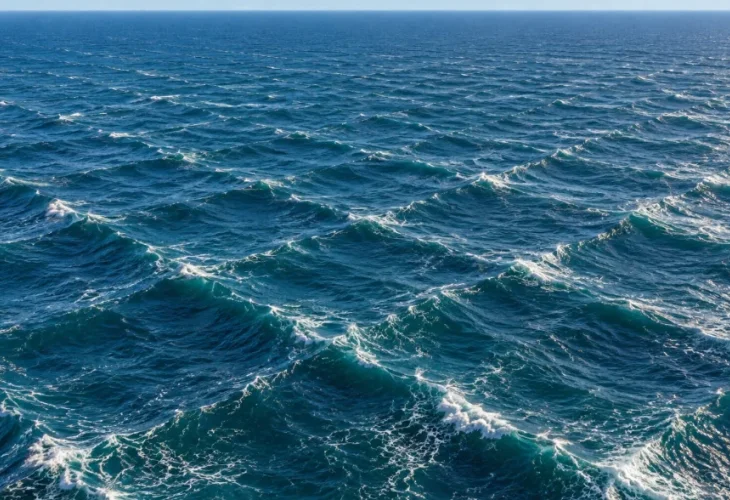
We commonly see ocean waves roll toward shore in orderly succession, each one following roughly the same path as the one before it. But every so often, the surface of the sea takes on a startlingly different appearance: waves cross one another at sharp angles, forming a pattern that resembles a giant chessboard.
The sight can look almost too perfect to be natural. Long rows of waves intersect to form squares and diamonds across the water, creating the kind of image that is often mistaken for digital editing or an optical illusion.
Known as a cross sea, this occurs when two separate wave systems meet while traveling in different directions.
How Does a Cross Sea Form?
Ocean waves do not necessarily disappear when the winds that created them die down. Waves generated by a distant storm, for example, can continue traveling for considerable distances long after the original weather system has weakened or moved elsewhere.
Now imagine that one of these existing wave systems reaches an area where winds or another weather system have produced a new set of waves traveling in a different direction. When the two systems meet at an angle, they do not simply merge into one. Instead, the waves continue moving through one another. The result is the distinctive crisscross pattern known as a cross sea.
If one set of waves is moving from north to south while another travels from east to west, for example, their intersecting paths can create what looks like a grid on the surface of the water.
The pattern is not always perfectly square. Its appearance depends on the angle at which the two wave systems meet, as well as the length, speed, and strength of the waves. Sometimes the water appears to be covered in neat squares; at other times, the shapes resemble diamonds or irregular geometric patterns. The effect may last only a short time or remain visible for much longer, depending on conditions.
Cross seas are particularly striking when viewed from above. From the top of a lighthouse, a cliff, a tall building, or a drone, the geometric pattern can be clearly visible. At water level, however, the same phenomenon may simply feel like a confused, unsettled sea, with waves arriving from more than one direction.
Where Can Square Waves Be Seen?
Cross seas are not unique to one particular location. They can develop in different parts of the world whenever the right combination of wind and wave conditions occurs.
One of the most famous examples can be seen near Île de Ré, an island off the western coast of France. Photographs taken from the island’s lighthouse have made the phenomenon famous, showing the sea divided into an extraordinary pattern of intersecting waves.
But cross seas can occur elsewhere as well, both near the coast and farther out at sea. Their formation depends on a combination of factors, including local winds, waves generated by distant weather systems, and sometimes the shape of the coastline.
As beautiful as the phenomenon may be, however, those geometric patterns can signal challenging conditions on the water.
Are Square Waves Dangerous?
For boats and ships, a cross sea can be particularly difficult to navigate.
Vessels are generally better able to handle waves when they are approaching from a predictable direction. When two wave systems arrive from different angles, a vessel may be pushed and rocked in more than one direction at once. This can increase rolling and make maintaining a stable course more difficult.
For swimmers, the appearance of square waves does not necessarily mean that the water is immediately life threatening. The actual level of danger depends on the conditions at the time, including the height and strength of the waves, the presence of currents, water depth, distance from shore, and local weather.
Still, swimming in a cross sea can be difficult and disorienting. In ordinary conditions, a swimmer can usually see where the next wave is coming from and prepare accordingly. In a cross sea, a wave may arrive from the side just as the swimmer is bracing for one coming from the front. Being pushed from different directions can make it harder to maintain balance and orientation, and the additional effort required to swim can lead to fatigue more quickly.
These conditions can be especially hazardous for children, inexperienced swimmers, anyone in deep water, or those swimming at a beach without lifeguard supervision.
Despite some claims that circulate online, a cross sea should not be confused with a rip current. A rip current is a concentrated flow of water moving away from the shore and back toward the open sea. A cross sea refers specifically to two wave systems crossing one another at different angles.
The two phenomena can exist at the same time, but they are not the same thing. Seeing a checkerboard pattern on the water does not, by itself, mean that a rip current is present.
What Should You Do If You See a Cross Sea?
If you spot square waves from shore, the safest place to appreciate the remarkable sight is from dry land. There is no reason to enter the water simply to experience the phenomenon up close.
If you are already swimming and notice waves beginning to approach from different directions, particularly if the water becomes rough or you are having difficulty making progress, calmly make your way back toward shore. Avoid exhausting yourself by fighting forcefully against the water, and do not panic. If you are unable to return safely, signal to a lifeguard or people on shore for assistance.
Ultimately, the striking geometry of a cross sea is a reminder of just how complex the ocean can be. What looks from above like a beautifully ordered chessboard is actually the meeting point of two powerful systems, each carrying energy across the water from a different direction.
It may be mesmerizing to watch, but it is also a phenomenon that deserves respect.
Never enter the sea when swimming is prohibited, when warning flags indicate dangerous conditions, or at a beach without lifeguard supervision.

