

Personal Stories
The Cave of Rashbi: Why This 82-Year-Old Woman Climbs There Every Day
What brings an 82-year-old woman to Rashbi’s cave every single day? Ruth de Jong’s remarkable story began decades ago with a mysterious painting.
- Michal Arieli
- | Updated
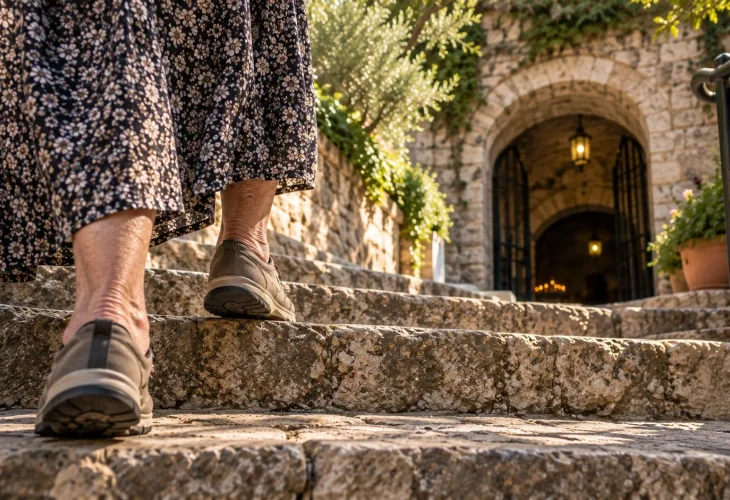
“We won’t be able to talk before 9 a.m.,” Ruth de Jong tells us when we first speak. “Before then, I need to pray, feed the cats and chickens, water the garden, and sweep the entrance to the cave. A large group visited yesterday, so I need to get everything back in order.”
Meet Ruth de Jong, an 82-year-old resident of the Druze village of Peki’in who shows no signs of slowing down. Along with taking care of her own home, she makes a point of visiting the cave of Rashbi in the village every day. Anyone who has been there knows that reaching the cave means climbing a long flight of stairs, but Ruth takes it in stride.
“For now, I can still do it,” she says. “And between us, maybe climbing up to the cave every day is what keeps me strong. Other people my age go out to exercise. This is my workout.”
Roots That Go Back Generations
Ruth still speaks with a noticeable Dutch accent, but after many years in Israel, her Hebrew is fluent. She was born in the Netherlands during World War II to a Dutch mother and a father who was half German and half Jewish.
“My father’s connection to the Jewish people meant that life was not easy for him and his family during the war,” she says. “At the same time, it sparked in them a desire to learn more about the Jewish people. As a little girl, I remember my mother taking a great interest in what was happening to the Jews, and she was deeply moved when the State of Israel was established. I was always interested in the Jewish people too, and after finishing my studies, I even lived in Jerusalem for about a year.”
Ruth went on to become a doctor. When she married her husband, Abel, a lawyer, she had no idea that he was Jewish. In fact, neither did he.
“He didn’t know either,” she explains. “He is a Holocaust survivor who, at the age of two and a half, was given to a Christian family and raised as a Christian. He only discovered that he was Jewish after we were already married. I was actually very moved and happy. Some people were surprised because they thought the discovery should have made me anxious, but finding out about his Jewish identity only made me happy.”
At first, the discovery did not seem likely to change their lives dramatically. Ruth and Abel had established careers in the Netherlands and were raising three sons. Then something unexpected happened, something Ruth is convinced was no coincidence, but rather a remarkable example of Divine providence.
“One day, my husband was on his way home from work when he happened to walk into a shop at a flea market. There, he saw an extraordinary painting of a man he didn’t recognize. It was very expensive, and although he had no idea who the man was, he immediately paid the asking price and bought it. At the time, he had no idea that the figure in the painting was Rabbi Shimon bar Yochai.”
A Painting That Led Them to Israel
When Abel brought the painting home, Ruth noticed Hebrew writing on it and set out to decipher it.
“I compared the writing with Hebrew letters and managed to work out the name: ‘Rabbi Shimon bar Yochai.’ I looked him up in an encyclopedia, and that was how we first learned about his remarkable life. Later, my husband took the painting to a prominent museum, where they told us it was probably several centuries old and had come from Salonika.”
The painting remained on the wall of their home, gradually deepening their connection to Judaism and awakening in Ruth a desire to become part of the Jewish people. Before long, she began a conversion process that lasted several years, eventually becoming Jewish.
Not long afterward, Ruth suggested that she and Abel take a short trip to Israel. But another unexpected development meant their visit would last much longer than planned.
“Around that time, I discovered that I was pregnant again,” she recalls. “I was already 45, and pregnancy hadn’t even crossed my mind. By the time we arrived in Israel, I was already five months pregnant, and it was clear that the baby would be born here.”
The couple settled in the moshav of Amirim with their third son, while their two older sons remained in the Netherlands. Their new baby was born in Israel, and they named him Boaz. Then came another discovery that Ruth found remarkable.
“To our amazement, we discovered that the moshav where we were living was very close to the grave of the holy Rashbi, without our having planned any of it,” she says. “It was clear to me that I wanted to stay. I opened a natural medicine clinic in the moshav, my husband found work, and we decided to give it a try.”
That trial period lasted about two and a half years. Eventually, the couple returned to the Netherlands, as Ruth puts it, “for the children.” But their hearts remained in Israel, and they continued returning for frequent visits.
Then, 19 years ago, they heard about an abandoned house for sale in old Peki’in, close to the cave of Rashbi.
“We immediately knew it was meant for us,” Ruth says. “We quickly signed the deal, and since then we have lived here. We see it as a great mission to care for the area and look after the cave.”
A Jewish Woman in a Druze Village
Today, Ruth is almost the only Jewish woman living in old Peki’in, alongside Margalit Zinati, the local “keeper of the flame,” who has lived there since birth.
“It isn’t always easy to be the only Jewish woman in the area,” Ruth admits. “But I felt reassured when I researched Peki’in and learned that it was originally mostly Jewish. My neighbors tell me that even today, there are houses, plots of land, and orchards in the village that are known to have officially belonged to Jews. People often say that the village has always been home to four religions. So here we are, representing the Jews in that story.”
What is your relationship with your neighbors like?
“There are times when tensions arise, but generally we have good relationships,” she says. “Over the years, I’ve learned to respect everyone. I don’t impose my culture on anyone, and I live my life quietly. I think they’re also happy that I take care of the cave because it is sacred and deeply valued by them as well.”
What does a typical day look like for you?
“I have plenty to keep me busy,” Ruth says. “It is very important to me that the cave is protected and properly maintained. I go there regularly, take care of it, sweep it, and put a great deal of effort into looking after it, without receiving anything in return.”
What about your family in the Netherlands? Do you visit them?
“Only rarely. If I leave, I need someone to take my place both at home and at the cave. It isn’t easy to find someone willing to take that on, so sometimes I bring volunteers from the Netherlands to help.”
And what are your plans for the future?
Ruth pauses before answering.
“I plan to keep doing this for as long as I have the strength. Maybe one day one of my children or grandchildren will want to come and live in the house, or perhaps there will be other plans. But one thing is certain: the home near the cave of Rashbi must remain.”

