

Fast of Gedaliah
Today Is the Fast of Gedalia: Here’s Why We Fast
Today is the Fast of Gedalia. Learn the tragic story behind the fast, who is obligated to fast, and the deeper meaning of the apple and honey eaten on Rosh Hashanah.
- הרב רונן חזיזה
- | Updated
Today is the Fast of Gedalia. Why do we fast on this day?
After Nebuchadnezzar, king of Babylon, destroyed the First Temple and exiled most of the Jewish people to Babylon, he left a small portion of the nation in the Land of Israel and appointed Gedalia ben Achikam to lead them.
Gedalia was a righteous, G-d-fearing man who had the ability to strengthen the people’s spirits and begin rebuilding after the devastation. At that time, however, there was an evil man named Ishmael ben Netaniah, who, together with a group of criminals, resented Gedalia’s appointment as governor and asked to meet with him.
People who were aware of Ishmael ben Netaniah’s intentions warned Gedalia that he meant to harm him. But Gedalia, in his innocence, did not believe that Ishmael would do such a thing. Ishmael and his men arrived at Gedalia’s home, where Gedalia prepared a meal for them. In the middle of the meal, they rose up against him and killed him, along with those who were with him.
With Gedalia’s death, the last remaining ember of Jewish life in the Land of Israel was extinguished, and those who had remained in the land were plunged into darkness.
Why Was a Fast Established?
The day was established as a fast to teach us that “the death of the righteous is equivalent to the burning of the House of our G-d.”
The Rambam wrote, “As a result, the remaining ember of Israel was extinguished, and exile came upon them.” The Mishnah Berurah adds: “Because Gedalia was killed, they all went into exile, and thousands among them were killed.”
On the Fast of Gedalia, the prohibitions apply to eating and drinking. Other activities are permitted, including washing, listening to music, and wearing leather shoes.
Every male over the age of 13 and every female over the age of 12 is obligated to fast on the Fast of Gedalia. We should take care not to treat the words and enactments of our Sages lightly.
When the Sages instituted the fast, however, they established it for healthy people who are able to fast. Someone who is ill and confined to bed, a pregnant or nursing woman, or a very elderly person whose body is weak is exempt from fasting.
Why Do We Eat Apple and Honey?
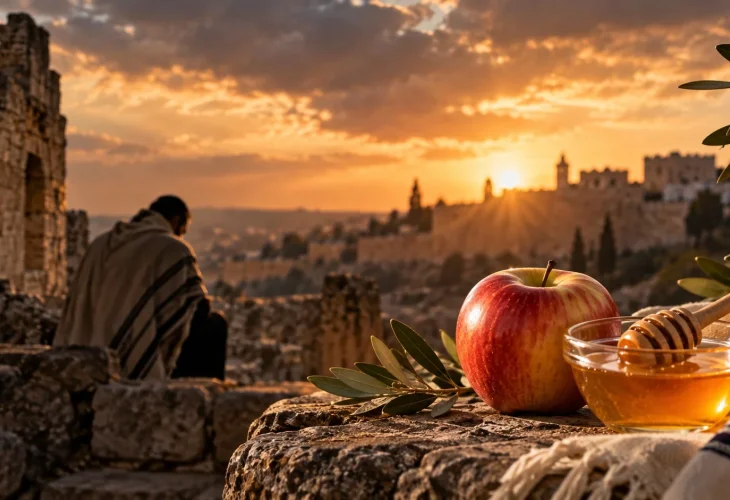
Every preschool child who hears the words Rosh Hashanah immediately thinks of apples and honey. But why did this become such a familiar custom, and what does it symbolize? Our holy Sages offer several explanations.
The apple recalls the merit of our forefathers. Abraham represents the attribute of kindness, whose color is white. Isaac corresponds to strength and judgment, represented by red. Our forefather Jacob corresponds to beauty and compassion, represented by green. An apple contains all three colors: green and red on its peel and white inside.
The apple also recalls Hashem’s way of guiding the world through these three attributes: kindness, judgment, and compassion. Therefore, the Creator of the world is compared to an apple, as it says in Song of Songs: “Like an apple tree among the trees of the forest, so is my beloved among the sons.”
We dip the apple in honey because honey has the power to transform what is placed inside it into something like itself. This hints at the transformative power of teshuvah: when a person returns in teshuvah, they can become renewed and purified.
There are additional meanings hidden within the custom. “Apple” has the same gematria as “be fruitful and multiply” (494), while “honey” has the same gematria as “woman” (306). On Rosh Hashanah, Sarah, Rachel, and Hannah, who had been unable to have children, were remembered. Therefore, eating apple and honey is considered a segulah for women hoping to have children.
The Ben Ish Chai adds that an apple has appearance, taste, and fragrance, hinting at children, life, and livelihood, all of which we pray will be blessed on Rosh Hashanah.
And we’ll end with something that may bring a smile, but is indeed mentioned in the books: If someone does not have an apple from a tree on Rosh Hashanah, they should eat... a potato!

