

Simchat Torah
Simchat Torah and Shemini Atzeret: Rejoicing with the Torah
The Complete Guide to Simchat Torah 2026 — Dates, Hakafot, the Torah Reading Cycle, Yizkor and the Prayer for Rain, with Hebrew Texts and English Translation
- Hidabroot
- | Updated
What is Simchat Torah?
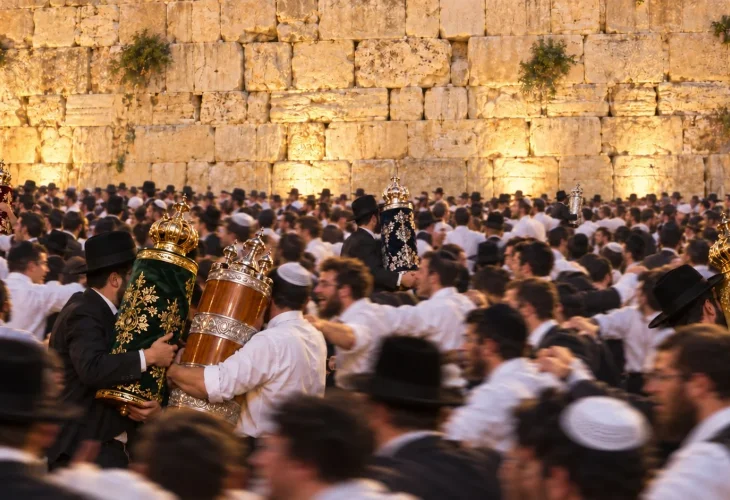
Simchat Torah (Rejoicing with the Torah) is a joyful Jewish holiday celebrating the completion and immediate restart of the annual Torah reading cycle. It falls on the 23rd of Tishrei, immediately after Shemini Atzeret (the Eighth Day of Assembly), marking the culmination of the fall holiday season. The day is celebrated with hakafot — seven joyful processions dancing with Torah scrolls — and by reading the final verses of Deuteronomy followed immediately by the opening of Genesis. In Israel, Simchat Torah and Shemini Atzeret are combined into a single day; in the Diaspora they are observed on two consecutive days. In 2026, Shemini Atzeret begins at sundown on Friday, October 2, and Simchat Torah begins at sundown on Saturday, October 3, ending at nightfall on Sunday, October 4.
What is Simchat Torah?
Simchat Torah is the closing celebration of the long Tishrei holiday season — the season that opens with the judgment of Rosh Hashanah, passes through the atonement of Yom Kippur and the seven days of [Internal link: Sukkot], and ends here, with a synagogue full of people dancing.
The occasion for that dancing is unusual. Simchat Torah does not commemorate an exodus, a rescue, or a military victory. It marks the completion of a reading cycle — the finishing of the last verses of Deuteronomy after a year of weekly Torah portions, and the immediate return to the opening words of Genesis.
That is the entire event. A community finishes a book and starts it again, and treats the moment as worth dancing about for hours.
The Meaning of "Simchat Torah"
Simchat Torah (שִׂמְחַת תּוֹרָה) means "the Rejoicing of the Torah" — or, as it is often rendered, "Rejoicing with the Torah."
The Hebrew construction is deliberately ambiguous, and the tradition reads it both ways. It is the joy the Jewish people take in the Torah — and it is also the joy of the Torah itself, understood as rejoicing in its own completion and in the people who studied it.
The name is not biblical. It emerged over centuries as the custom developed, and became standard only in the medieval period.
Simchat Torah vs. Shemini Atzeret — Two Holidays or One?
This is the most common point of confusion about the fall holidays, and the answer has two layers.
In the Torah, there is only Shemini Atzeret. The Torah commands an eighth day of assembly following the seven days of Sukkot (Leviticus 23:36). Simchat Torah appears nowhere in the Torah — it is a later rabbinic development, layered onto that biblical day.
In practice, they are separate days in the Diaspora. Because of the ancient practice of observing a second festival day outside the Land of Israel, the eighth day expanded into two: the 22nd of Tishrei kept the name Shemini Atzeret, and the 23rd took on the Simchat Torah celebration.
So: one biblical holiday, two observed days in the Diaspora, one combined day in Israel.
How the Holidays Differ in Israel and the Diaspora
How the Holidays Differ in Israel and the Diaspora
| Feature | Israel | Israel |
|---|---|---|
Number of days | One (22 Tishrei) | Two (22 and 23 Tishrei) |
Names used | Both, interchangeably | Shemini Atzeret, then Simchat Torah |
Hakafot | On the single day | Some on Shemini Atzeret night, main ones on Simchat Torah |
Yizkor | On the single day | On Shemini Atzeret |
Tefillat Geshem | On the single day | On Shemini Atzeret |
Torah completion | On the single day | On Simchat Torah |
Eating in the sukkah | No | Yes on Shemini Atzeret, without the blessing |
A visitor from the Diaspora spending the holiday in Israel encounters everything compressed into twenty-four hours; an Israeli in New York finds the same content stretched across two days.
Read more: Sukkot — dates, the sukkah, and the Four Species
When is Simchat Torah 2026:
Shemini Atzeret: sundown Friday, October 2, 2026 through nightfall Saturday, October 3.
Simchat Torah (Diaspora): sundown Saturday, October 3 through nightfall Sunday, October 4.
In Israel: both are observed as one day — sundown Friday, October 2 through nightfall Saturday, October 3.
A note on the 2026 calendar: Shemini Atzeret falls on Shabbat this year. This affects several practical details — Yizkor and Tefillat Geshem are recited on Shabbat, and in the Diaspora the Simchat Torah evening hakafot begin only after Shabbat ends on Saturday night.
Simchat Torah Dates for the Coming Years
| Year | Hebrew Year | Shemini Atzeret | Simchat Torah (Diaspora) |
|---|---|---|---|
2026 | 5787 | Fri Oct 2 – Sat Oct 3 | Sat Oct 3 – Sun Oct 4 |
2027 | 5788 | Fri Oct 22 – Sat Oct 23 | Sat Oct 23 – Sun Oct 24 |
2028 | 5789 | Wed Oct 11 – Thu Oct 12 | Thu Oct 12 – Fri Oct 13 |
2029 | 5790 | Sun Sep 30 – Mon Oct 1 | Mon Oct 1 – Tue Oct 2 |
2030 | 5791 | Fri Oct 18 – Sat Oct 19 | Sat Oct 19 – Sun Oct 20 |
All holidays begin at sundown on the first date listed and end at nightfall on the second. In Israel, both holidays are combined into the single Shemini Atzeret date. Dates verified against Hebcal.
22–23 Tishrei and the Hebrew Calendar
Shemini Atzeret always falls on the 22nd of Tishrei, and Simchat Torah in the Diaspora on the 23rd.
Tishrei is the fullest month in the Jewish calendar. It opens with Rosh Hashanah on the 1st and 2nd, continues to Yom Kippur on the 10th, Sukkot from the 15th through the 21st, and closes with Shemini Atzeret and Simchat Torah on the 22nd and 23rd.
Three weeks of near-continuous observance, moving from awe to atonement to joy — and Simchat Torah is the final note.
Connection to Sukkot
Shemini Atzeret follows immediately after the seventh day of Sukkot, with no gap. Yet halachically it is a distinct festival: the Four Species are not taken, and the obligation to dwell in the sukkah has ended.
The Talmud (Sukkah 47a) treats the separation formally, noting that Shemini Atzeret is a regel bifnei atzmo — a festival in its own right — with its own offering, its own blessing of Shehecheyanu, and its own status.
What is Shemini Atzeret?
The Meaning of "Shemini Atzeret" — The Eighth Day of Assembly
Shemini (שְׁמִינִי) means "eighth." Atzeret (עֲצֶרֶת) is harder to translate, and the difficulty is itself the point.
The root ע־צ־ר means "to hold back," "to restrain," or "to stop." The word is variously rendered as assembly, gathering, solemn assembly, or holding back.
Rashi (on Leviticus 23:36) explains it in the second sense: God holds Israel back for one more day. The pilgrims are preparing to leave Jerusalem after a week of festival; God asks them to stay.
Others read atzeret as "assembly" in the plain sense — a final gathering that closes the season.
Both readings sit in the day's character. It is a holiday about staying, and about the difficulty of parting.
The Biblical Source (Leviticus 23:36, Numbers 29:35–38)
Hebrew (Leviticus 23:36):
שִׁבְעַת יָמִים תַּקְרִיבוּ אִשֶּׁה לַיהוָה; בַּיּוֹם הַשְּׁמִינִי מִקְרָא קֹדֶשׁ יִהְיֶה לָכֶם וְהִקְרַבְתֶּם אִשֶּׁה לַיהוָה, עֲצֶרֶת הִוא, כָּל מְלֶאכֶת עֲבֹדָה לֹא תַעֲשׂוּ.
"Seven days you shall bring a fire-offering to the Lord. On the eighth day it shall be a holy convocation for you, and you shall bring a fire-offering to the Lord. It is an atzeret — you shall do no laborious work."
Numbers 29:35–38 gives the offerings of the day and confirms the pattern noted below: a single bull, where the seven days of Sukkot had brought seventy.
"Stay with Me One More Day" — The Midrashic Meaning
The best-known teaching about Shemini Atzeret comes from the Talmud (Sukkah 55b) and is built on a detail in the offerings.
Throughout the seven days of Sukkot, seventy bulls were brought — a number the Sages connect to the seventy nations of the world. Sukkot is the festival with a universal reach; Israel offers on behalf of all humanity.
On Shemini Atzeret, the count drops to one.
The Talmud reads this as a parable. A king held a great feast for many guests over many days. When the celebration ended and the guests began to leave, he turned to his closest friend and said: "Stay with me one more day — just the two of us. It is hard for me to part from you."
The word the Talmud puts in the king's mouth is "kasheh alai preidatchem" — "your parting is difficult for me." The eighth day is not an eighth day of Sukkot. It is a private day, after the crowd has gone home.
Yizkor on Shemini Atzeret
Yizkor (יִזְכּוֹר — "May He remember") is the memorial service recited four times a year: on Yom Kippur, on the eighth day of Passover, on the second day of Shavuot, and on Shemini Atzeret.
The placement is striking. Yizkor falls on the day the Talmud describes as the most intimate of the year — and the intimacy makes room for grief. A community that has spent three weeks in celebration stops, before the season closes, to remember those who are not there.
The opening of Yizkor for a parent:
יִזְכּוֹר אֱלֹהִים נִשְׁמַת אָבִי מוֹרִי / אִמִּי מוֹרָתִי שֶׁהָלַךְ לְעוֹלָמוֹ, בַּעֲבוּר שֶׁאֶתֵּן צְדָקָה בַּעֲדוֹ. בִּשְׂכַר זֶה תְּהֵא נַפְשׁוֹ צְרוּרָה בִּצְרוֹר הַחַיִּים.
May God remember the soul of my father, my teacher / my mother, my teacher, who has gone to his eternal world — for I pledge charity on his behalf. In this merit, may his soul be bound up in the bond of eternal life.
In many communities, those whose parents are both living leave the sanctuary during Yizkor. The custom is not universal; follow your community's practice.
Yom Kippur: laws, prayers, and the Yizkor service
The Prayer for Rain (Tefillat Geshem)
The central liturgical feature of Shemini Atzeret is Tefillat Geshem — the Prayer for Rain — recited during the Musaf service. The chazzan wears a white kittel and chants it to the solemn High Holiday melody.
From this day forward, the phrase "Mashiv haruach umorid hageshem" is inserted into the Amidah throughout the winter months.
מַשִּׁיב הָרוּחַ וּמוֹרִיד הַגֶּשֶׁם.
He causes the wind to blow and the rain to fall.
The full Geshem prayer is an elaborate piyyut composed by Rabbi Elazar HaKalir, invoking the merit of Abraham, Isaac, Jacob, Moses, Aaron, and the twelve tribes — each connected to water in some episode of their lives.
It closes with a set of paired requests that specify exactly what is being asked for.
שֶׁאַתָּה הוּא יְיָ אֱלֹהֵינוּ מַשִּׁיב הָרוּחַ וּמוֹרִיד הַגֶּשֶׁם.
לִבְרָכָה וְלֹא לִקְלָלָה. לְחַיִּים וְלֹא לַמָּוֶת. לְשֹׂבַע וְלֹא לְרָזוֹן.
For You are the Lord our God, who causes the wind to blow and the rain to fall —
For blessing and not for curse. For life and not for death. For abundance and not for famine.
A frequent point of confusion: the praise ("Mashiv haruach") begins on Shemini Atzeret, but the actual request for rain — "V'ten tal u'matar livracha" — begins later: from the 7th of Cheshvan in the Land of Israel, and from the evening of December 4 in the Diaspora (December 5 in the year before a secular leap year).
The Origin and History of Simchat Torah
The Annual Torah Reading Cycle
The Torah is divided into 54 weekly portions (parshiyot), read publicly in the synagogue on Shabbat morning across the course of a year. Some weeks combine two portions, so that the count fits the lunar year.
The cycle begins with Bereshit (Genesis 1) on the Shabbat after Simchat Torah and ends with V'zot HaBracha (Deuteronomy 33–34) on Simchat Torah itself.
This annual cycle was not the only historical practice. In the Land of Israel during the Talmudic period, a triennial cycle was widespread — the Torah was completed once every three years rather than annually. The Babylonian annual cycle eventually became universal, and Simchat Torah is a direct consequence of it: a fixed yearly completion date creates an occasion
Parashat HaShavua: the weekly Torah portion
Origins in Babylonia
The custom took shape in the Babylonian Jewish community during the Geonic period (roughly the 7th–11th centuries). The Talmud (Megillah 31a) already records that V'zot HaBracha is the reading for the final day of the festival — but says nothing about dancing, hakafot, or a distinct celebration.
Those developed gradually. Geonic-era sources describe the completion of the Torah being marked with honour and festivity, and over the following centuries the practice grew into the celebration recognisable today.
How Simchat Torah Became a Distinct Holiday
The stages are traceable across the medieval period:
The name. "Simchat Torah" as a title for the day appears in sources from around the 11th century onward.
Hakafot. The seven circuits with the Torah scrolls became standard considerably later — the practice spread widely from the 16th century, influenced by the kabbalists of Safed, who gave it structured meaning.
Kol HaNe'arim. The custom of calling all the children collectively for an aliyah developed alongside it.
Hakafot Shniyot. The "second hakafot" on the night after the holiday are a modern Israeli development, dating to the twentieth century.
The result is a holiday assembled over roughly a thousand years, resting on a single biblical verse about an eighth day.
How Simchat Torah is Celebrated
Reading the End of the Torah (V'zot HaBracha)
The final portion of the Torah, V'zot HaBracha (Deuteronomy 33–34), is read only on Simchat Torah — it is the one parshah that never falls on a Shabbat.
It contains Moses' final blessings to the twelve tribes, and then the account of his death: he ascends Mount Nevo, sees the land he will not enter, and dies there.
Deuteronomy 34:10–12
וְלֹא קָם נָבִיא עוֹד בְּיִשְׂרָאֵל כְּמֹשֶׁה, אֲשֶׁר יְדָעוֹ יְהוָה פָּנִים אֶל פָּנִים.
לְכֹל הָאֹתוֹת וְהַמּוֹפְתִים אֲשֶׁר שְׁלָחוֹ יְהוָה לַעֲשׂוֹת בְּאֶרֶץ מִצְרָיִם, לְפַרְעֹה וּלְכָל עֲבָדָיו וּלְכָל אַרְצוֹ.
וּלְכֹל הַיָּד הַחֲזָקָה וּלְכֹל הַמּוֹרָא הַגָּדוֹל אֲשֶׁר עָשָׂה מֹשֶׁה לְעֵינֵי כָּל יִשְׂרָאֵל.
"And there has not arisen since a prophet in Israel like Moses, whom the Lord knew face to face — with all the signs and wonders that the Lord sent him to perform in the land of Egypt, to Pharaoh and all his servants and all his land; and with all the mighty hand and the great awe that Moses displayed before the eyes of all Israel."
When the reading concludes, the congregation calls out together:
חֲזַק חֲזַק וְנִתְחַזֵּק!
Be strong, be strong, and let us be strengthened!
Immediately Beginning Genesis Again (Bereshit)
The Torah scroll is not closed and put away. A second scroll is opened, and the reader begins immediately:
Genesis 1:1:
בְּרֵאשִׁית בָּרָא אֱלֹהִים אֵת הַשָּׁמַיִם וְאֵת הָאָרֶץ.
In the beginning, God created the heavens and the earth.
There is no pause between them. The last word of the Torah — Yisrael — and the first word — Bereshit — are read within moments of each other.
The classical teaching draws out the point: the final letter of the Torah is ל (lamed) and the first is ב (bet), and together they spell לב — lev, "heart." Read in the other direction, from the beginning to the end, they spell בל — bal, meaning "not" or "never." Torah study never ends, and its purpose is the heart.
The Chatan Torah and Chatan Bereshit Honors
Two honours are given on Simchat Torah, and both use the language of a wedding.
Chatan Torah (חֲתַן תּוֹרָה) — "Groom of the Torah" — is called for the final aliyah of Deuteronomy.
Chatan Bereshit (חֲתַן בְּרֵאשִׁית) — "Groom of Genesis" — is called for the opening of Genesis.
In many congregations the honorees are escorted to the bimah under a chuppah — a canopy held over them, exactly as at a wedding — while the congregation sings. Both honours are typically given to community members recognised for their Torah learning or their service to the congregation, and in many places they are followed by a kiddush hosted by the honorees.
The wedding imagery is not decorative. It rests on a well-established metaphor in Jewish tradition of the Torah as a bride and Israel as the groom.
Kol HaNe'arim — All the Children Under the Tallit
Before the final aliyah, an aliyah is given to the children of the congregation collectively — Kol HaNe'arim (כָּל הַנְּעָרִים, "all the young ones").
Every child below bar mitzvah age comes up to the bimah. A large tallit is spread over all of them like a canopy, and an adult recites the blessings on their behalf while they answer along. The congregation then recites the blessing Jacob gave to Ephraim and Menashe.
Genesis 48:16:
הַמַּלְאָךְ הַגֹּאֵל אֹתִי מִכָּל רָע יְבָרֵךְ אֶת הַנְּעָרִים, וְיִקָּרֵא בָהֶם שְׁמִי וְשֵׁם אֲבֹתַי אַבְרָהָם וְיִצְחָק, וְיִדְגּוּ לָרֹב בְּקֶרֶב הָאָרֶץ.
May the angel who redeemed me from all evil bless these young ones. May my name be called upon them, and the names of my fathers Abraham and Isaac, and may they multiply abundantly in the midst of the earth.
For most children, standing beneath a tallit with a whole community singing over them is the single most vivid memory of the synagogue year.
Hakafot — The Seven Torah Processions
What are Hakafot?
Hakafot: Hakafot (הַקָּפוֹת, "circuits") are the seven processions in which the Torah scrolls are carried around the synagogue bimah, accompanied by singing and dancing. They are held on the night of Simchat Torah and again in the morning, and are the defining feature of the holiday. Each circuit is introduced by a set of verses and followed by extended dancing.
The word comes from the root ה־ק־ף, "to encircle." Seven circuits echo the seven circuits of Hoshana Rabbah with the Four Species, the seven days of Sukkot, and the seven circuits around Jericho.
The Seven Circuits with the Torah Scrolls
Before the hakafot begin, all the Torah scrolls are removed from the ark — an unusual act in itself, and one of the very few occasions when scrolls are taken out at night.
The congregation first recites Ata Horeita Lada'at, a collection of biblical verses about God's uniqueness, the giving of the Torah, and the ark's journeys. It is recited responsively, verse by verse, and in many communities each verse is "sold" as an honour.
Opening verses of Ata Horeita
אַתָּה הָרְאֵתָ לָדַעַת כִּי יְיָ הוּא הָאֱלֹהִים, אֵין עוֹד מִלְבַדּוֹ.
לְעֹשֵׂה נִפְלָאוֹת גְּדֹלוֹת לְבַדּוֹ, כִּי לְעוֹלָם חַסְדּוֹ.
אֵין כָּמוֹךָ בָאֱלֹהִים אֲדֹנָי, וְאֵין כְּמַעֲשֶׂיךָ.
יְהִי כְבוֹד יְיָ לְעוֹלָם, יִשְׂמַח יְיָ בְּמַעֲשָׂיו.
וַיְהִי בִּנְסֹעַ הָאָרֹן וַיֹּאמֶר מֹשֶׁה: קוּמָה יְיָ וְיָפֻצוּ אֹיְבֶיךָ, וְיָנֻסוּ מְשַׂנְאֶיךָ מִפָּנֶיךָ.
כִּי מִצִּיּוֹן תֵּצֵא תוֹרָה, וּדְבַר יְיָ מִירוּשָׁלָיִם.
You have been shown, in order to know, that the Lord is God — there is none besides Him.
To Him who alone performs great wonders, for His kindness is everlasting.
There is none like You among the mighty, O Lord, and there are no works like Yours.
May the glory of the Lord endure forever; may the Lord rejoice in His works.
And it came to pass, when the ark journeyed, that Moses said: "Arise, O Lord, and let Your enemies be scattered, and let those who hate You flee before You."
For from Zion shall go forth Torah, and the word of the Lord from Jerusalem.
The Seven Hakafot — Verse by Verse
Each of the seven hakafot opens with the same refrain — "Ana Hashem hoshia na" ("Please, Lord, save us") — followed by a distinct set of divine attributes arranged in alphabetical order. The chazzan chants each line and the congregation repeats it, and only then do the scrolls begin to move.
The refrain recited before every hakafah:
אָנָּא יְיָ הוֹשִׁיעָה נָּא. אָנָּא יְיָ הַצְלִיחָה נָּא. אָנָּא יְיָ עֲנֵנוּ בְיוֹם קָרְאֵנוּ.
Please, Lord, save us. Please, Lord, grant us success. Please, Lord, answer us on the day we call.
| # | Hebrew invocation | Transliteration | Meaning |
|---|---|---|---|
| 1 | אֱלֹהֵי הָרוּחוֹת הוֹשִׁיעָה נָּא | Elohei haruchot | God of all spirits — save us |
| 2 | בּוֹחֵן לְבָבוֹת הַצְלִיחָה נָא | Bochen levavot | Examiner of hearts — grant us success |
| 3 | גּוֹאֵל חָזָק הוֹשִׁיעָה נָּא | Goel chazak | Mighty Redeemer — save us |
| 4 | דּוֹבֵר צְדָקוֹת הַצְלִיחָה נָא | Dover tzedakot | Speaker of righteousness — grant us success |
| 5 | הָדוּר בִּלְבוּשׁוֹ הוֹשִׁיעָה נָּא | Hadur bilvusho | Glorious in His garment — save us |
| 6 | וָתִיק וְחָסִיד הַצְלִיחָה נָא | Vatik v'chasid | Eternal and kind — grant us success |
| 7 | זַךְ וְיָשָׁר הוֹשִׁיעָה נָּא | Zach v'yashar | Pure and upright — save us |
The invocations continue through the full Hebrew alphabet across the seven circuits, from א to ת — a complete alphabetical portrait of God, spoken by a congregation holding the book in which those letters appear.
After each set of verses, the scrolls are carried around the bimah and the dancing begins. There is no fixed duration. A hakafah may last two minutes or forty, and in many communities the seven together run several hours.
A note on the number seven: The seven circuits echo the seven days of Sukkot, the seven circuits of Hoshana Rabbah with the Four Species, the seven circuits around Jericho, and — in the kabbalistic reading given by the Safed mystics — the seven divine attributes from chesed through malchut, one for each hakafah.
Singing and Dancing with the Torah
The dancing is the heart of the night. Men carry the scrolls in circles, others dance around them, and the songs are drawn from a repertoire that varies enormously by community.
Some pieces are near-universal. The best known is Sisu V'Simchu, sung in nearly every community:
שִׂישׂוּ וְשִׂמְחוּ בְּשִׂמְחַת תּוֹרָה, וּתְנוּ כָבוֹד לַתּוֹרָה.
כִּי טוֹב סַחְרָהּ מִכָּל סְחוֹרָה, מִפָּז וּמִפְּנִינִים יְקָרָה.
נָגִיל וְנָשִׂישׂ בְּזֹאת הַתּוֹרָה, כִּי הִיא לָנוּ עֹז וְאוֹרָה.
Rejoice and be glad in the Rejoicing of the Torah, and give honour to the Torah.
For her merchandise is better than any merchandise — more precious than fine gold and pearls.
We will exult and rejoice in this Torah, for she is our strength and our light.
Another universal favourite is Torah Tziva, sung to countless melodies:
תּוֹרָה צִוָּה לָנוּ מֹשֶׁה, מוֹרָשָׁה קְהִלַּת יַעֲקֹב.
Moses commanded us the Torah — an inheritance for the congregation of Jacob. (Deuteronomy 33:4)
Beyond these, the repertoire varies enormously. Chasidic communities have their own niggunim for each hakafah. Sephardic communities sing piyyutim in Hebrew and Judeo-Arabic. Yemenite communities have distinct melodies of their own.
Children participate fully, and are typically given flags, sweets, and small paper Torah scrolls of their own.
A halachic note: dancing while holding a Torah scroll requires care. The scroll is held firmly and upright, and the dancing is vigorous but controlled. Those unsteady on their feet, or who have been drinking, should not carry a scroll.
Hakafot Shniyot — The Second Hakafot in Israel
Hakafot Shniyot (הַקָּפוֹת שְׁנִיּוֹת — "second hakafot") are held in Israel on the night after the holiday ends — the night that in the Diaspora is still Simchat Torah.
The custom is modern, developed in Israel in the twentieth century and popularised widely from the 1950s onward. Its original rationale was solidarity: while Israelis had finished the festival, Jews in the Diaspora were still celebrating, and the second hakafot expressed a connection across that gap.
Because the holiday has ended, musical instruments and amplification are permitted. Hakafot Shniyot are therefore held outdoors in city squares, with live bands and large crowds — from Jerusalem and Tel Aviv to towns across the country. They have become major public events in their own right.
Simchat Torah Prayers and Services
Evening Service — Introducing the Torahs
The Simchat Torah evening service follows Ma'ariv. All the scrolls are taken from the ark, Ata Horeita is recited, and the seven hakafot begin.
In most communities, a Torah reading is held at night — a rarity, since the Torah is normally read only in the morning and at Shabbat and fast-day Mincha. Three people are called for a short reading from V'zot HaBracha.
Morning Service — The Aliyot
The morning service is the longest of the year in many congregations, for a simple reason: everyone is called to the Torah.
The same short passage from V'zot HaBracha is repeated as many times as needed so that every adult male in the congregation receives an aliyah. In a large synagogue this can mean well over a hundred aliyot, and many communities run several simultaneous readings in different rooms to manage it.
After all have been called, the sequence closes with:
- Kol HaNe'arim — the children's collective aliyah.
- Chatan Torah — the final aliyah of Deuteronomy.
- Chatan Bereshit — the opening of Genesis, from a second scroll.
- Maftir and the Haftarah — Joshua 1, which opens with God's instruction to Joshua after Moses' death.
The choice of Haftarah completes the theme: the Torah has ended with the death of Moses, and the Prophets begin with his successor being told to continue.
Musaf and the Prayer for Rain
In Israel, where the days are combined, Tefillat Geshem is recited at Musaf on the same day as the hakafot.
In the Diaspora, Tefillat Geshem belongs to Shemini Atzeret — the day before Simchat Torah — and the Simchat Torah Musaf is the standard festival service.
Simchat Torah Customs and Traditions
Everyone Gets an Aliyah
The principle that every adult male receives an aliyah on Simchat Torah is one of the few times in the year when a synagogue honour is universal rather than selective.
Ordinarily aliyot are limited in number and distributed by the gabbai. On Simchat Torah the limit is lifted entirely, and no one who wants to be called is passed over.
The custom's message is straightforward: the Torah does not belong to the learned or the prominent. On the day it is completed, everyone touches it.
Waving Flags for Children
Children carry Simchat Torah flags — traditionally paper flags on wooden sticks, decorated with Torah imagery, sometimes topped with an apple and a candle.
The apple-and-candle version is older and now less common for safety reasons, but the flags themselves remain universal, and children wave them throughout the hakafot.
Sweets are distributed throughout the evening, and in many communities the children's participation is treated as the point rather than a distraction from it.
Festive Meals
Both Shemini Atzeret and Simchat Torah carry the obligation of festive meals, with kiddush, challah, and the usual festival foods.
Many communities hold a kiddush after the morning service sponsored by the Chatan Torah and Chatan Bereshit — often substantial, and often running well into the afternoon.
Drinking and Rejoicing
Simchat Torah is one of two occasions in the Jewish year — alongside Purim — associated with drinking.
The tradition permits it, and it is genuinely part of the atmosphere in many communities. But the halachic authorities are direct about the limits: the drinking exists to serve the joy of the Torah, not to replace it.
A person who becomes intoxicated to the point of behaving inappropriately, disrupting the service, or being unable to pray has not fulfilled anything. Carrying a Torah scroll while drunk is prohibited outright.
Many communities have moved toward moderation in recent decades, and a number set explicit limits.
Shemini Atzeret Customs
Eating in the Sukkah (or Not) — Diaspora vs. Israel
This is one of the more curious halachic situations in the calendar.
In Israel: the sukkah obligation has ended. One eats indoors.
In the Diaspora: because of the doubt that historically underlies the second festival day, many eat in the sukkah on Shemini Atzeret — but without reciting the blessingLeishev BaSukkah.
The logic is a compromise between two possibilities. If the day is really the eighth day of Sukkot, one should be in the sukkah; if it is a separate festival, one should not. Eating there without the blessing acknowledges both.
Customs vary: many Chasidic communities do not eat in the sukkah at all on Shemini Atzeret, and practice differs by community. Follow your rabbi.
The Yizkor Memorial Service
Yizkor is recited on Shemini Atzeret morning, after the Torah reading and before Musaf.
Many congregations precede it with a short address, and in most communities it is among the best-attended services of the year — including by people who attend rarely otherwise.
The custom of pledging charity in memory of the departed is integral to the service and is not incidental: the Hebrew text itself makes the pledge the basis of the request.
The Spiritual Meaning of Simchat Torah
The Endless Cycle of Torah Study
The defining act of Simchat Torah is refusing to stop.
There is no ceremony marking the Torah as finished, no closing of the book. The last verse is read, and the first verse follows within seconds, from a scroll already open and waiting.
The classical teaching is that Torah has no completion in the sense that other books do. A person who has learned it once has not finished it; they have qualified to begin. What changes on the second pass is not the text but the reader.
Joy in Judaism — Simcha Shel Mitzvah
Simchat Torah is the clearest expression in the calendar of simcha shel mitzvah — joy taken in a commandment.
The concept matters because it cuts against a persistent misreading of religious life as primarily a matter of restriction and obligation. The Torah itself makes joy a requirement (Deuteronomy 28:47 warns of consequences for serving God "without joy and gladness of heart"), and Simchat Torah is where that requirement becomes most visible.
What makes the day distinctive is what is being celebrated. Not a rescue, not a victory — a book. The joy is directed at the fact of having been given something to learn.
Unity of the Jewish People
The customs of the day are organised around inclusion.
Everyone receives an aliyah. All the children come up together. The scrolls are carried by whoever wants to carry them. Learning, status, and background determine nothing about participation.
Communities that spend the year distinguishing between people by knowledge or standing suspend those distinctions for a day, and the suspension is the observance.
Simchat Torah in American Jewish Communities
Simchat Torah draws some of the largest synagogue attendance of the year in American Jewish life, across every denomination.
Orthodox communities in Brooklyn, Lakewood, Monsey, the Five Towns, Baltimore, Chicago, Los Angeles, Miami, and Toronto hold hakafot that frequently run past midnight. Large congregations conduct multiple simultaneous Torah readings in the morning to get through the aliyot. Chasidic communities gather in the thousands around their rebbes.
Conservative and Reform congregations hold Simchat Torah services with hakafot, and both movements have made the day a focus of family and youth engagement — with flag parades, unrolling a full Torah scroll around the sanctuary so the congregation can see it in its entirety, and consecration ceremonies for children beginning religious school.
Campus Hillels and Chabad houses hold some of the most heavily attended student events of the year.
The Simchat Torah Movement of Soviet Jewry
One of the most consequential chapters in modern Jewish history is bound to this holiday.
Beginning in the 1960s, Jews in the Soviet Union — where religious practice was suppressed and Jewish identity officially discouraged — began gathering in the streets outside synagogues on Simchat Torah night. In Moscow, thousands assembled outside the Choral Synagogue on Arkhipova Street to sing and dance in public.
Many participants knew little of the holiday's content. What the gathering offered was one night a year when being visibly Jewish in a crowd was possible, and the authorities found it difficult to suppress a crowd that was, formally, doing nothing illegal.
The Moscow gatherings became a defining image of Soviet Jewish identity and a rallying point for the international Soviet Jewry movement. Elie Wiesel's 1966 book The Jews of Silence, which brought the situation to Western attention, opens with his account of Simchat Torah night in Moscow.
American Jewish communities responded by holding solidarity rallies on Simchat Torah, and the connection between the holiday and the movement persisted until the Soviet Union's dissolution.
October 7, 2023 — Simchat Torah and Modern Memory
On October 7, 2023 — Simchat Torah, and Shabbat, in Israel — Hamas launched an assault on southern Israel. Approximately 1,200 people were killed and 251 taken hostage. It was the deadliest single day for Jews since the Holocaust.
The date has changed how the holiday is experienced. For many communities, Simchat Torah now carries a second layer of memory alongside its joy, and the tension is not resolved so much as held.
Responses have varied. Some communities have added memorial prayers or a moment of silence before the hakafot. Some dedicate a hakafah to those killed, to the hostages, or to soldiers. Some have made no liturgical change and describe the dancing itself as the response — that continuing to celebrate is what the day requires.
There is no established practice, and none is likely to settle quickly. Communities are working it out, and the question of how to hold grief and joy on the same day is one Judaism has faced before without ever resolving cleanly.
Simchat Torah and Shemini Atzeret: all articles and videos
Sources & References
Biblical Sources:
- Leviticus 23:36 — "On the eighth day shall be an atzeret."
- Numbers 29:35–38 — the Shemini Atzeret offerings.
- Deuteronomy 33–34 — V'zot HaBracha, the final Torah reading.
- Genesis 1 — Bereshit, read immediately after V'zot HaBracha.
- Genesis 48:16 — the blessing recited at Kol HaNe'arim.
- Deuteronomy 4:35 — the opening of Ata Horeita.
- Deuteronomy 33:4 — "Torah tziva lanu Moshe," sung during the hakafot.
- Joshua 1 — the Haftarah of Simchat Torah.
Talmudic and Rabbinic Sources:
- Mishnah Sukkah 4:1 — Shemini Atzeret as a distinct festival.
- Babylonian Talmud, Sukkah 47a–48a — the eighth day as a festival in its own right.
- Babylonian Talmud, Sukkah 55b — the seventy bulls and the parable of the king.
- Babylonian Talmud, Megillah 31a — the Torah reading for the final festival day.
- Rashi on Leviticus 23:36 — the interpretation of atzeret.
Halachic Sources:
- Shulchan Aruch, Orach Chayim 668–669 — the laws of Shemini Atzeret and Simchat Torah.
- Rama (Rabbi Moshe Isserles), glosses to Orach Chayim 669 — Ashkenazi customs of hakafot and Kol HaNe'arim.
- Rambam (Maimonides), Mishneh Torah, Hilchot Yom Tov.
- Mishnah Berurah 668–669 — practical halacha.
- Rulings of Rabbi Ovadia Yosef ZT"L — Sephardic practice.
Historical References:
- Elie Wiesel, The Jews of Silence (1966) — Simchat Torah in Moscow and the Soviet Jewry movement.
Contemporary References:
- Chabad.org — guides to Simchat Torah and Shemini Atzeret customs and laws.
- Orthodox Union (OU.org) — halachic guidance on the fall festivals.
- Sefaria (sefaria.org) — full texts of Talmud Sukkah, Megillah, and Mishneh Torah.
- Hebcal (hebcal.com) — verified Shemini Atzeret and Simchat Torah dates, 2026–2030.
- Encyclopaedia Judaica — entries on Simchat Torah, Shemini Atzeret, hakafot, and the Torah reading cycle.
For practical halachic guidance on individual situations — Diaspora sukkah practice on Shemini Atzeret, Yizkor customs, or community-specific observances — consult a qualified Orthodox rabbi.
Questions & Answers
+What is Simchat Torah and why is it celebrated?
+When is Simchat Torah 2026?
+What is the difference between Simchat Torah and Shemini Atzeret?
+What are hakafot?
+Why do we dance with the Torah on Simchat Torah?
+What is Yizkor and when is it recited on Shemini Atzeret?
+What is Tefillat Geshem (the Prayer for Rain)?
+Who is the Chatan Torah and Chatan Bereshit?
+What is Kol HaNe'arim?
+Why is Simchat Torah observed differently in Israel and the Diaspora?
+Do you eat in the sukkah on Shemini Atzeret?
+What Torah portion is read on Simchat Torah?
+Why do we immediately start Genesis after finishing Deuteronomy?
+What do you say to someone celebrating Simchat Torah?
+What is Ata Horeita?
+What songs are sung on Simchat Torah?

