

Magazine
Vote Because You Can
Every election cannot be the most important of our lifetime. But in a democracy that recognizes Jews as individual citizens, every vote is an opportunity to make our voices heard.
- Rachel Wigman
- | Updated
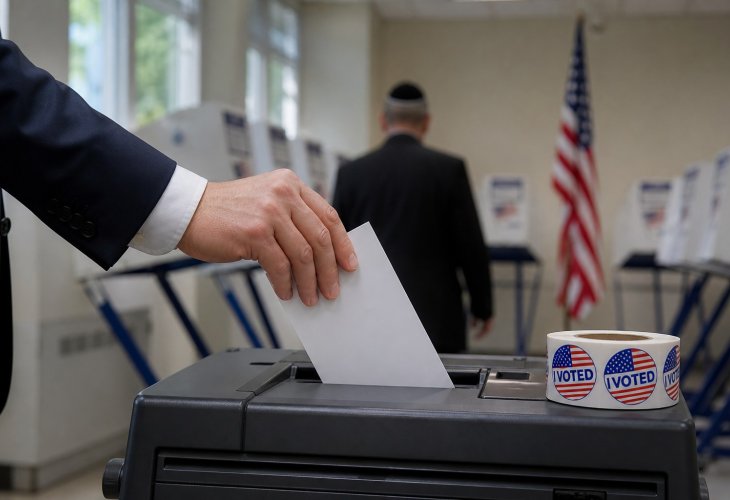 Illustrative image: casting a ballot on Election Day
I celebrated my eighteenth birthday while I was on my gap year here in Israel. It was the year of a presidential election, but my birthday fell out too late for me to still register to vote and obtain an absentee ballot. And so I missed the first possible election in which I could have exercised my right as a citizen. Since then, I have been pretty good about making sure to vote. I remember, as a child, going with my parents when they went to vote, and being very impressed at the whole democratic process, and it instilled in me a sense of civic responsibility and a desire to partake in government in the only way that I can.
Truth be told, the right to vote is not something to be taken for granted, particularly not as Jews. It was not until the end of the eighteenth century that France (of all the ironies) became the first country to give Jews fully equal rights as citizens. In the great Athenian democracy of the classical era, it would have been unthinkable to grant a Jew citizenship, and indeed, throughout the ages, Jews were politically treated as an entity in which members of said entity were afforded certain privileges because of their association as Jews.
Sometimes it feels, in this post-October 7 world in which we live, as though we have gone back to that era. Anti-Zionism is the new antisemitism, yet anyone looking remotely Jewish is immediately branded with the scarlet letter, regardless of whether or not they are actively engaged in Zionist activities. Jewish organizations have taken to removing their addresses from websites, instructing employees to remove the address from their email signatures, due to safety concerns. Events that are run by these organizations have the locations kept under wraps until the last minute, and even then, it is only disclosed to the people who signed up in advance. Jews of all stripes, of all religious affiliations, and of all political associations are once again being treated as a single entity rather than as individuals with rights enshrined by law just as is the case for every other citizen of the country.
Which brings me back to voting. The language surrounding the midterm elections next week has been one of urgency, coming from both sides of the aisle. “This election is critical because [fill in the blank with your political hyperbole],” seems to be the messaging that every candidate has harnessed. If I’m being honest, I’m very tired of this sense of political urgency that has been the M.O. of every candidate for the last decade. The United States’ democracy is not about to die. This is not the most important election of your lifetime, because every election lately has been the most important election of your lifetime, and statistically speaking, they can’t all be the most important. (Ironically, the race in my district in New York is one of those that is being watched across the country as one that could determine the shape of the House of Representatives. But I digress.)
Yet, that does not mean that there are not important issues at stake, and it does not mean that we should sit back and let the democratic process happen around us, particularly when the outcome of these midterm elections can have a real impact for Israel and the Jewish people.
There are some countries in which voting is required for all citizens. Those who choose not to vote are fined for not upholding their civic obligation. In the United States, that is not the case: voting is a privilege, not an obligation. It is a right with which one can choose to do as he sees fit. And there is a responsibility that comes along with that right.
When you go out to vote next week, don’t do so because this is the most important election recently. Recently, in this case, means two years, and there will be another, bigger election in another two years. It’s the way the American democracy works, and as long as it continues to work, as long as we continue to exercise our civic right, then the political landscape will continue to shift and change with each subsequent cycle. Rather, vote because you have a voice, as a citizen, and this is the way in which you can speak up. You can make your position heard on the issues at stake, regardless of whether or not the election in your district is a swing election, because that is your right as an individual citizen of this great country, which recognizes you, us, as more than members of our ethno-religious group.
And throughout this democratic process, while exercising our civic rights, it’s worth keeping in mind the final sentences of the prayer that is said in synagogues for the welfare of the government: “King of Kings, with His mercy He shall place in [the president’s] heart and in the hearts of all of his advisors and officers the mercy to do what is good with us and the whole Jewish people. In his days and in our days, may Judah be redeemed and Israel dwell securely; may a redeemer come to Zion, and may it be Your will. And let us say: Amen.”

