

Israel News
Golan Druze Increasingly Turn Toward Israeli Citizenship
Citizenship applications have surged as ties to Syria weaken and recent regional violence reshapes attitudes toward Israel.
- Shlomo Hodges
- | Updated
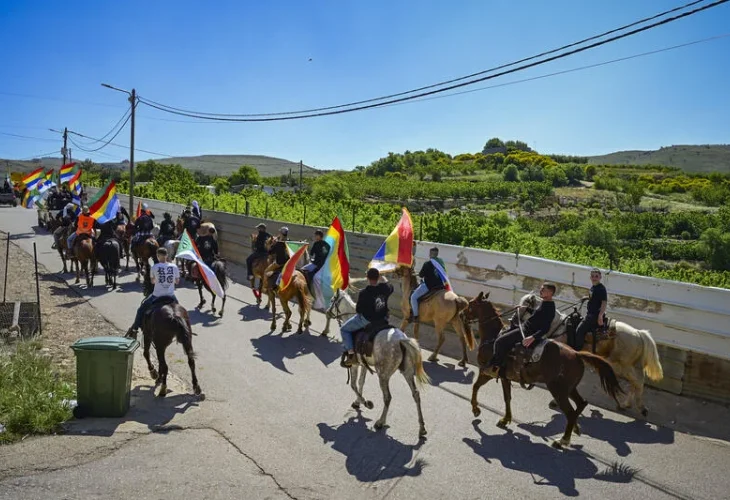 Druze horsemen and cattle growers from the four Golan Heights Druze villages (Michael Giladi/Flash90)
A growing number of Druze residents in the Golan Heights are applying for Israeli citizenship, marking a significant shift in communities that historically maintained strong ties to Syria.
New figures show that approximately 44% of the Golan Druze now hold Israeli citizenship. As recently as 2023, the figure stood at around 20%.
The change has accelerated dramatically over the past two years.
In 2024, 572 residents of the Golan’s four Druze communities applied for Israeli citizenship. That number jumped to 3,750 applications in 2025, while another 1,444 applications were submitted during the first half of 2026.
The four communities are Majdal Shams, Buq’ata, Mas’ade and Ein Qiniyye.
For decades, most Druze residents of the Golan rejected Israeli citizenship and instead held permanent residency. Many continued to identify strongly with Syria after Israel captured the Golan Heights during the 1967 Six-Day War and extended Israeli law to the territory in 1981.
However, the Syrian civil war gradually weakened longstanding family, educational and economic connections with Damascus. The fall of Bashar Assad’s regime and subsequent instability in southern Syria accelerated that process.
Violence against Syria’s Druze community appears to have played an especially important role.
Fighting in the southern Syrian province of Sweida left hundreds dead and prompted Israel to intervene on behalf of the Druze community. Israel carried out strikes against Syrian government forces and targets in Damascus while also providing humanitarian assistance to Druze communities across the border.
Political scientist Salim Brik of the Open University of Israel said Israel’s response contributed to changing attitudes among Golan Druze, who saw Israel stand behind Druze communities during the violence in Syria.
Another turning point came in July 2024, when a Hezbollah rocket struck a soccer field in Majdal Shams and killed 12 children and teenagers. The attack deeply affected the local community and further challenged its traditional separation from Israeli national life.
Interest in Israeli citizenship had already started increasing before these events. The Syrian civil war pushed annual applications from only a handful to hundreds, particularly among younger residents. However, the latest figures show the process accelerating on a much larger scale.
Israeli citizenship gives Golan Druze the right to vote in national elections and receive Israeli passports. Permanent residents receive many Israeli social benefits but cannot participate in Knesset elections unless they become citizens.
The growing number of applications does not mean that the Golan Druze have abandoned their distinct identity or connections to Syria. Views still vary significantly within the community.
However, the rapid increase in Israeli citizenship marks one of the clearest changes in the relationship between the Golan Druze and the State of Israel in decades.

