

Simchat Torah
Why Do We Dance With the Torah on Simchat Torah? The Tradition of Hakafot
Dancing with the Torah is one of the most joyful traditions of Simchat Torah. Discover how hakafot began and the deeper meaning behind the seven circles.
- Amitai Chania
- | Updated
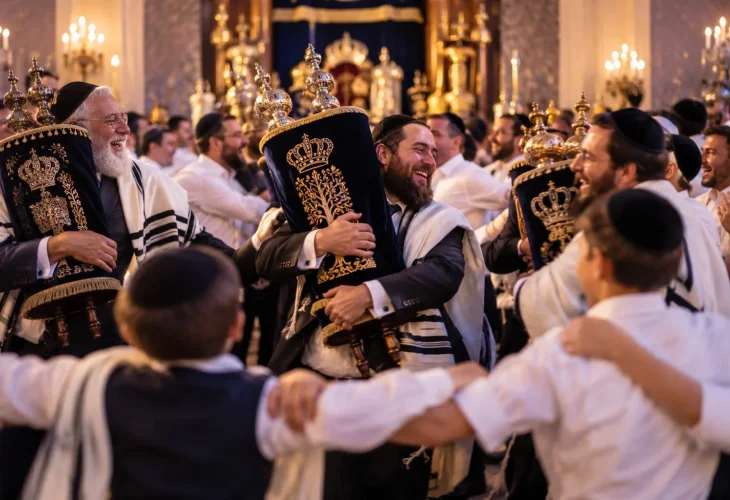
Hakafot on Simchat Torah are among the most joyful customs of the Jewish calendar. They take place in the synagogue after the evening prayer on the night of Simchat Torah and again in the morning after Shacharit. During the hakafot, the Torah scrolls are taken from the ark and carried by worshippers as they circle the bimah at the center of the synagogue.
The custom expresses the Jewish people’s immense joy in the Torah, which stands at the heart of Jewish life and our spiritual connection to Hashem.
The Origins of Hakafot
Hakafot in their current form are a relatively late custom, becoming established during the Middle Ages, likely around the 15th century. During the era of the Rishonim, it was customary to take the Torah scrolls out of the ark on Simchat Torah, but without performing hakafot as we know them today.
The hakafot of Simchat Torah are generally performed seven times, a number associated with completion in Jewish tradition. We find the number seven throughout Judaism, including the seven days of Creation, the seven circuits around the altar during Sukkot, and the seven blessings recited at a Jewish wedding.
On Simchat Torah, these circles accompany another kind of completion and renewal: We finish the annual cycle of Torah reading with the final chapter of Devarim and immediately begin again with Bereishit. There is no real ending to the study of Torah. As soon as one cycle is completed, another begins.
Dancing With the Torah
Simchat Torah is not simply a physical celebration. It is a celebration of the soul. We dance with the Torah scrolls not because of one particular mitzvah or passage, but out of joy for all the mitzvot and wisdom contained within the entire Torah.
The scrolls are held with love as the congregation sings and dances around them, expressing the Jewish people’s deep appreciation for and connection to the Torah. The celebration extends throughout the community, with children and women joining in the joy and holiness of the occasion.
What Are Second Hakafot?
Another custom is known as “Second Hakafot,” held after Simchat Torah. These celebrations are connected to the second day of the festival observed by Jewish communities in the Diaspora.
Based on customs associated with the kabbalists of the era of the Ari, Second Hakafot provide another opportunity to celebrate with the Torah. The festivities are often held outside the synagogue, sometimes spilling into streets and public spaces, creating an open community celebration filled with singing, dancing, and music.
The hakafot of Simchat Torah remind us that our connection to the Torah is not expressed through study alone. We celebrate it with our whole selves, holding it close, singing with it, and dancing with joy.

