

Yom Kippur
The Two Words That Can Change Your Yom Kippur
Yom Kippur is about more than simply asking for forgiveness. Discover why true teshuvah begins by understanding Hashem as both our Father and our King.
- Rabbi Avigdor Miller zt"l
- | Updated
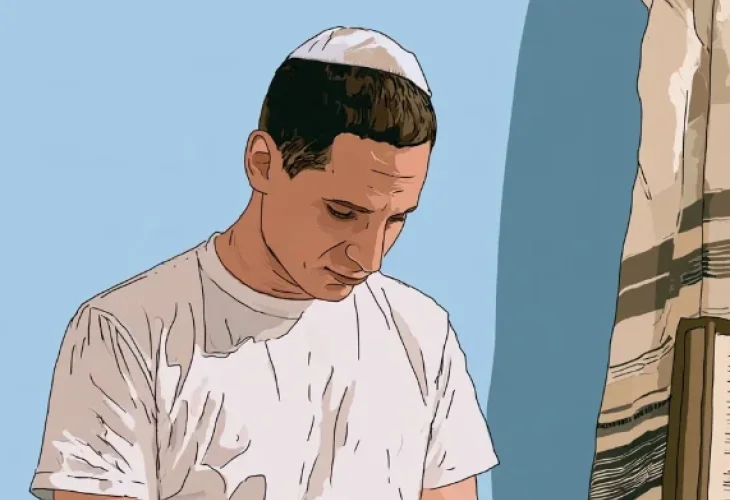
Regret and asking for forgiveness are not formalities we simply need to complete.
Some people approach Yom Kippur almost as though they are filling out a “forgiveness request form.” They bought a seat in synagogue, showed up for the prayers, said the right words, and now they can feel satisfied that they have done what was required.
But teshuvah does not work like submitting paperwork to a bank and waiting for the request to be approved.
It is not enough to say, “I hereby declare that I am returning in teshuvah. I now ask to be forgiven.” Perhaps that represents some small measure of teshuvah, but it is not the kind of transformation we are seeking on Yom Kippur. If we want to experience the promise of “For on this day He shall atone for you,” and truly seek the erasure of our sins, there are certain perspectives we first need to develop.
Speak to Your Father
The first is contained in two familiar words: “Our Father.”
When we ask Hashem for forgiveness, we are not speaking to a clerk processing our request. We are speaking to our Father. That means teshuvah must begin with recognizing Hashem as our Father and longing to restore our closeness to Him.
The Hebrew word for father, av, is closely connected here to ahav, meaning love, with only the softly pronounced letter hei separating them. The idea is that fatherhood and love belong to the same emotional world. When a child turns back to his father, he wants to awaken that love again.
So too, a person doing teshuvah should long to return to the love of his Father.
This gives deeper meaning to the words, “Forgive us, our Father, for we have sinned.” Here, “we have sinned” can be understood not simply as “we rebelled,” but as “we fell short.” The word chet can express a sense of lacking or missing something.
When King Solomon’s mother feared that Adonijah would take the throne after King David’s death, she said, “Then I and my son Solomon will be considered sinners” (I Kings 1:21). She did not mean that they would have committed a transgression. She meant that they would lose out.
In this sense, sin means losing something precious: closeness to our Father. A person who understands what a transgression has cost him feels that distance and longs for it to disappear.
That is why teshuvah can sometimes bring a person even higher than where he stood before the sin. When someone feels genuine shame over actions that created distance from Hashem and sincerely longs to regain His closeness and love, that longing itself can transform him.
The Jew Who Comes Only on Yom Kippur
This perspective can also change the way we look at another Jew.
Consider someone who does not observe Shabbat or other mitzvot, yet still comes to synagogue on Yom Kippur. Perhaps he cannot even follow the prayers in the machzor. It can be easy to dismiss that gesture and focus instead on everything he is not yet observing.
But the very fact that he came can be deeply significant.
His presence in synagogue may express something inside him that still longs to make peace with his Father. He may have a long road ahead, but turning up on Yom Kippur can itself reveal a desire to reconnect.
That is the perspective we should cultivate when asking Hashem for forgiveness. “Forgive us, our Father” means: Father, forgive us for allowing ourselves to become distant from You. We want to return.
But that is only half of the picture.
Hashem Is Also Our King
Immediately after saying, “Forgive us, our Father, for we have sinned,” we continue: “Pardon us, our King, for we have rebelled.”
Teshuvah requires us to see Hashem not only as “Our Father,” but also as “Our King.”
A father represents love and closeness. A king represents authority, law, and responsibility. We seek Hashem’s embrace as our Father, but we also stand before Him as subjects who recognize that our actions matter.
The world itself teaches us this principle. If someone jumps from a roof, gravity does not disappear because he dislikes its consequences. If someone runs across an open field during a lightning storm, the laws of nature do not adjust themselves to accommodate his wishes. The world operates according to an order established by its Creator.
The same principle applies to the laws of the Torah. “Our King” means recognizing that Hashem created a world of order in which our choices have consequences.
What Does It Mean to Stand Before a King?
This understanding of Hashem as King is meant to awaken awe.
King David says, “My flesh trembles from fear of You” (Psalms 119:120).
For people in earlier generations, the idea of standing before a king naturally inspired fear. A king represented real authority, and his laws were not treated casually. Someone who had violated the king’s command would not simply mumble an apology and assume everything was settled. He understood the seriousness of what he had done and begged to be pardoned.
That is the feeling Yom Kippur asks us to rediscover.
It is a day to say: Hashem, You are my King. I recognize that I did not always accept Your authority. I am ashamed of that distance and rebellion, and I am asking You to pardon me.
Both perspectives are essential. We approach Hashem with the longing of a child who wants to return to his Father and with the awe of a subject standing before his King.
The Avinu Malkeinu of Earlier Generations
How do we develop those feelings when the words “Our Father” and “Our King” have become so familiar that we can say them almost automatically?
The prayer of Avinu Malkeinu, recited during the Aseret Yemei Teshuvah, gives us an opportunity to practice.
A rosh yeshivah in Europe once explained that Jews of earlier generations approached Avinu Malkeinu differently. Today, our attention often goes immediately to the request at the end of each line: “Renew for us a good year,” “Send complete healing to the sick of Your people,” and the many other things we desperately want from Hashem.
But according to this account, earlier generations placed their greatest emphasis on the first two words.
“Our Father.”
“Our King.”
They would linger over those words and then say the request more quickly, because the greatest achievement was not simply asking Hashem for something. It was reaching the point where they genuinely felt that He was their Father and their King.
Saying Avinu Malkeinu With Feeling
This work does not have to be limited to the synagogue or even to Yom Kippur.
One practical approach is simply to repeat the words “Our Father” slowly and thoughtfully until their meaning begins to sink in. On another occasion, do the same with “Our King.” The point is not mechanical repetition, but giving ourselves enough time to actually hear and absorb what we are saying.
This approach is associated with Rabbi Yisrael Salanter, of blessed memory, who taught that repeatedly expressing a profound idea while listening carefully to the words can gradually help that idea penetrate the heart.
That may be one of the most important preparations we can make for Yom Kippur. Forgiveness is not a form to fill out, and teshuvah is not a box to check.
Before asking for a good year, healing, livelihood, or any of the other things we need, we can stop for a moment over the words that come first:
Our Father. Our King.
To know that we are returning to a Father whose closeness we long for, while standing before a King whose authority we take seriously. That is the inner work behind the words Avinu Malkeinu.

