

Magazine
“We Were Chosen”: Raising Two Sons With Special Needs
Yehuda and Maayan Steiman are raising two sons with special needs. They share the challenges, unexpected joy, and gratitude that shape their extraordinary family life.
- Michal Arieli
- | Updated
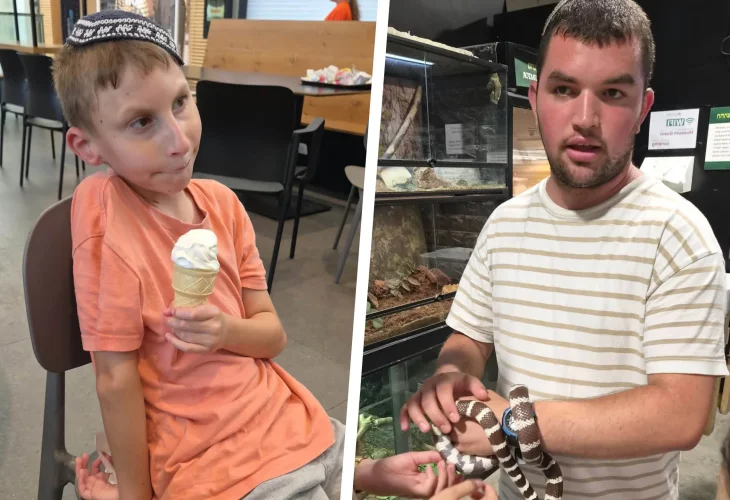 Uri and Netanel Steiman
“There are moments when you want to ask Hashem: ‘What is happening here? We already have one child with special needs. Why did we receive another one? How is it that one-third of our children have special needs?’”
Yehuda Steiman asks the question, but emphasizes that for him, it remains only that: a question.
“It is clear to me that Hashem does not owe me answers, and I am not looking for them either. I only know that my wife and I were chosen for a role that not many people experience: to be parents to Uri, 21, who has been diagnosed with high-functioning autism, and Netanel, 10, our youngest son, who is also on the spectrum.
“But Netanel’s story is more complex. In addition to autism, he was born with an extremely rare syndrome that took us a long time to discover. There are only about 500 children in the world with this syndrome, and because it is so rare, it does not even have a name, only a combination of English letters and numbers. As a result, he also has an intellectual disability.”
Around the Clock
Yehuda and Maayan Steiman became religious later in life after immigrating from Russia during the major wave of immigration in the 1990s. Maayan is a special education preschool teacher, while Yehuda has spent the past 15 years working as a Jewish researcher in rabbinical courts, following many years as a reserve military rabbi and five years working in the conversion court.
They are parents of six children and grandparents of four.
Looking back, they both say that raising Uri and Netanel has shaped their entire family life and affects nearly every part of their day.
When did you first realize that Uri and Netanel were developing differently from other children?
“Uri is our fourth child. Before him, we had three daughters, and I constantly noticed differences between him and his older sisters,” Maayan begins.
“I come from the field of special education, and there were things that raised red flags for me. Uri did not speak at all. He walked late, was toilet trained very late, made unusual sounds, and drooled. He also continued putting objects in his mouth long past the usual age.
“There was something else that actually charmed us: he loved flipping through books at lightning speed. We thought it was something special, were amazed by it, and kept buying him more and more books.
“When he was two, his preschool teacher told us that he could no longer attend because he was ‘destroying things and disturbing the other children.’ I had no choice. I left my job, stayed home with him, and started looking for a solution.
“Back then, more than 20 years ago, there was far less awareness and support surrounding autism, and we had no one to guide us through the process. In the meantime, I began submitting paperwork for occupational therapy and speech therapy. At age three, we managed to enroll him in an inclusive special education preschool.
“There was still no diagnosis, but for the first time, we felt that there was a team surrounding our child and supporting us.
“I remember that during one meeting, the preschool staff asked us, ‘What are you doing for yourselves to recharge and regain your strength?’
“We answered honestly: ‘Nothing.’
“We were busy around the clock caring for Uri and our other children. The staff told us, ‘You have to find something for yourselves.’ That made me think about what I enjoyed, and I eventually began taking a course that gave me tremendous fulfillment. We also received close parental guidance that helped us enormously.”
Yehuda continues: “Uri attended special preschools and later a special school in Jerusalem. Fifteen years ago, we moved to Lod, and he transferred to a special education school in Tel Aviv for children with learning disabilities.
“What is interesting is that despite being surrounded by professional staff throughout those years, no one realized that he had autism.
“Only at a relatively late age was Uri diagnosed with high-functioning autism. From that point on, it became easier to find programs suited to children on the spectrum. In yeshiva, he also studied in a communication class.
“A year and a half ago, he finished yeshiva, and we found him a supported housing program in Kiryat Malakhi run by the organization Yad LaYeled HaMeyuchad. He lives there with other young men in similar situations, works in a factory in the mornings, and receives professional support in the afternoons.
“He comes home once every two weeks for Shabbat. Of course, those weekends are challenging for all of us and keep us busy around the clock, but we all love when he comes home, and he is very happy too.”
Two Extraordinary Worlds
What about Netanel? When was he diagnosed?
“With Netanel, we already knew firsthand what special needs meant,” Yehuda replies. “Naturally, we were more alert, and when concerns began to arise, we immediately made appointments for testing.
“But then we discovered that his situation was more complicated because doctors could not diagnose him. We went from one test to another until we were finally referred for an exome test, which looks for genetic changes that may explain complex medical or developmental conditions. That was when his rare syndrome was diagnosed.”
How did you react?
“It felt like a five-ton hammer,” Yehuda says. “How could it be that out of six children, two have special needs?
“At the time, we still did not understand the implications of Netanel’s syndrome, and even today, the picture is not entirely clear because there is so little research on it. We were told that, with all the pain involved, a child with this condition may reach a developmental level of around eight or nine years old. That is frustrating, of course, and it also demands a great deal from us.”
At the same time, there is still Uri to care for.
“Today, Uri looks like an adult on the outside. He is tall and has a beard,” Yehuda says. “But his behavior is closer to that of a 10- or 11-year-old, and that is where many of the challenges begin. We cannot simply leave him on his own. When Uri and Netanel are home, caring for them requires constant attention.”
“They expand our patience,” Maayan adds. “You constantly have to be creative, reinvent the family schedule, and think about how to care for everyone while giving each person what they need.
“My dream is to write a book of anecdotes, tips, and uplifting insights for other parents raising children with special needs. Something that could strengthen them and show them that despite all the challenges, it is still possible to enjoy life, experience joy, and be happy.”
What About the Other Children?
Where do your other children fit into such a demanding family dynamic?
“It is genuinely complicated,” Maayan says.
“For example, when my third daughter was about to get married, I asked her how I could help her. She answered, ‘Mom, for the next two weeks, I’m asking you not to be only Uri and Netanel’s mother. Let me be your daughter too. Spend time with me and be with me without making me feel, as I always do, that I’m on the sidelines.’
“Another time, one of the girls asked me, ‘Why do you know Uri and Netanel’s ID numbers and every personal detail about them by heart, but not ours? Do we have to be that special for you to know our details too?’
“I usually do not respond to comments like these, but I understand the message.
“After consulting with an emotional therapist, I came to understand that there are times when it is appropriate to put Uri and Netanel’s needs aside for a moment and focus specifically on the other children.
“The same is true of our grandchildren. Sometimes I bring in a babysitter to watch Netanel so I can spend time caring for my grandchildren, because I realize that at that moment, they need me too. It is a mental switch I have made in recent years, and I think it has brought all of us to a much better place.”
Are you always able to see the good?
“Of course not,” Maayan says. “But thank G-d, I have strong support. When I am feeling down, my husband encourages me and sometimes sends me to my room to rest while he stays with the children. When he is struggling, I try to support him.
“One of the things he regularly tells me in the evening is, ‘Think of five things you want to be grateful for today.’
“It turns out that it is not so difficult, because thank G-d, we are surrounded by so much goodness, joy, and blessing. Even during difficult periods, such as when Uri was expelled from his program, during COVID, or during the war, we always managed to see the good things too. That gives us tremendous strength.”
Falling Down and Getting Back Up
When are the most difficult times?
“On holidays and Shabbat, of course,” they both answer.
“During the week, there is a routine,” Yehuda explains. “But on Shabbat and holidays, we are home with the children for long stretches of time, and that can be extremely demanding. Vacations are difficult in general, especially because we cannot simply go on trips or vacations without constantly thinking about how to handle difficult situations and calm the children.”
“For quite a few years, Seder night was the most challenging night of the year for us,” Maayan adds.
“Sometimes my husband could barely make Kiddush over the wine before one of the children would erupt in screaming and crying, making it impossible for us to sit around the table for even a moment.
“Thank G-d, in recent years things have improved greatly, but we still cannot predict what will happen. There can always be outbursts, screaming, and even self-biting, while we try to calm them or distract them and nothing seems to help.”
What gives you strength during those moments?
“It is a question I am asked often, both in lectures I give and by friends whose lives are completely different from mine,” Yehuda says.
“I explain that we did not choose to be parents of children with special needs. We were chosen.
“Obviously, if someone had asked me beforehand whether I wanted my children to be typically developing or to require special education, I would have chosen typically developing children. But that was not my choice.
“I once heard an interview with a journalist who has an autistic child. He said that from his experience with this world, situations like these can either make parents stronger or place enormous strain on their relationship.
“In our case, we certainly did not ask for this. But after raising two children with special needs, there is no question that we have become stronger.
“We are also very aware of our need to support one another. We regularly go out once a week for a date at a coffee shop. We even went abroad for a few days, just the two of us, because we understood how important that was.”
And who stays with Netanel?
They smile.
Their older children do.
“The children understand that we need time to breathe and take a break from our responsibilities, and they give us that wholeheartedly,” Maayan explains.
“For example, when we traveled abroad, our 18-year-old son came home especially from yeshiva, and our married daughters came to help as well.
“There is no question that this challenge has been difficult for them too, but it has also matured them in ways that are hard to describe. All of our daughters now work in professions connected to special education and at-risk youth.
“For us, that shows that the situation at home did not only make them stronger. It also opened their eyes and hearts to the people around them. They have gained from it too.”
“One thing that helps us enormously is the incredible community in Lod that surrounds us with so much support,” Yehuda adds.
“Uri is often hosted by families of friends on Shabbat and holidays, which gives us some quiet and a little room to breathe. Both Netanel and Uri are part of a special Bnei Akiva group for children with special needs on Shabbat and at other times.
“The counselors there are amazing. They know how to embrace them and accept them. They give them so much.”
Brothers on the Spectrum
What is the relationship between Uri and Netanel like?
Yehuda and Maayan smile and show a heartwarming video.
“My dear brother, I love you so much,” Uri tells Netanel before wrapping him in a hug.
“They have an incredible connection,” Maayan says. “It is interesting to see that when my husband tells stories to our younger son and puts on little performances for him, Uri always comes over and asks to join too. It is not only because the performance interests him. They simply love being together.”
What are those performances about?
“For a long time, I have thought that I should study medical clowning,” Yehuda replies, completely seriously.
“I discovered that in some of the most difficult and challenging situations, one thing that can help is turning the challenge into something funny and enjoyable. I invent characters for the children, and they definitely help me communicate messages, put them to bed, and persuade them to do tasks they do not always feel like doing.”
“There is a great deal of joy in our home, thank G-d,” Maayan adds. “At the same time, there is also struggle, and those two things do not contradict each other.
“I became religious later in life, and one of the things I have internalized is that there is no point in demanding answers to everything, because we do not have the ability to understand everything.
“Does that mean it is not frustrating? Of course it is frustrating. But I am not going to call the Creator of the universe and ask, ‘Why did You give me another challenge?’ because I do not run the world.
“I really do not like the worn-out phrase, ‘If Hashem gave you this kind of suffering, you must be strong.’ All of us would rather not have to be strong and not have to experience suffering.
“I prefer to see it differently: the souls of these children chose us, and all that remains for us is to summon all the patience we have for them, think positively, and believe that alongside the complexity and the challenges, Hashem also makes sure to give us joy.”
She pauses for a moment.
“I can testify to that firsthand. Thank G-d, we have been blessed with so many good things that not everyone merits. So how could we not be grateful?”

