

Sukkot
What Is a Chazon Ish Sukkah, and Do You Need One?
Why are some sukkahs built without nails, screws, or metal supports? Discover the halachic debate behind the Chazon Ish sukkah and whether it is actually required.
- Yehosef Yavetz
- | Updated
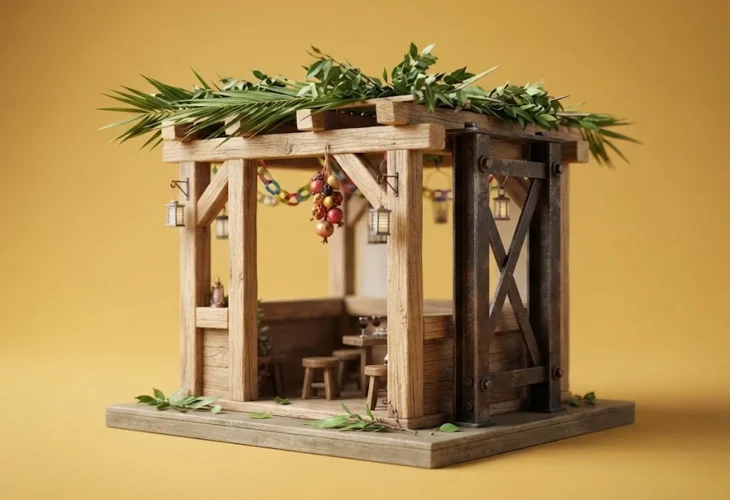
Have you ever seen a “Chazon Ish sukkah”?
At first glance, you might notice something unusual: there are no nails, screws, metal brackets, or plastic parts holding it together. Instead, the structure is designed so that the s’chach is supported only by materials that grow from the ground and cannot become ritually impure.
Why go to all that trouble? Is it required by halacha, an extra stringency, or simply a particular way of building a sukkah?
The answer begins with a debate in the Mishnah.
What can support the s’chach?
The Mishnah records a disagreement among the Tannaim over whether s’chach may be supported by something that can become ritually impure.
One example involves metal skewers. According to Rabbi Yehudah, something capable of becoming ritually impure should not be used to support the s’chach. The Sages, however, permit it.
The Mishnah gives another example involving the beds used at the time. These beds had four tall posts, with the sleeping platform attached partway up. The portions of the posts extending above the bed could be used to support a canopy or even another platform.
What if someone placed s’chach across those posts and effectively turned the bed into a sukkah?
Rabbi Yehudah does not permit it, while the Sages do.
The halacha follows the Sages. Strictly speaking, therefore, the s’chach may be supported by metal or another material that would itself be invalid for use as s’chach.
Nevertheless, as a preferred practice, Rabbi Yehudah’s opinion is taken into consideration, and many try to avoid supporting the s’chach directly with a material that would not itself be valid as s’chach.
This is where the Chazon Ish sukkah comes in.
What exactly counts as a support?
The question is how far this preferred practice extends.
According to the Mishnah Berurah, the primary concern is the direct support beneath the s’chach. For example, if the s’chach rests on wooden beams that are themselves suitable for s’chach, this satisfies the preferred practice even if those beams are supported by another material.
The Chazon Ish, however, takes a more stringent approach.
He extends the concern to what is known as a “support of a support.” In other words, it is not enough to consider only what directly holds up the s’chach. We also consider what holds up that support.
Imagine that the s’chach rests on a wooden beam. The beam itself is suitable for s’chach, but it rests on a metal structure. According to the Chazon Ish, the metal is still indirectly supporting the s’chach.
The same issue can arise when wooden walls or beams are held together with screws, nails, or other materials that can become ritually impure.
This is why a sukkah built according to the Chazon Ish can look so different. The goal is to avoid relying not only on an invalid material as the direct support for the s’chach, but also as the support beneath that support.
Does every sukkah need to be built this way?
No.
Strictly speaking, a sukkah does not need to follow the Chazon Ish standard in order to be kosher. Provided that it meets the other requirements of halacha, the basic ruling follows the Sages.
Someone who wants to follow the more stringent practice, however, has different considerations depending on which opinion they follow.
According to the Mishnah Berurah, one should make sure that the beams directly supporting the s’chach are made from material that is itself suitable for s’chach, such as wood.
According to the Chazon Ish, the concern extends further, and one should also avoid having those supports depend on metal or other materials that can become ritually impure.
Can a Chazon Ish sukkah contain nails?
Interestingly, even a Chazon Ish sukkah can contain nails or other metal pieces when they are used only for additional reinforcement.
The important question is whether the sukkah would remain standing without them.
If the structure is already stable enough to withstand an ordinary wind and the nails merely provide extra reinforcement, they may be used. If the metal is actually necessary to keep the structure standing in an ordinary wind, however, the Chazon Ish maintains that one should be stringent.
What about a concrete balcony?
The Chazon Ish raises another fascinating question.
Many sukkahs are built on balconies or other concrete structures. But reinforced concrete contains iron. If the concrete supports the wall, which supports a wooden beam, which in turn supports the s’chach, isn't the iron inside the concrete ultimately part of the support system?
The Chazon Ish offers grounds for leniency in this case.
One possibility is that because the iron is embedded inside the concrete and cannot be seen, the concern does not apply in the same way. Another is that the iron can be considered secondary to the concrete surrounding it.
The leniency, however, relates specifically to iron embedded within concrete and should not automatically be extended to exposed metal elsewhere in the structure.
So if you come across a sukkah built entirely from wood, without visible screws, brackets, or metal supports, there is probably a reason behind its unusual construction.
It may be a Chazon Ish sukkah, built to satisfy not only the basic requirements of halacha, but also a more stringent understanding of what may support the s’chach.

