

Raising Children
Tired of Reminding Your Child to Pray? Try This Instead
How can you raise children who pray because they want to, not just because you reminded them? A parenting expert explains how inner motivation develops.
- נועה הראל
- | Updated
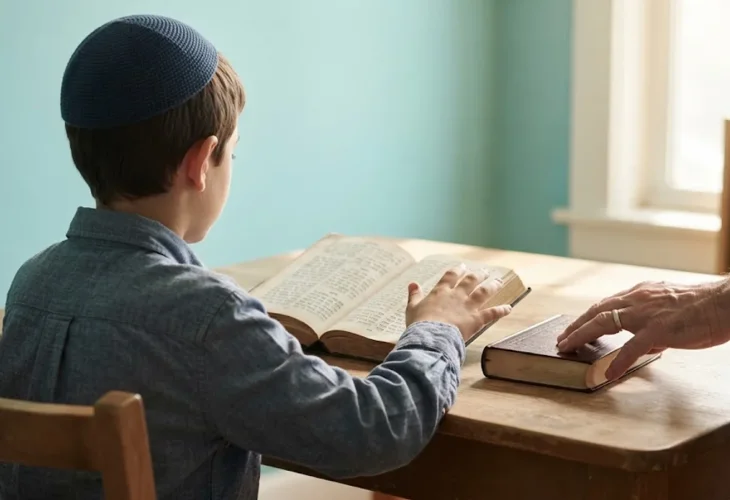
During the holiday season, we often find ourselves reminding our children to pray. Sometimes it feels as though, without our reminders, it simply won’t happen. How can we teach children to pray from an inner desire and a sense of personal responsibility?
It is a familiar situation, and one that often becomes particularly noticeable during vacations and holidays. Suddenly, children who usually follow a routine may forget to pray or wash their hands, and parents find themselves reminding them again and again.
It can easily lead to a worrying question: What did we do wrong?
The first thing to understand is that this behavior does not necessarily indicate an educational failure. Instead, it gives us an opportunity to clarify what our role as parents actually is and what we are trying to teach our children.
It helps to begin with one simple distinction:
Our responsibility is to educate. Our child’s responsibility is to gradually learn to take responsibility for what we have taught them.
These are two separate parts. A child’s choices do not automatically determine whether a parent has fulfilled their role.
Children learn from the atmosphere of the home
As parents, our responsibility is to teach, set a personal example, and create a home environment that reflects the values that matter to us.
And here is the good news: We do not have to constantly manufacture educational moments. Much of this education happens naturally.
In a home where prayer is valued, children encounter that message throughout everyday life.
Something difficult happens, and we pray for help. Something is lost, and we pray that it will be found. It is time to pray, and Dad makes an effort to find a minyan. On Friday evening, Mom pauses amid all the preparations and takes a quiet moment by the candles to make a personal request.
These are powerful messages that children absorb simply by living in the home.
There is no need to announce, “Look, children, this is how important prayer is.” When the value is genuine, they see it for themselves.
The child’s role, according to their age and ability, is gradually to learn, practice, and eventually take responsibility for these values independently.
When should we stop doing it for them?
With younger children, this distinction has a very practical application.
Suppose we decide that washing their hands is still our responsibility. In that case, we can simply go over and help them wash. There is no need to repeatedly call out, “Did you wash your hands yet?”
We help them do it as part of caring for them, just as we help a young child brush their teeth.
But eventually, the child becomes capable of doing it independently. At that point, we can begin transferring responsibility.
We teach them what to do. We make sure the water and washing cup are accessible. We clearly explain what is expected.
From there, we may choose to remind them occasionally, “Did you wash your hands?” Or, depending on the child’s age and maturity, we may simply trust them to remember.
The important principle is this: We should not try to take control of something that is no longer our responsibility.
You cannot pray for your child
The same principle applies to prayer.
We can explain why prayer matters. We can teach our children how to pray, tell stories that help them develop a connection to it, set a personal example, and remind them when it is time to pray.
We can also listen when they tell us that prayer is difficult and think together about what might make it easier or more meaningful.
All of these things are within our control.
What we cannot do is pray in their place.
At some point, prayer has to become theirs.
How does inner motivation develop?
A genuine desire to do something does not usually appear all at once. It develops gradually as children begin taking ownership of their choices.
The process can look something like this:
- I realize that the responsibility is mine. The consequences of my choice belong to me.
- I begin investing effort. Once I have chosen to do something myself, I naturally begin thinking about why that effort matters.
- I develop my own understanding of the value. Instead of doing something only because my parents told me to, I begin connecting it to ideas and values that make sense to me.
- The value gradually becomes mine. What began as an expectation from the outside can eventually develop into something I personally connect with and want.
This process takes time.
And importantly, it requires enough space for the child to actually take ownership.
Your child’s choices are not a parenting report card
Understanding this distinction can also relieve some of the guilt parents carry.
If your child does not do something you taught them to do, it does not automatically mean you failed.
Of course, we can always ask ourselves whether there is something more we could teach, explain, model, or change. Perhaps the child needs additional guidance. Perhaps something is making prayer difficult. Perhaps we need to reconsider how we are approaching the subject.
But we do not have to turn every choice our children make into a test of our parenting.
Our job is to fulfill our part consistently, lovingly, and calmly.
The clearer we are about what belongs to us and what gradually belongs to our children, the more room we give them, with Hashem’s help, to take responsibility for their own choices.
And ultimately, that is what we want.
Not children who pray only because someone reminded them for the fifth time, but children who gradually take the values we have given them and make those values their own.
Noa Harel is a parenting facilitator, couples counselor, and consultant in personal awareness and relationships.

