

Magazine
Listen First: The Rabbi Who Invites People to Ask Anything
From converts and teenagers to skeptics and people angry at God, Rabbi Elchanan Shoff has learned that answering people often begins with hearing what lies beneath their questions.

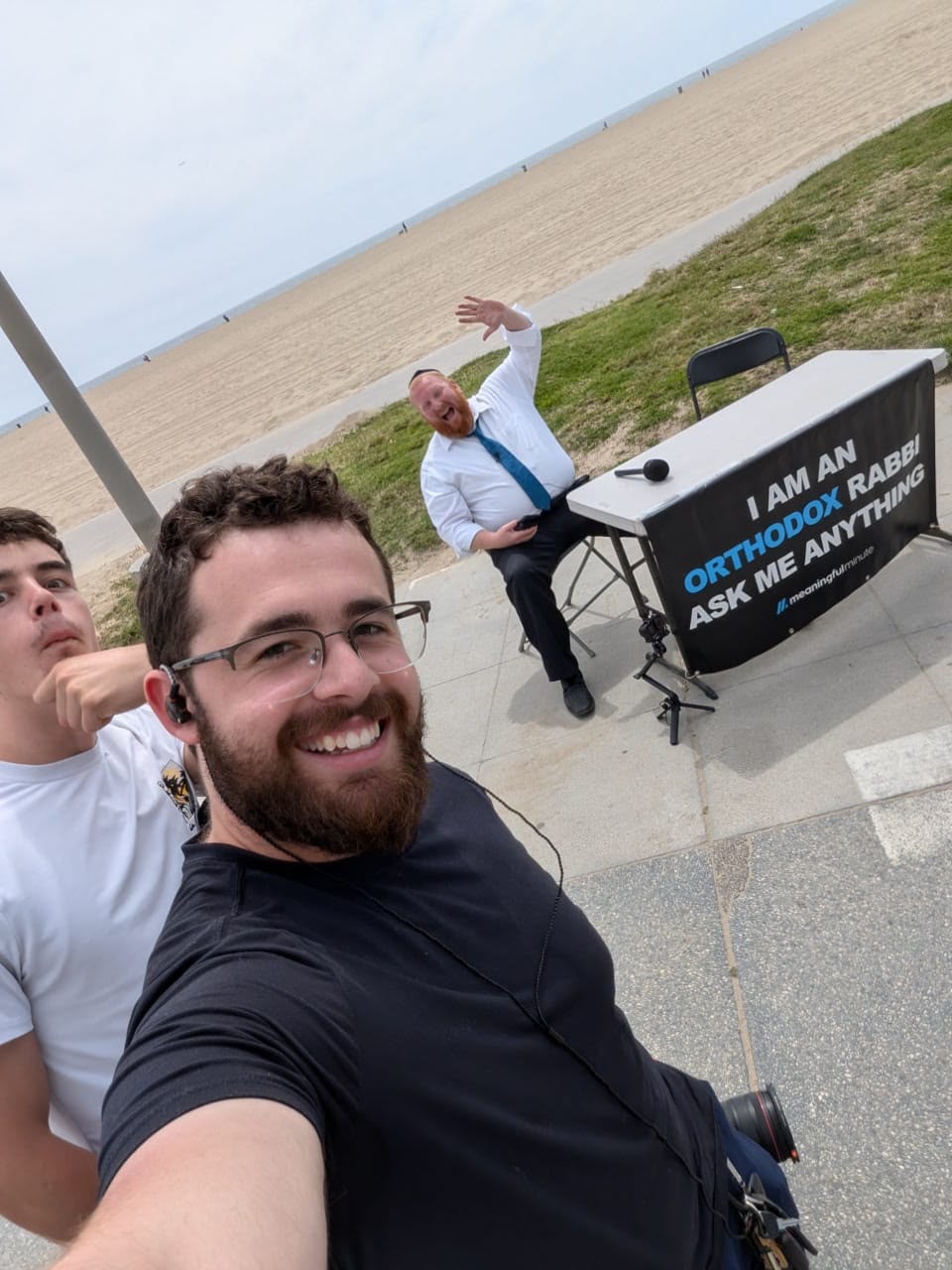
Rabbi Elchanan Shoff is used to hearing questions that people do not always dare to ask a rabbi. They approach him during open encounters in the marketplace and other public spaces and speak to him about faith, doubt, anger at God, painful experiences, conversion, antisemitism and the feeling that, at times, there is simply no place for them in the Jewish community. Shoff, 42, a rabbi at a synagogue in Los Angeles and head of The New Yeshiva High School of Los Angeles, invites people to come over and ask him almost anything.
Does he really believe he has an answer to every question? Quite the opposite. “When I say, ‘Ask me anything,’ what I mean is, ‘I’m not afraid to be as honest with you as I can be,’” he explains. “A lot of the time, I simply don’t know the specific answer to the question, and it’s okay to say, ‘I don’t know.’”
For Shoff, a rabbi who is willing to admit that he does not know something is not failing. Sometimes, that admission creates room for a more honest conversation. “The goal is not to solve every question that exists in the world,” he says. “There are subjects where I do have thoughts that may help a person see something from a different angle, and in those cases, I share them.”
Over the years, those questions have led to conversations he has never forgotten. One was with Cory, a convert who had traveled a long road to join the Jewish people, yet found himself feeling painfully alone. “During the conversation, he suddenly started crying and told me how lonely he felt, and just then a group of American yeshiva students who knew me happened to walk by. I called them over and said, ‘This is Cory. He is a holy convert who is trying so hard, but sometimes he feels very alone. Tell him what you think of him.’”
What happened next was completely unplanned. The students hugged him, kissed him, danced with him and told him how deeply they admired what he had done. One told Cory that although he himself had spent years trying to learn, pray and do the right thing in yeshiva, he had never done anything as difficult or courageous as choosing to convert.
“I know that Jews have a special love and concern for one another, but to see that kind of ahavat Yisrael, so genuine and so powerful, still gives me chills to this day. We really do love one another. We really do care about one another.”
“That Distance Strengthened My Relationship With My Parents”
Perhaps it is no coincidence that Shoff believes so strongly in listening and in making room for the person in front of him. He was born in Los Angeles to parents who had both become more observant. Their journey toward a fuller life of Torah and mitzvot shaped the home in which he grew up.
“Our home was always full of guests,” he recalls. “I can remember only a handful of Shabbatot when we didn’t host people. For years, almost every Shabbat, there were people sitting around our table whom we didn’t know. Some came only for the meal, others stayed overnight, and sometimes I had to give up my room and sleep on the couch so that one of the guests could have it.”
His parents drew spiritual inspiration from Rabbi Daniel Lapin, who taught them not only how to live a Jewish life marked by growth and positivity, but also how to pass what they were learning on to others. “People around us were constantly becoming more observant and taking on additional mitzvot with enthusiasm,” Shoff recalls. “So my childhood was filled with a very positive experience of Judaism.”
At 14, he left home to attend a yeshiva on the other side of the United States. Rather than remembering that period primarily as lonely, he remembers the kindness shown to him by people he barely knew. “Families opened their homes to me without making me feel pitied or different,” he says. “And in retrospect, that distance actually strengthened my relationship with my parents. I remember calling my mother several times a week and having long conversations with her.”
Today, as a father of seven, he tries to pass that lesson on. “We all encounter people who may be very lonely. If you are a teacher, pay attention to the new student. Look for the person on the margins, the one who still isn’t sure whether he has a place, and give him that attention.”

“If You Want to Help Someone, He Needs to Feel That You Are on His Side”
The loneliness Shoff encounters is not always social. Sometimes a person is surrounded by family, friends and community, yet feels completely alone inside a question he is afraid to ask or a pain he fears no one will understand. In those moments, Shoff says, the most important thing is not to rush to provide an answer, but first to give the person space to speak.
He learned that lesson partly from his own life. “I haven’t had too many times in my life when I felt terribly misunderstood, or when I desperately needed someone to listen,” he says. “But there have been times when people simply weren’t willing to let me speak. They judged me and wouldn’t let me defend myself, and that was very, very difficult.”
Those experiences taught him the value of simple listening. “I learned the enormous value of listening to a person and validating them, and doing nothing more than that. That itself is a kindness. I know from my own life how much it means to have somebody to talk to, somebody who understands you and simply listens. I try to be that person for others.”
Some of the conversations he encounters touch the most sensitive places of faith and pain. There are people who tell him plainly, “I’m angry at God.”
When someone tells you that, what do you hear behind those words?
“It may not be a particularly strong question intellectually, but it is very real emotionally. So in my view, it should first be addressed on an emotional level.” Shoff explains that from his Orthodox perspective, anger at God does not make intellectual sense, but that does not mean a person’s emotions should be dismissed. “If a person genuinely feels that way, you cannot dismiss what he is feeling. You can help him, but the help needs to be emotional rather than intellectual. To me, this is not an intellectual question. It is pain that needs to be addressed.”
The same principle applies when someone tells him he was hurt by a yeshiva, community or religious institution. “The point is not to defend institutions. It is to hear people’s pain, to love them and to truly listen. If you want to help someone, he needs to feel that you are on his side.”
That does not mean every statement must go unchallenged. Shoff distinguishes between public and private conversations. If someone says in front of others that all yeshivas are terrible, for example, he may acknowledge the person’s painful experience while also noting that many wonderful yeshivas exist. Privately, however, he does not feel the same need to immediately balance every statement. “There I can simply listen, empathize and make room for his pain. He is not necessarily describing objective reality, but rather the way he experienced it, and that experience is real to him.”
That level of empathy can also be exhausting. “I really do enjoy connecting to people and feeling what they’re feeling, and for that reason, this work can be exhausting,” Shoff says. “If I sit with a married couple that is struggling, or with a person telling me about the challenges they are going through, I can feel very tired, emotionally and even physically, by the end of the interaction.”
Professionals have told him that over time he may learn to compartmentalize. He has no desire to do so. “I’m not looking to disconnect myself, and I’m not willing to. I’m not a full-time therapist, and I don’t think I need to learn that skill. I value the ability to truly empathize with people. Still, that is one of the bigger challenges of this work.”
How Did the Teenager Who Threw a Rock at Him Become One of His Biggest Supporters?
Shoff learned the power of personal attention long before he became a rabbi. While working as a counselor at summer camp, an older teenager began taunting him relentlessly. He insulted him, followed him, hit him and once even threw a rock at him.
One day, after yet another provocation, Shoff responded with something unexpected. “It’s lucky that I like you so much, otherwise I would really have to beat you up.”
Everything changed. The teenager who had been so hostile quickly became one of Shoff’s strongest supporters. Only later did he understand what had been hiding behind the boy’s behavior. “The kid had almost never heard a significant adult tell him that he liked him. Not his mother, not his stepfather and not his teachers. That was all he had been desperate to hear.”
For Shoff, the incident became a lesson in education. The teenager could have been punished for throwing the rock, but punishment would not necessarily have touched what he was missing. “Human beings are not laboratory rats whose behavior can easily be predicted. We are incredibly complex.”
That outlook guides his educational work today. Shoff is involved in establishing a new yeshiva high school and strongly rejects the idea that one educational model can suit every child. “The idea that one size fits all is simply nonsense,” he says. “A particular yeshiva can be wonderful for one boy and completely wrong for another. You cannot force everyone into the same mold.”
He encourages parents to ask a different question. Instead of focusing on the most prestigious institution, they should ask where their child will flourish. “There is not a single teenager who does not need to feel valued, to be seen as a treasure and to be surrounded with love. Every young person will benefit from loving parents, from an aunt or uncle, from a rabbi or teacher who cares about him, loves him and brings him closer to Torah.”

“What Is This Person Really Asking?”
This may also explain the way Shoff approaches the questions people bring him. Even when someone arrives with a halachic, theological or painful question, he believes the question itself may be only part of the story. Behind it is a person with fears, disappointments, hopes and experiences that may not emerge in the first sentence.
For Shoff, that principle extends beyond the Jewish community. During one of his “Ask Me Anything” encounters in the marketplace, filmed and published on the Meaningful Minute YouTube channel, a person of another faith approached him to speak about belief and a relationship with God.
“One thing that stayed with me from that conversation and others like it is that our mandate in Tanach is to be a light to the nations,” he says. “If we truly care about being a light to the nations, that means it is important that every person in the world knows about Hashem, is able to ask questions and is able to connect, because Hashem is ready to listen to the prayer of any person.”
Shoff cites the Radak’s commentary on the verse in Psalms, “Hashem is close to all those who call to Him, to all who call to Him sincerely.” According to Shoff, the commentary emphasizes that this applies to a person of any nation. “When I speak to any human being, even someone of another faith, I try to remember that if they authentically turn to the one true God, Hashem is interested in hearing from them. It is an achievement for them, and it is a great opportunity to help any human being connect to Hashem.”
After years of conversations with teenagers, converts, searching Jews, people hurt by religious institutions, believers, skeptics and people angry at God, Shoff says he has learned one central lesson: sometimes a person asks one thing but is really trying to find out something entirely different.
A question about faith may really mean, “Do I still have a place?” An angry argument may be hiding a deep wound. Criticism of a religious institution may actually be a plea for someone to acknowledge that the person was hurt. And a request for a Torah answer may conceal an even simpler need: for someone to listen without judging, becoming alarmed or rushing to correct.
“The goal is not to answer questions, but to answer people,” Shoff says. “To try to dig deeper and discover: What is this person really asking? What is the deeper question hiding behind the question that surfaced?”
“Not every question has to end with a perfect explanation, and not every conversation has to end with the person being convinced. Sometimes, the simple fact that someone felt truly heard is already the beginning of something. Care about the person. Listen to the person,” he says. “Isn’t that what all of us are looking for?”

