

World News
Iran’s President at the UN: “We Will Not Yield to Military Force”
Iranian President Masoud Pezeshkian told the UN that war was imposed on his country, while sharply criticizing Israel and the United States. He did not rule out a diplomatic solution and declared: “We will not allow others to use the Strait of Hormuz.”
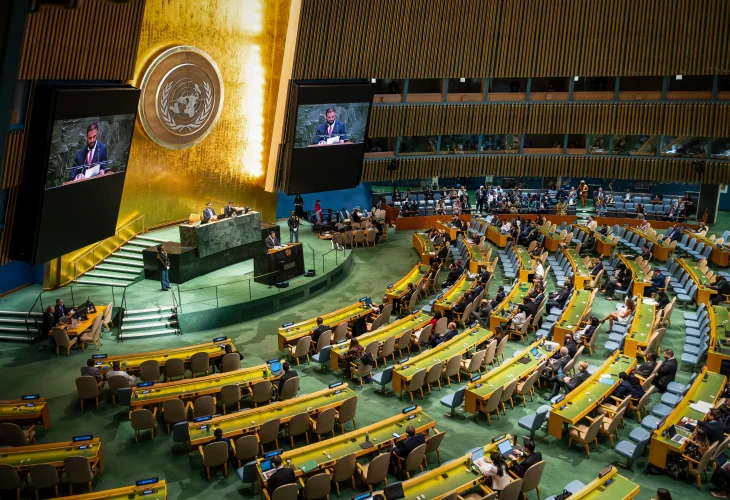 UN General Assembly, archive (Photo: Liri Agami, Flash90)
Iranian President Masoud Pezeshkian addressed the UN General Assembly in New York today (Wednesday). At the center of his speech, he laid out Tehran’s position on the war and sharply criticized Israel and the United States. Pezeshkian claimed that “the war was imposed on us” and that, in its response, Iran avoided deliberately targeting civilian sites.
Pezeshkian also addressed U.S. President Donald Trump’s speech the previous day. “He described us yesterday as terrorists, but we were the victims of terrorism,” he said. The American delegation left the General Assembly hall at the start of his speech.
Pezeshkian later addressed the killing of the former supreme leader, Ali Khamenei, claiming that he “was murdered without any legal justification.” The Iranian president also sought to draw a comparison between the treatment of Israel and that of his country: “They have an atomic bomb, and we have inspectors. They kill, and we are punished with sanctions.”
Another part of the speech focused on the Israeli-Palestinian conflict and the war in Gaza: “As long as the occupation continues, the resistance will continue, and if it is harmed in one form, it will grow with even greater strength in another form.”
He later criticized Israel: “They assassinated Ismail Haniyeh on the day I was sworn in. Israel carries out assassinations without restraint. They killed tens of thousands in Gaza; tens of thousands have been displaced. They are committing genocide.”
Alongside the sharp criticism, Pezeshkian presented Iran as interested in a diplomatic solution to the conflict, while stressing that it would not surrender to military pressure: “Are we destabilizing the region? Those who attack and go to war are the ones destabilizing the region.”
At the end of his remarks, he addressed the dispute over the Strait of Hormuz and sent a message to the United States: “We will not allow others to use the Strait of Hormuz while Iran is denied the ability to benefit from it.”
U.S. Secretary of State Marco Rubio responded to his remarks and sharply criticized Tehran: “I think massacring tens of thousands of your own people is a violation of UN principles. I think funding terrorist organizations in neighboring countries to attack them is a violation of UN principles. I don’t know from what position Iran thinks it can lecture anyone about human rights when it violates them all the time, funds terrorist organizations, and massacres its own people.”
Rubio also addressed the nuclear issue: “They do not want nuclear energy. There are dozens of countries producing it around the world that can supply it. They want their own enrichment facilities; they have repeatedly researched nuclear weapons programs. The world’s leading sponsor of terrorism cannot have nuclear weapons; it is unacceptable.”

