

Wonders of Creation
What Are the Waters Above the Heavens in Genesis?
Explore the biblical creation account through Jewish commentaries, Kabbalah, and scientific theories about Earth's early history
- Daniel Blass
- | Updated
Alex asks: “Hello, I have always struggled to understand the description of the separation of the upper waters, the waters above the heavens. Is this description meant to be taken literally?”
Hello, Alex, and thank you for your question.
Parshat Bereishit contains many profound secrets that were traditionally revealed only to select students (Mishnah Chagigah 2:1). Kabbalah explains the separation of the waters as a division established by God between the spiritual and physical worlds, which were originally connected.
However, these deeper explanations do not contradict a literal interpretation of the text. The Torah contains multiple layers of meaning, collectively known as Pardes: Peshat (literal meaning), Remez (allusion), Derash (interpretive meaning), and Sod (mystical meaning). The verses can therefore convey spiritual teachings while also offering insights into the physical world.
The Earth Was Originally Covered in Water
For example, the Torah describes the Earth at the beginning of creation as entirely surrounded by water: “And darkness was upon the face of the deep, and the Spirit of God hovered over the face of the waters” (Genesis 1:2).
Scientists have proposed a similar possibility, that the early Earth may once have been completely covered by a global ocean, without any exposed landmasses. Such a world is sometimes referred to as an ocean planet.
Where did all that water go? And how did dry land emerge if the entire Earth was originally covered by water?
The Torah tells us: “And God said, ‘Let there be a firmament in the midst of the waters, and let it separate water from water.’ And God made the firmament” (Genesis 1:6–7).
The Hebrew word rakia, commonly translated as “firmament,” can be understood as an expanse or space, which Ibn Ezra associates with the air. In modern terminology, the closest equivalent would be the atmosphere.
According to one proposed literal interpretation, God caused enormous quantities of water to evaporate and escape into outer space. Today, we know that water exists in frozen form in space, including in comets.
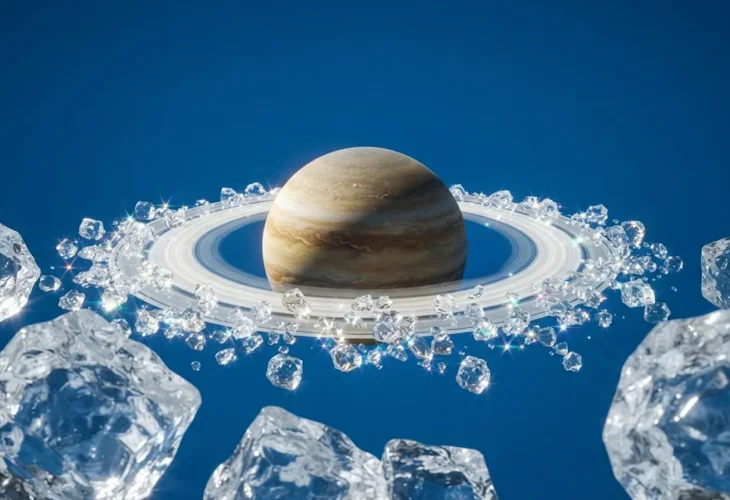
An interesting comparison can be made with Saturn, a planet in our own solar system.
Could the Waters Above the Firmament Refer to Water in Space?
Saturn is surrounded by a magnificent system of rings composed of countless small pieces of ice. In a sense, Saturn has “waters above the firmament” in the form of frozen water surrounding the planet.
From this perspective, the biblical verses could suggest that Earth once had conditions resembling those of Saturn.
It is also possible, according to this interpretation, that after the Great Flood, water escaped back beyond the atmosphere and eventually traveled into distant space in the form of comets. Today, thousands of comets have been identified in our solar system, including more than 5,000 cataloged objects.
Following the creation of the firmament, the Earth was no longer submerged beneath the same deep waters that had originally covered it. The remaining water could then gather into oceans, allowing dry land to appear.
As the Torah states: “And God said, ‘Let the waters beneath the heavens be gathered into one place, and let the dry land appear.’ And it was so” (Genesis 1:9).
The Formation of the Continents and the Torah's Description of One Landmass
Interestingly, scientists have observed that the continents appear to fit together, providing one line of evidence that they were once joined into a single enormous landmass. This ancient supercontinent is known as Pangaea.
The Torah anticipated this scientific discovery by describing a single original landmass from which the continents eventually separated. The Zohar offers an intriguing description: “The waters brought forth one single land, and from it seven lands were formed” (Zohar Chadash, Volume 1, Parshat Bereishit, page 21).
According to this approach, the Torah's account of creation bears a remarkable resemblance to certain scientific ideas about the Earth's early history, even when the biblical text is understood according to its literal meaning.
Editor's note: This article presents a particular interpretation connecting the biblical creation narrative with scientific concepts. While early ocean-covered Earth models, icy planetary rings, comets, and the ancient supercontinent Pangaea are subjects of scientific study, the proposed connection between Earth's original waters and Saturn-like rings is speculative and is not an established scientific explanation. The suggestion that water from the Great Flood escaped into space is likewise not supported by current scientific evidence.

