

Parashat Bereshit
Finding the Light
What do the first words of Bereishis, the 28 times mentioned in Koheles, and a remarkable act of courage on October 7 have in common? A powerful lesson about discovering Hashem’s presence in every moment of our lives.
- Rebbetzin Tziporah Heller Gottlieb
- | Updated
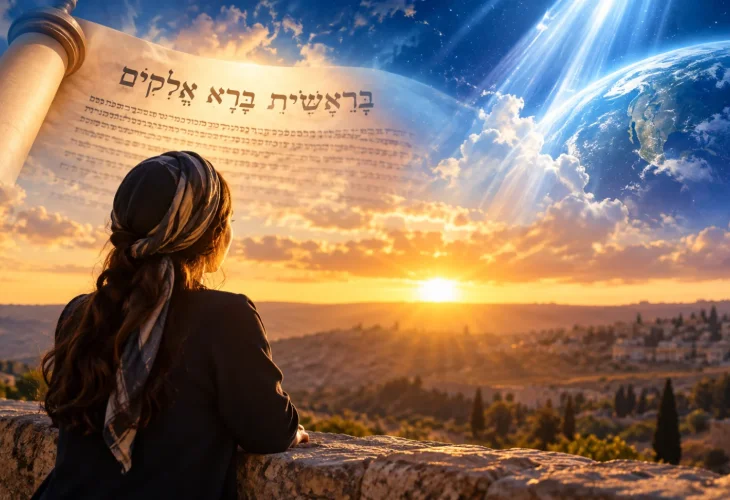
Today is Oct. 5. Just a few days ago was Simchas Torah, the day that celebrates our nation finished reading the entire torah still another time of the thousands of times it was read. Each time adds something to each person’s story and to the story of our nation. It is also the anniversary of the worst attack on our people since the Holocaust.
Time is a gift from its creator. How to use it is up to you.
My birthday, which is the 20th of Tishrei, is also important- as is your birthday. The Baal Shem Tov is reputed to have said that before any of us is born, Hashem determined that the world can’t move forward without the new person’s entrance to the world. You are an important character in history’s hashgachic flow.
In a few days, my family will also be commemorating my first husband’s yahrtzeit. When I look at the children and grandchildren (and there are now even a few greats), it isn’t hard for me to see what his presence put into their personalities and their lives.
The word Bereishis doesn’t mean “number one”; it means in the beginning of Hashem’s creation of the world that He was and is (still now) creating. The first components are heaven and earth. Shamayim- heaven includes everything transcendent, - all of the spiritual light that flows downward to us from Hashem’s infinity, which is what that makes meaning possible. We also have “haaretz,” which includes the macro world of the planets and beyond, and also the micro world of cells that have hundreds of functions. All the components were there as soon as the Creator wanted them there.
The story of creation begins with the letter Bais. It’s number value (2) is anti-intuitive. If you were writing the narrative, wouldn’t you start with Aleph (equally 1)? The torah is both the blueprint of the world, and the instruction book that came with it. It tells you that only Hashem is One in the absolute sense. We live in a world in which we are simultaneously in two places- the heaven and the earth. The written aspect of the Torah, came to us directly from shamayim, along with the Oral Law, that by its nature demands that we use our own words, to describe the details of how we are meant to interact with the earth. Bringing the word of Hashem into our world, the world of aretz, is what challenge is about. The word Bereishis, which hints at both heaven and earth, is used only two other places in Torah, the Baal HaTurim points out. One is “Bereishis mamlachas Yehoyakim,” a phrase that describes the beginning of Yehoyakim’s rule, an era of profound spiritual failure. The other one is “Bereishis mamlachas Tzidkiyahu,” the last king of Yehuda who (although not infallible) was a great tzadik. The Midrash tells you that Hashem would have destroyed the world in Yehoyakim’s time, but He foresaw Tzidkiyahu and didn’t do so in his merit. The earth defeated Yehoyakim, but Tzidkiyahu succeeded in bringing Heaven to earth.
A Closer Look
Hashem chose to use 7 words in the first sentence of the Torah. The Aretz is symbolized by the number 6. Everything physical has 6 sides--the four sides plus up and down. This is what we call surface. There is always an inside, that can’t be seen if you only look at the surface. The number that hints at this dimension is 7. You have to sometimes struggle with the outside until it gives way and lets you see the inside.
When you go to shul, you will notice that the seven words in “Yehei Shmei Rabbah,” invoking Hashem’s blessed Name’s greatness is repeated many times, The words are Aramaic, not Hebrew. This tells you of times in which we are so distant that we don’t even know our own language, that there is still an inside - still meaning. No matter how distant you may feel, there is never only 6 - the inner reality is there. This is why the Talmud tells you that if you say Yehei Shmei Rabbah with all of your strength (which is not only physical - we all have deep spiritual strength, sometimes untapped), you are a partner with Hashem in the act of creation.
Partnership
There are 28 letters in this sentence. There is another famous 28 that occurs much later. In Koheles, Shlomo tells you about 28 different “times,”
Rashi - Very Briefly
1. עת ללדת
The time of birth - nine months.
2. ועת למות
The appointed lifespan of each generation.
3. עת לטעת
The establishment of a nation and kingdom.
4. ועת לעקור נטוע
The time when that nation/kingdom is uprooted.
5. עת להרוג
The time when an entire nation is destroyed at its appointed time.
6. ועת לרפוא
The time to heal Israel from its destruction.
7. עת לפרוץ
The time when Jerusalem's walls are breached.
8. ועת לבנות
The time to rebuild Jerusalem.
9. עת לבכות
Tishah B'Av.
10. ועת לשחוק
The future redemption - “then our mouths will be filled with laughter.”
11. עת ספוד
The days of mourning.
12. ועת רקוד
Dancing at weddings.
13. עת להשליך אבנים
The destruction of the Mikdash - Israel's youth scattered.
14. ועת כנוס אבנים
The ingathering of Israel from exile.
15. עת לחבוק
A time to embrace.
16. ועת לרחוק מחבק
A time to keep away from an embrace.
17. עת לבקש
Hashem will seek the dispersed of Israel.
18. ועת לאבד
Israel being lost/scattered in exile.
19. עת לשמור
A time to preserve/keep.
20. ועת להשליך
A time to discard.
21. עת לקרוע
The splitting of the Davidic kingdom.
22. ועת לתפור
The reunification of the kingdoms.
23. עת לחשות
A time when silence is rewarded - like Aharon.
24. ועת לדבר
A time when one must speak - like Moshe, Devorah, and words of teshuvah.
25. עת לאהוב
A time to love - Rashi connects this to Hashem's love for Israel.
26. ועת לשנוא
A time to hate evil.
27. עת מלחמה
A time for war.
28. ועת שלום
A time for peace.
It is up to you to discover the inner reality that Hashem put into every life experience and to be part of finding shamayim as you live in Aretz.
What Does This Look Like in Real Life?
On October 7, Rachel Segal was in her home on Kibbutz Kissufim with her two daughters, who had come from Beersheba for the holiday.
Then their neighbor Mazal Mansour came running to their door crying, “They've kidnapped Shlomo!” Her husband had just been taken by the terrorists. Rachel did something very simple -and very courageous.
She opened the door in spite of the horror unfolding outside, and pulled Mazal inside.
The terrorists subsequently took over the Segals' house. For hours, they were outside that door, shooting at the safe room and trying to force their way in. The four women remained together, with almost no communication and no electricity. They had no way of knowing that there were tefillos said everywhere in Israel. They felt alone. Eventually, after more than fifteen hours, the army rescued them.
What made this moment special was that she opened her door.
For the rest of us their silent prayers, acts of chessed, and at times feeling Emunah that anyone finds in moments like these are part of the story. You don’t have to live through the drama of Oct. 7 to find Hashem’s transcendental light and bring it to the world. You have to live in the “time” Hashem put in front of you. The 28 “times” demand different responses. Sometimes they are dramatic; sometimes bringing heaven to earth can happen when you make sure that someone standing in the darkness is not standing there alone.
We can open a door.
We can make a phone call.
The number 28 is the same number value as the word koach, strength. It’s there in you. Hashem wants you to encounter Him in your “times.”
Have a wonderful Shabbos Bereishis,
Love
Tziporah

