

Parashat Noach
The Flood, Human Corruption, and the New Beginning of Noach
A deeper look at moral collapse, Noach’s righteousness, and how the Flood created the conditions for humanity to begin again
- Yosef Yaavetz
- | Updated
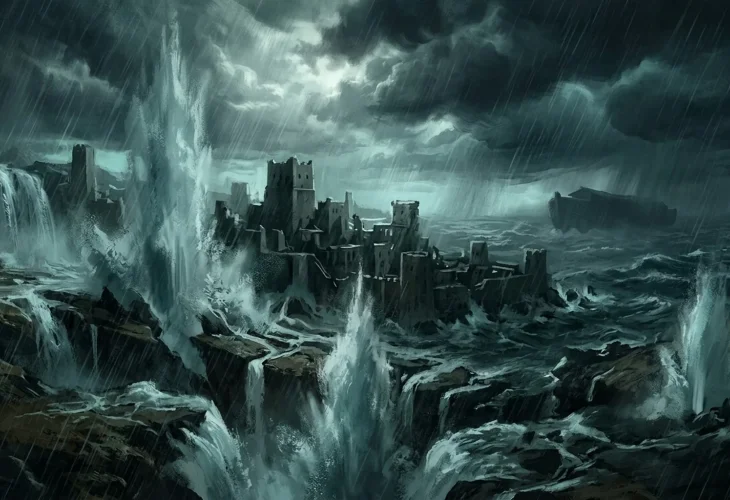
The Torah describes the wickedness of the generation of the Flood in two statements: “The earth had become corrupt before God,” and “the earth was filled with violence.” The first describes the corruption of society’s moral foundations, while the second describes the consequences of that corruption in everyday social life.
Rabbi Samson Raphael Hirsch explains that a society can continue to maintain commerce, institutions, and a legal system even when people commit sins, including serious sins. But it cannot survive when people are no longer able to live together in a basic framework of fairness and trust.
When Injustice Escapes the Law
The word chamas (violence) refers to a form of wrongdoing that can slip through the limits of human law: a small injury, manipulation, or exploitation that the legal system finds difficult to punish. The example given by the Sages is taking a single piece of fruit from a merchant’s stand under the pretense of merely “tasting” it. When this happens repeatedly, the victim has little legal recourse, yet the accumulated loss becomes real and destructive.
When such behavior becomes widespread and persistent, it can destroy another person’s livelihood and ultimately undermine society itself. A society can defend itself against open robbery through punishment. It is much harder to protect itself from calculated behavior that exploits technicalities and operates just within the boundaries of the law.
Social order therefore depends not only on courts and enforcement, but also on conscience, which restrains a person even when no judge is present. The statement that the earth had become filled with chamas thus describes a society collapsing from within.
Why Noach Was Chosen
This helps explain why the Torah emphasizes that “Noach was a righteous and wholehearted man.”
A tzaddik, a righteous person, gives others what is rightfully theirs and evaluates his behavior according to justice. A tamim, a wholehearted person, preserves his moral integrity and independence even while living in a corrupt environment.
These qualities made Noach the foundation upon which humanity could begin again. He was chosen to stand at the beginning of a new generation, much as Adam stood at the beginning of creation.
The Flood Was Not Only Destruction
God’s statement, “The end of all flesh has come before Me,” implies that humanity had reached a point at which continuing along the same path would lead to its own destruction.
According to this understanding, the Flood was not needed simply to destroy the world. Humanity was already destroying itself.
The Flood came in order to save the possibility of a new beginning. Through Noach, divine intervention preserved the seed from which a new world could develop after the foundations of the previous one had disintegrated. The ark protected that remaining core of life from which civilization could be rebuilt.
A Different Path After the Flood
After the Flood, God declares: “I will never again curse the ground because of man, for the inclination of man’s heart is evil from his youth; nor will I ever again strike down every living thing as I have done. As long as the earth endures, seedtime and harvest, cold and heat, summer and winter, day and night shall not cease.”
At first glance, the verse might seem to say that God will no longer curse the earth because human beings are not really responsible for their actions, because their inclination is evil from youth. However, that interpretation raises an obvious difficulty. Does the Torah really mean to say that people are not accountable for their behavior?
Rabbi Hirsch explains the verse differently. God is saying that He will no longer curse the earth even though the inclination of man’s heart is evil from youth, because from now on there will be another way to correct human behavior.
Hirsch connects the Hebrew word na’ar, youth, with the idea of shaking oneself free. A young person naturally seeks independence and therefore struggles with accepting restraint and authority. This tendency reflects something broader about human nature: people often resist limits and obligations.
Yet even so, the earth will no longer be cursed.
A New Structure for Human Life
The method of correction after the Flood would now be different: “Seedtime and harvest, cold and heat, summer and winter, day and night shall not cease.”
Following teachings of the Sages, Rabbi Hirsch explains that this verse reflects a change in the conditions of human life after the Flood.
The changing seasons, the need for repeated labor, and the shortening of the human lifespan created a world in which people became more dependent on changing circumstances. New generations would continually replace earlier ones, and even the power of the strongest individual would be limited by the length of his life.
This structure would help prevent human evil from spreading without restraint. Differences between countries, climates, and nations would allow societies to develop in different ways, making it more difficult for a single form of corruption to dominate all of humanity.
Human beings would move from a world characterized by strength and mastery to one shaped by work, effort, and limitation, similar in some ways to the consequences imposed upon Adam after the sin in the Garden of Eden.
The Meaning of the Rainbow
The covenant of the rainbow gives visible expression to this idea. The different colors of the rainbow symbolize the many different levels and forms of human development that exist within one shared covenant.
Human beings may stand at very different spiritual and moral levels, but all remain part of the same divine promise. As Rabbi Hirsch writes, even those who remain distant from the light are still, ultimately, “children of the light.”
The covenant therefore includes not only those who have reached perfection, but also those who are still far from it.

