

Shabbat
How One Family Makes Shabbat Beautiful, Meaningful, and Memorable
Yael Mizrachi shares how thoughtful preparation, family traditions, hospitality, Torah, and a love for beauty transform Shabbat into the highlight of the week
- Moriah Luz
- | Updated
“My name is Yael Mizrachi. I’m 45, married, and a mother of six. I live in Beitar Illit and teach at a special education high school in Jerusalem.”
Shabbat Memories and Preparations
“As a young girl, I grew up on a secular moshav with parents who had become religious. Every Shabbat, we would walk about half an hour to the synagogue. I still remember the looks people sometimes gave us along the way, but for us there was never any question: Shabbat was Shabbat. I’m the oldest of my siblings, and setting the Shabbat table was always my job. I’ve always loved beauty and design, so I would put a lot of effort into making the table look especially nice. As the oldest daughter, I was also my mother’s right hand in the kitchen, helping with cooking and cleaning.
“Another memory that has stayed with me is the singing at our Shabbat table. My parents loved Shabbat zemirot. At the high school I attended, we would sing beautiful Shabbat songs, and whenever I came home, my parents would ask me to sing them. They loved listening.”
Today, Yael brings that same sense of beauty and intention into her own home. “We divide the Shabbat preparations among the family, so everything doesn’t fall on me. I’m more like the manager of the operation, but everyone knows what they are responsible for. By Wednesday, the Shabbat shopping is done. My daughter handles it and buys everything, including the fish and meat, and once she gets home I start defrosting and marinating whatever needs to be prepared.
“Thursday is my day off from work, so that becomes our big preparation day. In the morning, I start cooking and put pots on the stove while cleaning the house and washing the floors. When my older daughters are home, we do it all together. On Thursday afternoons, we also have a family tradition: a really good lunch of schnitzel in challah with fresh salads.
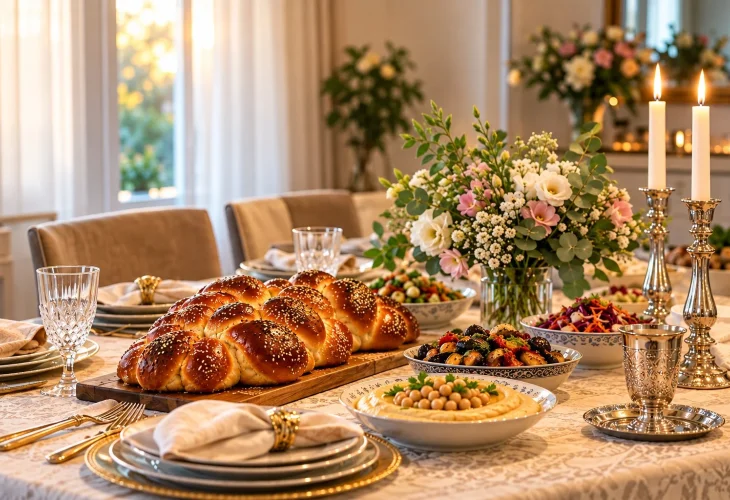
“The table is set later in the afternoon, so by evening the house already feels like Shabbat. My oldest daughter once told me that when she comes home after a long, busy day and sees the table beautifully set, she feels her whole body relax. For me, every Shabbat is an occasion. I try to make it as special as possible with different foods, interesting cakes, beautiful dishes, and especially different styles of table settings. Every week, the table looks a little different, with another tablecloth, another set of dishes, and a different flower arrangement.
“I work on Fridays, so while I’m away, my husband takes over. He prepares the challah dough, and when I come home, he leaves the mitzvah of separating challah for me.”
Turning Shabbat Dreams Into Reality
“When I was 20, I was on shlichut (emissary work) in the United States. The homes there were very spacious, and some families had a special room known as a ‘Shabbat room.’ To me, it seemed almost magical. You opened the door and entered a room that was used only for Shabbat. I dreamed that one day, when I built my own home, I would have a room like that too. At the time, it felt like a distant dream because homes here are much smaller.
“A few years ago, my husband and I bought a home, and it happened to have a little alcove that was just right. I told my husband that this had always been my dream, and now I finally had the chance. We turned that space into a Shabbat room and invested in making it beautiful, from the walls to the dining area. During the week, we barely used it. Our weekday meals were eaten at the kitchen island, while that room remained reserved for Shabbat.
“We have since moved and sold that house, but I did fulfill my dream of having a Shabbat room. I believe that when a person keeps a dream alive, sometimes Hashem opens the way for it to become real.”
Recently, Yael fulfilled another long-held dream: replacing the family’s Shabbat dining set. To earn the money, she volunteered to coordinate her high school’s summer program, a demanding role usually taken on by younger teachers. “I really wanted that dining set. I kept picturing it, and I prayed about it. I would say to Hashem, ‘I want this so much, and You know I’m not asking for just another piece of furniture. I’m asking for something for Shabbat. So I’m going to offer myself for this position, and whatever happens, happens.’
“A close friend joined me, and we experienced tremendous Divine assistance. Usually, a certain number of students attend the program, but with us, the number doubled. We completely revamped the structure of the summer activities. Every provider we brought in turned out to be wonderful, and everything seemed to fall into place. It really wasn’t about us. The amount of help from Hashem we experienced was beyond anything I could have imagined.
“After the five-week program ended, my husband and I went to choose a new dining set. We found a huge table with a modern extension system, exactly the kind I had dreamed of. I felt that Hashem had given me a special gift.”
Hosting and the Shabbat Table
“I love having guests, and baruch Hashem, people enjoy coming to us. We try to give each guest everything we can through listening, conversation, food they love, and a warm, welcoming atmosphere. We have a relative who is becoming more observant, and she once told me, ‘When I spend Shabbat at your house, I feel that I heal.’ Those were her exact words.
“Of course, I’m tired after Shabbat because we put a great deal of effort into everything and give a lot of ourselves. But at the same time, hosting fills me and gives me enormous satisfaction. I already look forward to the next Shabbat when the guests can come again.”
Yael also makes a large batch of homemade hummus and plates portions beautifully to distribute among the neighbors.
“On Friday night, we serve homemade challah, two rich and filling fish dishes, and a wide variety of fresh and cooked salads. We prepare everything at home, completely from scratch. For example, when we make hummus, we soak the chickpeas ourselves, cook them, and grind them into a fresh spread. Our salads might include different varieties of cabbage, eggplant dishes, and fresh vegetable salad. My husband braids the challah in the shape of a bunch of grapes, with each person receiving a small challah shaped like a grape. Because the main meal is pareve, we always finish with an impressive spread of dairy desserts.
“On Shabbat morning, there is a very clear divide in our family. The men love cholent, so for them we make a rich cholent with side dishes. We women prefer dairy food, so we prepare quiche, a rich egg salad, and a colorful lettuce salad. We physically divide the table into two sections, one meat and one dairy, with a clear divider in the middle and separate dishes and placemats. Everyone is happy. The girls enjoy the dairy food, the boys enjoy the meat, and the house remains peaceful.
“Seudah Shlishit is also important to us, especially to my husband. We serve fish, and I buy special bourekas made without margarine.”
The Moments That Matter Most
Despite all the food and beautiful table settings, Yael says her favorite part of Shabbat is her husband’s words of Torah. “I always tell him that the food can be wonderful and the atmosphere beautiful, but I need the Torah. I need those uplifting words. Baruch Hashem, my husband has a gift for finding exactly the right message and expressing it beautifully. Everything comes together, and the children sit, listen, and absorb.”
She also treasures the time spent learning with her sons when they review what they studied in cheder. Another favorite moment happens early on Shabbat morning with her youngest son, who finds reading a little challenging. “We both wake up early, and at seven in the morning we go for a walk together. We take siddurim with us. He opens his siddur and davens at his own pace, happily and without pressure.”
Her advice for creating a meaningful Shabbat is simple: “Invest in Shabbat. Save special treats for it. Wear clothing you love. Prepare foods that make it feel different from the rest of the week.”
The family also celebrates birthdays on Shabbat by going around the table and having each person describe the birthday child’s talents, the gifts Hashem has given them, and the light and joy they bring into the home. “You can see in the child’s eyes and shy smile just how much those few minutes mean.”
Yael’s Special Shabbat Recipe
Homemade Hummus
Ingredients
500 grams dried chickpeas
A little baking soda
1 cup raw tahini
5 tablespoons lemon juice
2 garlic cloves, or more to taste
½ teaspoon salt
½ teaspoon cumin
Place the chickpeas in a large bowl, cover generously with water, and soak for at least 12 hours.
Drain and transfer them to a pot. Cover again with water, add the baking soda, and bring to a boil. Reduce to medium heat and cook for about an hour, until the chickpeas are very soft.
Once cooked, reserve about two thirds of the cooking liquid and discard the rest. If possible, remove the loose, transparent skins.
Set aside a few whole chickpeas for garnish.
Add the tahini, lemon juice, garlic, salt, cumin, and some of the reserved cooking liquid. Blend with an immersion blender until smooth and creamy. Add more cooking liquid as needed.
The hummus should remain slightly loose, since it will thicken after standing for a few hours.
Serve on a plate and garnish with the reserved whole chickpeas.
Note: Before cooking, dried chickpeas should be checked for insect infestation. Vacuum-packed chickpeas may be available in a form that does not require checking.

