

Personality Development
Would You Keep a Lost Wallet? What Science and Jewish Law Reveal
A global study of 17,303 lost wallets revealed surprising findings about honesty. Discover what Jewish law says about returning lost money.
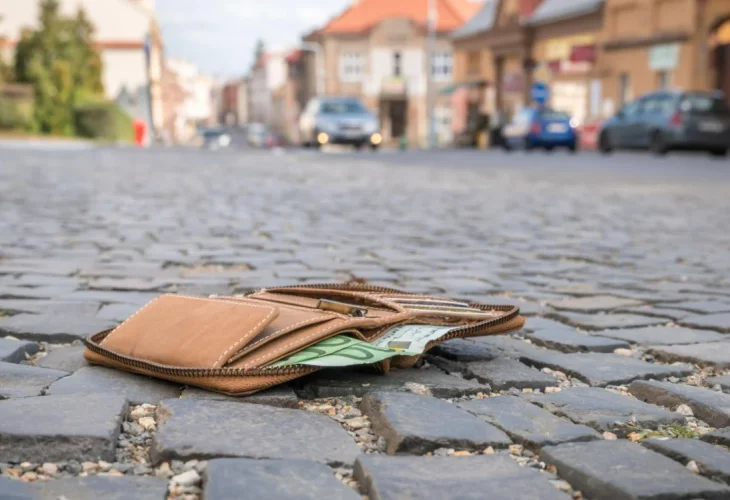
What would you do if you were walking down the street and suddenly found a wallet full of cash? Would you keep it or try to return it to its owner?
Jewish halacha requires us to fulfill the mitzvah of hashavat aveidah (returning lost property). However, when it comes to finding money, the laws can be more complicated, and several factors determine whether there is an obligation to return it.
If you find a wallet containing cash, you should not automatically assume that you are allowed to keep it simply because it was lying in the street. You need to consider whether the money or wallet has identifying features, whether the owner can be identified, and the circumstances in which it was found.
In an actual case, particularly when a significant amount of money is involved, it is advisable to consult a rabbi who specializes in Jewish monetary law and explain exactly where and how the money was discovered.
But beyond the halachic question, how honest are people when faced with the opportunity to keep money that does not belong to them?
This question became the focus of one of the largest social experiments ever conducted on the subject. The findings, published in the scientific journal Science, surprised psychologists, researchers, and economists alike.
Researchers from the University of Michigan, the University of Zurich, and the University of Utah investigated how people respond when presented with what appears to be a lost wallet.
Between 2013 and 2016, research assistants handed in 17,303 supposedly lost wallets across 355 cities in 40 countries. The wallets were delivered to employees at various institutions, including banks, hotels, museums, post offices, and police stations.
The scenario was simple: a person would enter an institution, explain that they had found a wallet nearby, say they were in a hurry, and ask an employee to take care of it.
The More Money in the Wallet, the More Likely People Were to Return It
Each wallet contained business cards with the email address of a fictitious owner, a shopping list, and, in some cases, a key. This allowed researchers to determine whether the person receiving the wallet would attempt to contact its supposed owner.
In the first stage, the researchers compared wallets containing no money with wallets holding $13.45.
The results were surprising. When the wallets contained money, 51% of recipients attempted to contact the owner, compared with just 40% when the wallets were empty.
The researchers then wanted to find out whether a larger amount of money would change people's behavior.
In a further experiment conducted in Britain, the United States, and Poland, some wallets contained approximately $94.15.
Rather than making people less likely to return the wallets, the larger amount had the opposite effect. The rate of attempts to contact the owner rose to 72%, compared with 51% for wallets containing the smaller amount and 40% for empty wallets.
The findings suggested that people were often more motivated to act honestly when the financial stakes were higher.
But what does Jewish law say about finding money? Here are three important situations to consider.
1. You Find a Wallet Containing the Owner's Identifying Details
If you find a wallet containing an ID card, business cards, documents, or other information that makes it possible to identify its owner, the mitzvah of returning lost property generally applies.
The fact that the wallet was found in a public place does not automatically make it ownerless. If the owner can be identified, you should take appropriate steps to contact them and arrange for the safe return of their property.
2. You Find Cash With No Identifying Marks
This situation is more complicated.
Cash, particularly loose bills without distinctive identifying features, may sometimes be considered lost property that does not carry a halachic obligation to return it.
However, the ruling depends on several factors, including how the money was lost and whether the owner has already given up hope of recovering it.
There is no general rule that all money found in the street may automatically be kept.
The way the money was found also matters. For example, loose bills scattered on the ground may have a different halachic status from a bundle of money tied or wrapped in a distinctive way.
3. You Witness Someone Dropping Money or Find a Distinctive Bundle
If you actually see someone drop money, or if you discover a bundle with identifying features, there may be an obligation to return it.
Depending on the circumstances, identifying features might include the number of bills, the way they are wrapped, or other distinctive details that could help the owner establish that the money belongs to them.
In such cases, it is not enough to assume that cash has no identifying marks. The circumstances must be examined to determine whether the owner can be identified and whether the money must be returned.
Ultimately, halacha distinguishes between money with no identifying features and lost property whose owner can be identified. It also considers the circumstances in which the money was found.
The research offers an encouraging reminder that honesty often prevails, even when people have an opportunity to benefit financially from someone else's loss.
And from a Jewish perspective, finding a wallet full of cash is not simply a question of what we can keep, but also of our responsibility toward another person's property.
When in doubt, particularly if the amount is significant, the best approach is to consult a rabbi knowledgeable in Jewish monetary law before making a decision.

