

Parashat Noach
Noah's Ark: How Could Eight People Care for 16,000 Animals?
A fascinating study explores the logistics of Noah's Ark, from feeding and housing thousands of animals to managing waste and ensuring their survival.
- Yehosef Yaavetz
- | Updated
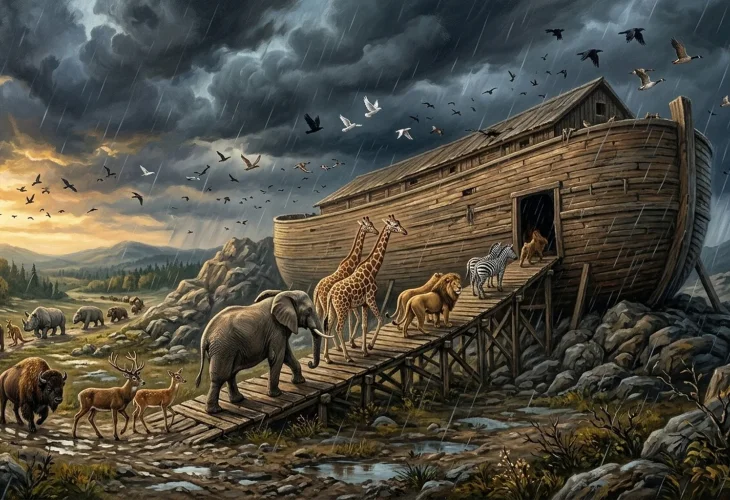
The Torah describes an Ark measuring 300 amot long, 50 amot wide, and 30 amot high, divided into three decks. Noach was commanded to bring animals aboard to preserve them through the Flood. But how could so many animals, along with enough food and drinking water to sustain them for approximately a year, fit inside a single structure?
Geologist John Woodmorappe explores this question in his book Noah's Ark: A Feasibility Study, arguing that the task was logistically possible. According to the author, the book is the result of seven years of multidisciplinary research and draws on approximately 1,200 sources.
The study examines how many animals would have needed to board the Ark, their sizes and housing requirements, the quantities of food and water needed, waste management, and the enormous workload facing the eight people on board. It also addresses special dietary needs, climate conditions, the survival of organisms outside the Ark, and the recovery of animal and plant populations after the Flood.
Woodmorappe's central question is whether the Ark could have functioned through practical methods of design, storage, and animal care, without relying on miracles to explain its day-to-day operations. To investigate this, he compares the Torah's description with information from zoology, agriculture, nutrition, and animal care.
His conclusion is that, under the assumptions outlined in his model, approximately 16,000 animals could have been maintained aboard the Ark for about a year by a crew of eight people.
How Many Animals Were on Noach's Ark?
The first stage of the research focuses on determining which groups of animals would have needed to board the Ark. By examining the wording of the Torah's verses, Woodmorappe arrives at an estimate of approximately 16,000 animals.
However, the number of animals alone does not reveal how much space they would require. Animals vary enormously in size and weight, so the author divides them into eight weight categories, ranging from creatures weighing just a few grams, such as hummingbirds, to the largest animals.
According to the distribution used in his model, most of the animals were relatively small. Woodmorappe describes the average animal as approximately the size of a rat, with only about 15% of the animals being the size of a sheep or larger.
Based on these calculations, he argues that it would not have been necessary to bring all large animals aboard as juveniles simply to save space.
Nevertheless, larger animals would have consumed a disproportionate share of the food and produced much of the waste. For this reason, the study calculates resource requirements according to the animals' different weight categories rather than assuming that every animal consumed the same amount.
How Could the Ark Hold Enough Food and Water?
To estimate the space needed to house the animals, Woodmorappe used established standards for keeping laboratory animals of comparable body weights. These provided a basis for calculating the housing requirements of each size category.
He then calculated the quantities of food and water needed for a period of 371 days, using data on animal body weights and food consumption.
Particular attention was given to large herbivorous mammals, which require substantial quantities of feed, especially hay. Such food presents a challenge not only because of its weight but also because of the amount of storage space it occupies.
According to Woodmorappe's calculations, the Ark had sufficient volume to accommodate the animals and store their food and water for the entire period. He even estimates that a significant amount of unused space would have remained.
What About the Waste Produced by Thousands of Animals?
Housing thousands of animals in an enclosed structure for an extended period presents another major challenge: waste management.
Woodmorappe estimates that the animals aboard the Ark would have produced approximately 12 tons of waste every day.
To determine whether this could have been managed, he examined agricultural research and established methods of handling animal waste.
The study considers two main approaches. The first involves removing waste from animal enclosures daily. The second allows waste to accumulate under controlled conditions over longer periods, without requiring complete daily removal.
By comparing these approaches with modern agricultural systems, Woodmorappe argues that methods from both categories could have been adapted to the Ark.
He emphasizes that the amount of waste produced does not necessarily determine how many workers are needed to manage it. The design of the collection system, the frequency of removal, and the methods used all influence the workload.
In his assessment, an appropriately designed system could have allowed the Ark's eight occupants to handle the waste effectively.
Could Eight People Really Care for 16,000 Animals?
Another question is whether Noach and the seven other people aboard could realistically have cared for so many animals.
Woodmorappe examines studies measuring the time required to care for animals under different housing conditions, using the findings to estimate the workload aboard the Ark.
His proposed scenario involves eight caretakers working ten hours a day, six days a week.
According to his calculations, efficient animal-handling methods would have allowed them to care for approximately 16,000 animals within that schedule, while still leaving some free time.
He argues that this would not have required advanced machinery and even considers a scenario involving only basic tools.
The key, according to the study, would have been organizing certain tasks centrally and reducing the time needed to care for each individual animal. Rather than assuming that every animal required a separate sequence of daily tasks, the model considers how housing arrangements and feeding systems could have made the work more efficient.
How Were Animals With Special Diets Fed?
Not all animals can survive on ordinary feed. Some are predators, others depend on live prey, and certain species require highly specific foods that may spoil quickly.
Woodmorappe devotes considerable attention to these challenges.
For large predators such as lions, he argues that their dietary needs could have been met without keeping large numbers of additional animals aboard solely as food.
He also examines insect-eating bats and certain birds that normally depend on live prey, suggesting that they could have been fed without maintaining an extensive insect-breeding operation inside the Ark.
Other examples include koalas and pandas, whose diets are strongly associated with eucalyptus leaves and bamboo. According to Woodmorappe, keeping these animals aboard would not necessarily have required growing eucalyptus trees or bamboo inside the vessel.
The study also considers vampire bats, king cobras, certain leaf-eating primates, and three-toed sloths.
Beyond food, the author examines ventilation, the behavior of wild animals in captivity, overcrowding, movement and exercise, bathing requirements, and the challenges of housing animals that struggle to survive in captivity.
He argues that practical solutions could have been developed for these issues, many of them relatively simple.
Could Polar Bears and Tropical Birds Survive Together?
Animals from different parts of the world have very different environmental needs. How, then, could creatures associated with freezing polar regions and tropical climates have survived aboard the same vessel?
Woodmorappe approaches this question by examining the range of temperatures and conditions different animals can tolerate, rather than assuming that they can survive only in the climates where they are commonly found today.
His analysis also considers the assumption of a warmer world before the Flood.
Based on the data he surveys, he argues that conditions could have existed in which animals associated with both polar and tropical environments could survive.
He extends this discussion to plants, examining their ability to tolerate different climatic conditions as well.
What Did the Animals Eat After Leaving the Ark?
The challenges would not necessarily have ended when the Floodwaters receded.
After leaving the Ark, the animals would have entered an environment that had undergone enormous changes. Would there have been enough food for them to survive?
One argument Woodmorappe examines is that, without their usual food sources, the animals would have been forced to prey on one another immediately after leaving the Ark.
He challenges this assumption by pointing to the variety of possible food sources in a post-Flood environment and the ability of some animals to adjust their diets when necessary.
The study presents examples of animals that consume alternative foods when their preferred food is unavailable, suggesting that dietary flexibility could have helped some species survive temporarily under difficult conditions.
How Could Plants Survive the Flood?
The study also explores how vegetation could have survived the Flood and recovered afterward.
Woodmorappe examines two central concerns: that increased soil salinity after the waters receded would have prevented seeds from germinating, and that seeds submerged during the Flood would have germinated prematurely, leaving them unable to grow afterward.
To address these questions, he reviews research on seed survival during prolonged submersion and the environmental conditions required for germination.
His conclusion is that prolonged flooding would not necessarily have destroyed every seed or caused all seeds to germinate before conditions were suitable.
He also discusses how some plants can survive and regenerate through parts other than their seeds, providing additional possible mechanisms for the return of vegetation.
How Could Animal Populations Recover From So Few Individuals?
A final challenge concerns the recovery of animal populations after the Flood.
Could such small groups of animals reproduce successfully and eventually develop into the populations found around the world?
Woodmorappe examines population growth, genetic diversity, and the potential effects of inbreeding.
Drawing on the studies he reviews, he argues that a small number of founding animals may retain a substantial portion of the genetic potential of a larger population.
He presents examples of animal populations that survived and expanded after beginning with only a few individuals. Based on these examples, he suggests that the groups leaving the Ark could have established viable populations, even with the inbreeding that would initially have been unavoidable.
The study also addresses the relationship between the animals aboard the Ark and the many species that exist today.
According to Woodmorappe's model, it would not have been necessary for every modern species of land animal to have been represented separately aboard the Ark. Instead, he proposes that some species could have developed afterward through speciation, the process by which new species arise.
He examines the argument that speciation could not have occurred within approximately 5,000 years and presents examples that he believes demonstrate the emergence of new species within centuries, and in some cases, decades.
He also distinguishes between evidence for particular instances of speciation and the broader conclusions drawn from them about the development of the animal world.
Ultimately, Woodmorappe's study presents a model in which the biological and logistical challenges of Noach's Ark could be addressed together. By considering the number and sizes of animals, housing arrangements, food and water supplies, waste management, and available manpower, he argues that the Ark could have functioned as described in the Torah.
His conclusions depend on the assumptions used in his model and should not be understood as scientific proof that the Flood occurred or that the Ark operated in precisely this way. Rather, the book offers a proposed explanation of how the practical challenges described in the Torah might have been addressed.

