

Parshat Lech-Lecha
Lech Lecha and the Three Stages of Spiritual Growth
The conquest of Eretz Yisrael reflects three levels of serving Hashem: refining thought, speech, and action, elevating our character traits, and ultimately reaching a deeper attachment to Godliness
- Revital Yitzchaki
- | Updated
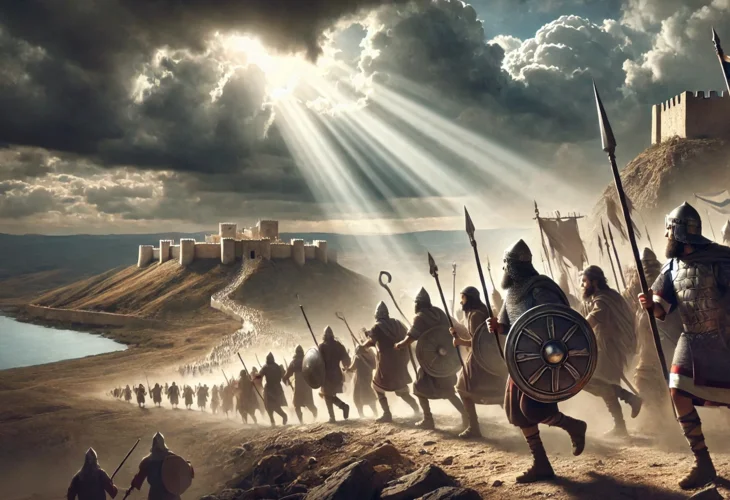
Our parsha opens with Hashem’s command to Avraham Avinu to go to the Land of Israel. Eretz Yisrael was uniquely chosen by Hashem as the land promised to the Jewish people, and one of the signs of the Redemption will be the ingathering of the Jewish exiles to the Land of Israel through Mashiach, as the Rambam rules: “He will build the Temple and gather in the dispersed of Israel.”
Three Stages in the Conquest of Eretz Yisrael
There are three stages in the Jewish people’s settlement of Eretz Yisrael, and each stage represents a particular dimension in serving Hashem.
The conquest of Jericho, which our Sages describe as “the lock of Eretz Yisrael.”
The conquest of the seven nations: the Canaanite, Hittite, Amorite, Perizzite, Jebusite, Girgashite, and Hivite, whom we mention each day in prayer.
The conquest of the full Land of Israel promised in our parsha at the Covenant Between the Parts, which also includes the territories of the Kenite, Kenizzite, and Kadmonite. This refers to the area east of the Jordan River, inhabited by Edom, Ammon, and Moab.
Entering “Eretz Yisrael” in Our Service of Hashem
The concept of “Eretz Yisrael” also has a spiritual meaning. Just as there are three stages in the physical conquest of the land, there are also three corresponding stages in our spiritual development, each with its own form of divine service.
The three spiritual stages we must pass through in order to enter “Eretz Yisrael” on a spiritual level are as follows:
1. Guarding Our Thoughts, Speech, and Actions
The first stage is entering Jericho, Yericho, which is associated with the word reiach, scent. Our Sages say that the city was given its name because the goats in Jericho would sneeze from the fragrance of the incense offered in the Beit Hamikdash. In other words, the atmosphere of holiness from the Temple could be sensed in the Jericho Valley.
Mashiach is described as “morach v’da’in”—he will judge through his sense of smell. He will spread an atmosphere of holiness throughout the world because his entire being is one of absolute attachment to Godliness.
What creates a positive “fragrance” around a person? His positive thoughts, words, and actions. As explained in Tanya, a person’s thoughts are the spiritual garments of the soul. When a person thinks thoughts of holiness, he creates an atmosphere of holiness around himself, and the same is true of speech and action.
Spiritually entering “the lock of Eretz Yisrael” therefore means guarding the three garments of the soul: thought, speech, and action.
2. Refining and Elevating Our Character Traits
The next stage requires us to refine our middot, our emotional traits, and to “clarify” them by separating the good within them from the negative and using them in the service of Hashem.
This means awakening the heart with love and awe of Hashem and learning from the tzaddik, whose refinement extends not only to his thoughts, speech, and actions, represented by Jericho, but also to his inner emotional qualities.
The seven emotional attributes are chesed, gevurah, tiferet, netzach, hod, yesod, and malchut.
The names of the seven nations contain allusions to the spiritual work involved in refining these traits. The Hittite, for example, is associated with fear, pointing to awe of Hashem; the Amorite is associated with speech, representing words of holiness; the Jebusite is associated with holy pleasure; and the Girgashite alludes to driving away negative character traits. The same principle applies to the others.
3. Deepening the Mind’s Awareness of Hashem’s Unity and Greatness
In the era of Redemption, three additional nations will also be conquered: the Kenite, Kenizzite, and Kadmonite. Spiritually, this represents the stage of conquering the mochin b’etzem, the essential intellectual faculties.
Mochin refers to the three intellectual attributes of chochmah, binah, and daat. There is one level of intellect that serves the emotions, known as mochin l’tzorech hamiddot, which has characterized our service of Hashem from the creation of the world until today. There is also a deeper level, mochin b’etzem, which will characterize the divine service of the era of Redemption.
In summary, the three stages of conquering the land represent three levels in serving Hashem:
1. The conquest of Jericho represents mastery over the three garments of the soul: thought, speech, and action.
2. The conquest of the seven nations represents the refinement and purification of the emotional traits.
3. The conquest of the territories of the three additional nations, the Kenite, Kenizzite, and Kadmonite, represents the transition from an intellectual understanding of Hashem’s greatness and divine providence to complete attachment to Godliness.
This idea is alluded to in Parshat Lech Lecha. It represents true movement from “strength to strength”: from “Jericho,” the sanctification of thought, speech, and action, to the conquest of the seven nations, the refinement of the emotional traits, and ultimately to the conquest of the Kenite, Kenizzite, and Kadmonite promised to Avraham Avinu in the Covenant Between the Parts. These three correspond to chochmah, binah, and daat, the essential intellectual faculties, and represent complete attachment to Godliness.
Adapted from the teachings of Rabbi Dov Menachem Dobruskin.

