

Israel News
Chief Rabbi David Yosef Urges Israelis to Vote: "It's a Sacred Duty"
Israel's Sephardic Chief Rabbi calls voting a sacred duty and shares a childhood memory revealing his father's firm stance on election participation.
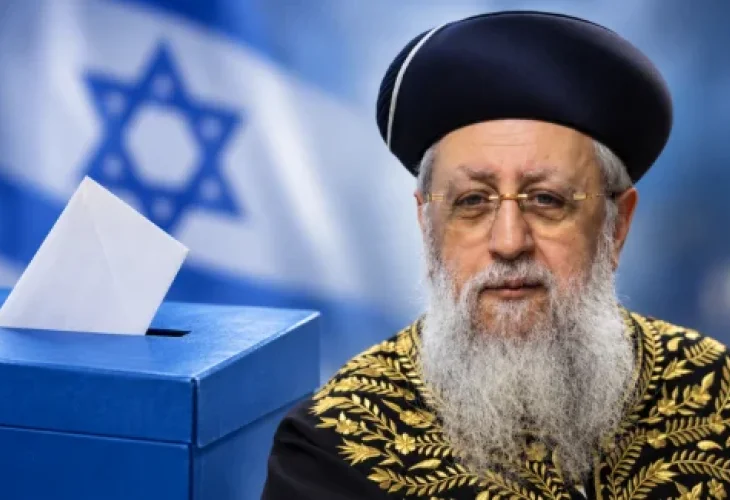 The Rishon LeTzion, Rabbi David Yosef (Photo: Flash 90)
Israel's Sephardic Chief Rabbi, Rabbi David Yosef, known as the Rishon LeZion, called on the public Wednesday to exercise their right to vote, describing participation in elections as a sacred obligation.
At the beginning of his remarks, Rabbi Yosef explained that, as president of the Supreme Rabbinical Court, he is not permitted to comment on individual political parties. However, he emphasized that he could address the importance of voting itself.
"What I am permitted to speak about, my friends, is the very act of participating in elections," he said. "There are things that are optional, things that are a mitzvah (commandment) or an obligation, and things that are forbidden. So I say clearly: It is a sacred duty for every person to vote in elections. It is forbidden to refrain from voting."
Rabbi Yosef recalled that when his father, Rabbi Ovadia Yosef z"l, returned to Israel from Egypt in 1950 (5710), he lived in severe poverty for several years, at times struggling to afford food. During that period, he was offered a prestigious, well-paid position as head of the rabbinical court of the Sephardic Eidah HaChareidit.
However, the position came with a condition: He would have to sign a declaration stating that participation in elections was forbidden. Rabbi Ovadia Yosef firmly refused, maintaining that voting was both an obligation and a mitzvah, a position he attributed to leading Torah authorities of the time, including the Chazon Ish and the Brisker Rav.
Rabbi David Yosef also shared a childhood memory from 1966 (5726), when his father delivered a daily Torah class at the Sha'arei Tzedaka synagogue in Jerusalem's Beit Yisrael neighborhood.
"About a hundred people would attend," he recalled. "It was very crowded, and the class lasted an hour and a half every day. When elections came around, my father would enter the class and ask each person individually, 'Have you voted yet?' Anyone who said he hadn't voted was told that he could not remain in the class and should go and vote."
Rabbi Yosef explained that polling stations were open until midnight at the time, while the class began at 8 p.m. Some participants suggested they could vote afterward, but his father refused to accept that reasoning.
"People would say, 'What's the problem? We'll go after the class.' But he would say, 'Absolutely not! Something might come up afterward. Go and vote now, quickly!' He insisted on this with every single person."
Rabbi David Yosef said the story illustrated how seriously his father regarded electoral participation, a view he said was shared by the majority of leading Torah scholars in Israel.
"From this, you can understand how my father viewed these matters," he said. "Therefore, I say again: It is a sacred duty, a mitzvah, to go and vote. We have the right to do so, but we regard it as a sacred obligation. It is forbidden to refrain from voting."

