

Interesting
Glowing Mushrooms: The Mysterious Fungi That Light Up in the Dark
Discover the fascinating science behind bioluminescent mushrooms, why they glow green at night, how their light may attract insects, and whether these extraordinary fungi are safe to eat
- Tehila Cohen
- | Updated
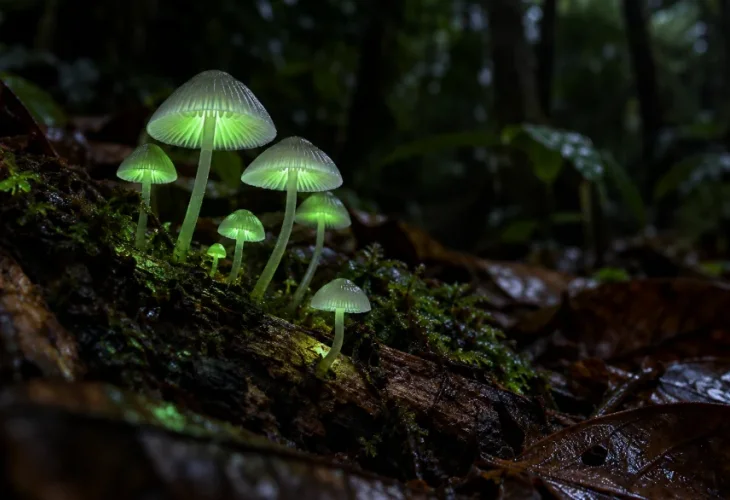
If you walked past glowing mushrooms in broad daylight, you probably wouldn't notice anything unusual. They look just like ordinary mushrooms. But once darkness falls, something extraordinary happens: they begin to emit a mysterious green glow, even though no external light is shining on them. This remarkable natural phenomenon is caused by a chemical reaction that takes place inside the mushrooms' cells.
Known as bioluminescence, this process is also found in fireflies and certain glowing marine creatures. Some mushroom species produce light only in specific areas, while others glow almost entirely. One fascinating example is Filoboletus manipularis, a mushroom found in parts of Australasia, Malaysia, and the Pacific Islands. In darkness, it produces a striking pale green light, creating an almost magical appearance.
How Do Mushrooms Produce Their Own Light?
Unlike glow-in-the-dark stickers, which absorb light and release it later, bioluminescent mushrooms generate their own illumination through a biological process. The light is produced when three components interact: a substance called luciferin, an enzyme known as luciferase, and oxygen. When these components react, energy is released in the form of visible light. The result is a natural glow that requires no sunlight, electricity, or external source of illumination.
Why Do Some Mushrooms Glow?
Scientists have yet to establish conclusively why certain mushrooms produce light. One leading theory suggests that the glow attracts insects, which may help spread the mushrooms' spores, the reproductive cells that allow fungi to multiply and colonize new areas.
To investigate this possibility, researchers placed artificial mushroom models equipped with green LED lights in a forest. They discovered that the illuminated models attracted more insects than those without lights. These findings support the idea that bioluminescence may help fungi attract insects capable of dispersing their spores.
Another intriguing discovery came from a 2015 study of the Brazilian mushroom Neonothopanus gardneri. Researchers found that its light production, which intensifies at night, is regulated by the mushroom's internal biological clock. This suggests that the glow is not simply a random chemical reaction but a carefully timed biological process. Nevertheless, scientists are still investigating the precise evolutionary purpose of this extraordinary ability.
Are Glowing Mushrooms Safe to Eat?
Despite their beautiful appearance, glowing mushrooms should not be eaten unless they have been reliably identified as safe by a qualified expert. Many bioluminescent fungi grow naturally in the wild, where they are not cultivated or monitored for human consumption.
Some species are poisonous. The Australian ghost fungus, for example, can cause vomiting, intestinal problems, and abdominal pain if consumed. Their enchanting glow may make them look like something from a fairy tale, but these mushrooms are best admired rather than tasted.
Imagine walking through a dark forest and suddenly discovering dozens of tiny green lights glowing among the trees. Would you dare to explore a forest filled with these mysterious, naturally glowing mushrooms?

