

Interesting
Injured Bird Gets World's First 3D-Printed Double Beak in Remarkable Surgery
Veterinarians used 3D printing to reconstruct both parts of a hornbill's damaged beak in a world-first procedure, with astonishing results.
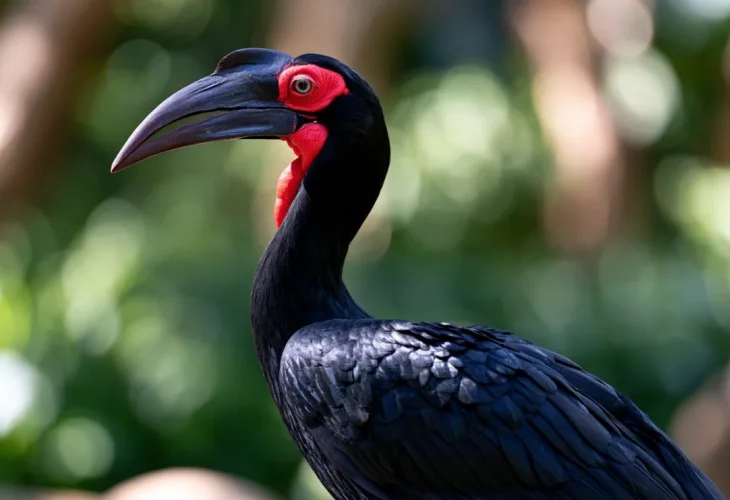
A severely injured bird at a zoo in the Netherlands has been given a remarkable second chance after veterinarians fitted her with a custom-made, 3D-printed beak. The groundbreaking procedure restored both the upper and lower sections of her damaged beak, allowing her to perform everyday activities that had become almost impossible.
The bird, a southern ground hornbill living at ARTIS Zoo in Amsterdam, had lost parts of both sections of her beak. Native to Africa, southern ground hornbills are large birds that spend much of their time searching for food on the ground. Their powerful beaks are essential not only for feeding but also for grooming their feathers, handling objects, and carrying out other daily activities.
Although the injured bird had managed to adapt to some extent, the damage made it increasingly difficult for her to collect food and care for herself. Zoo staff therefore began exploring whether modern medical technology could help restore the functions she had lost.
Rebuilding a Beak With 3D Printing
The ambitious project brought together specialists from ARTIS Zoo, Utrecht University's Faculty of Veterinary Medicine, UMC Utrecht medical center, and Belgian 3D-printing company Amnovis.
The team began by performing a CT scan to obtain detailed images of the bird's head and remaining beak. Using those scans, along with preserved fragments of her original beak, the specialists designed two artificial sections that would closely match her natural anatomy.
The replacement pieces were then manufactured using 3D-printing technology. During a carefully planned operation, veterinary surgeons from Utrecht University, working alongside the zoo's veterinary team, attached the artificial sections to the remaining beak using titanium components and screws.
While 3D-printed beak replacements have been used in other cases, this procedure was particularly unusual because both the upper and lower sections required reconstruction. According to ARTIS Zoo, it is the first known case in which both parts of a bird's beak have been restored using this approach.
An Unexpectedly Fast Recovery
One of the team's biggest concerns was whether the hornbill would be able to adapt to her new beak. Creating replacement parts that fit correctly was only part of the challenge. The bird also needed to regain the ability to pick up food, handle objects, and groom herself.
To the specialists' delight, she began showing signs of success almost immediately. On the very day of the operation, she started using her new beak. By the following morning, she was already able to pick up objects from the ground without assistance.
Just a few days later, she began using the reconstructed beak to arrange and clean her feathers, another important milestone in her recovery.
The rapid progress exceeded the team's expectations and demonstrated how successfully the artificial parts could function alongside the remaining natural beak.
For the specialists involved, the results were particularly meaningful because the hornbill's ability to survive depended heavily on the functions they were trying to restore. Without a working beak, a bird that relies on it for feeding and other essential activities faces enormous challenges.
The successful operation highlights the growing possibilities of combining veterinary medicine with advanced 3D-printing technology. By creating implants tailored to an individual animal's anatomy, specialists may be able to restore important functions that would otherwise be permanently lost.
For this southern ground hornbill, the innovation has already made a remarkable difference. What began as an ambitious attempt to repair a devastating injury has given her the ability to feed, groom, and interact with her surroundings once again.

