

Depression and Anxiety
A Rabbi's Battle With PTSD After October 7: Trauma, Faith, and Healing
After four months caring for fallen soldiers and civilians, Rabbi Menachem Perl opens up about his struggle with PTSD, the impact on his family, his journey toward healing, and the faith that continues to sustain him
- Moriah Luz
- | Updated
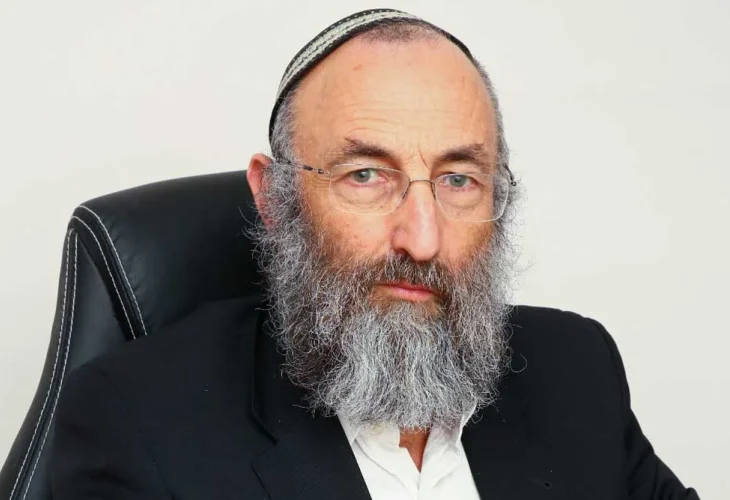 Rabbi Menachem Perl (Credit: Yishai Landau)
"Can I ask you about the dog?" I ask Rabbi Menachem Perl toward the end of our interview.
"Of course," he replies with a smile.
Rabbi Perl has spent decades in rabbinic service, holding numerous positions and, for the past ten years, serving as the head of the Zomet Institute for Halacha and Technology. It is therefore hardly surprising that the sight of a rabbi accompanied by a service dog attracts considerable attention.
Four months spent caring for the bodies of victims at the Shura military base left him struggling with post-traumatic stress disorder (PTSD). In an interview with Hidabroot, Rabbi Perl speaks openly about his experiences, neither concealing his pain nor regretting his decision to volunteer.
"Their Radiant Faces Stayed With Me"
Several days after the outbreak of the Swords of Iron War, Rabbi Perl, 62, began looking for ways to contribute to the war effort. His son, Oved, was serving at the Shura military base, and through him, Rabbi Perl learned that the facility desperately needed additional volunteers to assist in caring for the deceased. A week after Simchat Torah, he reported for duty.
"The work was carried out in teams, so there was no need for extensive training beforehand. They explained what I needed to do when I arrived," he recalls. When I ask whether he had any previous experience handling the deceased, he explains that he had not. Some of the work carried out at the base is too distressing to describe in detail. It involved preparing bodies for burial, arranging burial shrouds, and, in the rabbi's haunting words, "putting puzzles together."
"Even a week after the massacre, enormous trucks were still arriving, unloading dozens of bodies of soldiers and civilians," he recalls. Caring for the civilian victims was particularly traumatic. "The work involving civilians ended after a few days, but in many ways, it was much harder. I had seen deceased people several times before, but this was different, both because of the condition in which the bodies arrived and because of the overwhelming numbers."
Among the many victims he helped prepare for burial, several left a particularly deep impression. "There were victims whose parents I knew, and I could recognize which families they belonged to from their facial features. There were also two victims I had never met, but their radiant faces stayed with me." He mentions Yedidya Eliyahu and Yehonatan Lober, both of blessed memory. "Those are two cases that have truly remained etched in my heart."
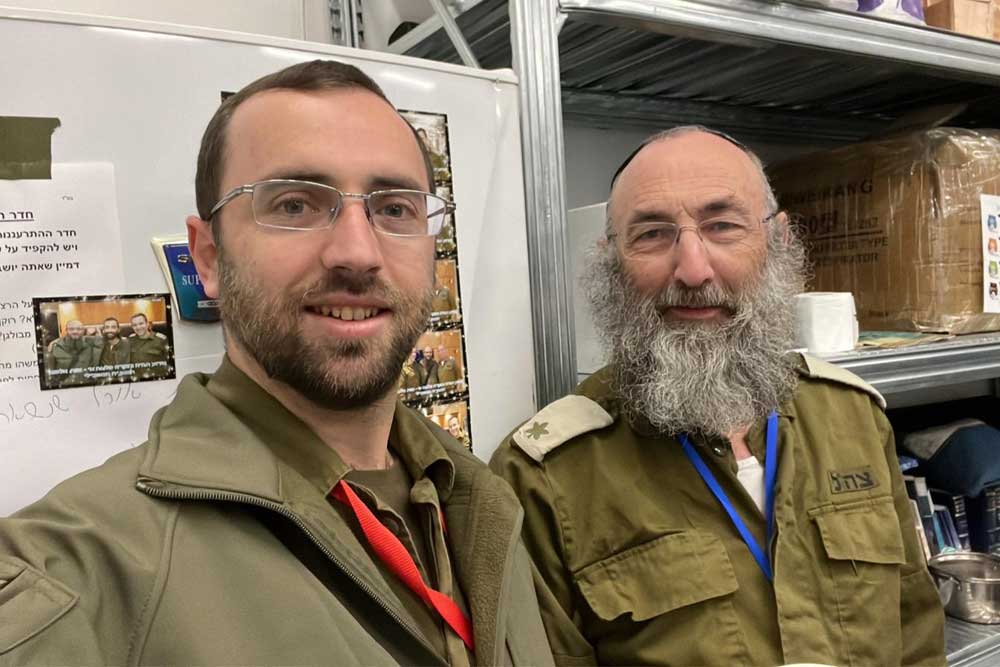 Oved's post-traumatic stress disorder was diagnosed at a late stage (Rabbi Pearl and his son Oved)
"Hiding It Only Makes You More Exhausted"
After four months at Shura, a particular incident prompted Rabbi Perl to request his release from reserve duty. "A fallen soldier arrived after a terrible explosion. I couldn't make sense of what I was seeing. After we finished caring for him, we discovered that he was the son of an employee at the Zomet Institute. When I heard his name and realized just how personally connected I was to this tragedy, I asked to be released."
Why was this particular incident the breaking point? After all, you had witnessed so many difficult cases during those months.
"I can't explain it," he admits after a moment of reflection. "Even before that, everything had been accumulating, one case after another. Over time, I could feel it becoming increasingly difficult for me to bear. After I learned the identity of that soldier, another soldier approached me, placed his hand on my shoulder, and said, 'I'm sorry for your loss.' Those words pierced my heart. Shortly after the identification, I went home. When I returned, I asked to be released."
In fact, Rabbi Perl had begun experiencing emotional difficulties much earlier, approximately six weeks after arriving at the base. At the time, he consulted mental health professionals working there. "They actually encouraged me to continue, saying that the likelihood of these feelings remaining with me for a long time was very small. I understand their reasoning. We're all wiser in hindsight."
The emotional collapse came after he left Shura. "It was extremely difficult. I cried a great deal, and I realized I had to do something. I began seeing a God-fearing psychologist. After two or three months, I thought I had received enough help and stopped going. But I soon realized I wasn't managing very well without him, so I returned."
Mental health struggles still carry a certain stigma. Did you feel embarrassed about seeking treatment, particularly as a well-known rabbinic figure?
"There was some embarrassment, a feeling of, 'What? I'm going to a psychologist or psychiatrist?' But it wasn't because I was a public figure. After all, therapy is private. I think nobody feels comfortable with the idea of being considered mentally unwell."
Nevertheless, from the beginning, Rabbi Perl chose to speak openly about his condition. At work, he would simply inform his colleagues that he would be arriving late on a particular day because he had an appointment with his psychologist.
"I didn't notice anyone raising an eyebrow. Over the years, I've learned that investing energy in hiding something can only cause harm, because the act of hiding is itself exhausting. An injury is an injury, whether it's in the body or the mind. I haven't done anything wrong. I haven't stolen anything or committed a crime. If this is my situation, then this is my situation. I decided not to hide it at all."
"I Realized It Was Much More Than That"
The incident that made Rabbi Perl realize he needed more intensive treatment occurred about a year ago. "My wife and I were abroad, taking a short vacation to rest and relax. While we were there, I experienced an extremely severe anxiety attack. I felt pressure in my chest, nausea, and trembling. After that incident, I understood that this wasn't something that could be addressed through psychological counseling alone. It was much more than that."
Rabbi Perl realized that medication would also need to become part of his treatment. "In my experience, seeing a psychiatrist isn't really therapy in itself. The psychiatrist doesn't cure you or give you peace of mind. You meet with him once every two months, and he prescribes medication that can help a little."
He subsequently approached the Rehabilitation Department of Israel's Ministry of Defense, requesting assistance with his recovery. "I began a whole range of treatments, including a therapeutic farm, yoga, working with animals, and other approaches." He says the techniques he has learned now help him sleep at night and respond more calmly to overwhelming situations. "Some people say that if you keep practicing these techniques consistently, you may eventually recover."
Do you mean recover completely from PTSD?
"Most of the professionals I've spoken with don't believe that's likely in a case like mine. They say you can learn to live with it. But every so often, I hear about a new experiment or treatment that might help."
"For Months, I Was Completely Withdrawn"
Alongside his struggle with PTSD, Rabbi Perl is the father of eight children, including two daughters who are still in high school. The emotional upheaval he experienced has inevitably affected his family as well.
"For many months, I was completely withdrawn. I had absolutely no energy to pay attention to what was happening around me, whether my children were doing well or struggling, how my daughters were managing at school, whether they were keeping up with their studies, or what was happening with my older children and grandchildren. I didn't have the strength to listen to anything, and even when I did hear something, it barely registered."
Responsibilities he had traditionally fulfilled at home have had to be taken over by other family members. His children have stepped forward to help wherever possible, even making a point of coming to study Torah with him. "So that I won't spend too much time sitting alone in an empty space," he explains.
He also expresses deep gratitude to his neighbors in the community of Mevo Horon. "We've had to learn to accept help from the wonderful community around us because carrying this burden alone is extremely difficult."
The Service Dog That Helps Him Through Anxiety Attacks
When someone first suggested that Rabbi Perl consider getting a service dog, he struggled with the idea. For a considerable period, he researched the potential benefits and effectiveness of having such a dog. At the same time, he sought halachic guidance from Rabbi Asher Weiss.
"I consult Rabbi Weiss frequently regarding halachic questions related to the Zomet Institute. He gave me a letter that was essentially a formal halachic ruling, explaining that, in his opinion, a service dog may be brought into a synagogue, along with all the relevant halachic reasoning. That encouraged me tremendously. At that point, I made my decision. I wasn't going to look back."
Several weeks ago, a photograph of Rabbi Perl attending a rabbinic gathering with his dog beside him attracted attention. He laughs as he explains that the picture was taken during the brief interval between his arrival and the moment he settled the dog beneath the table.
"That's actually how it works in everyday life. When I bring him to work or meetings, I position him to the side, and it's as though he isn't there. He can remain completely quiet for hours."
During moments of anxiety, the body releases cortisol, a stress hormone that trained dogs may be able to detect through scent. According to Rabbi Perl, his dog can recognize signs of an approaching anxiety episode even before he becomes physically aware of them. The dog then moves close to him, providing comfort and support that helps him manage the attack.
"Every Single Case Passed Through Him"
Rabbi Perl is not the only member of his family coping with PTSD. As he explained earlier, it was his son Oved's service at Shura that initially brought him to the base. Oved continued serving there long after his father had completed his own duties, remaining for approximately a year and a half. Sometime afterward, Oved developed severe symptoms of PTSD.
"I was physically involved in caring for the deceased. Oved, on the other hand, worked in the operations room and saw far fewer bodies. At first, I was a little surprised that he had been affected so severely. But every incident and every fallen soldier, without exception, passed through him. I was only there for shifts, and even when I handled a body, we usually didn't know the person's identity, name, or story. In his case, perhaps the verse 'He who increases knowledge increases sorrow' applies."
What does it mean for your family to have both you and Oved struggling with PTSD?
"The consequences affect my wife, our daughters who still live at home, and the rest of the children. Everyone wants to help both him and me, and that requires twice the effort."
Rabbi Perl explains that both he and his son have support systems suited to their individual needs. Occasionally, they exchange information and insights from their similar experiences. "You could say that we're learning from each other," he reflects. "But I would have preferred not to have to learn these lessons."
You went to Shura with the intention of performing a tremendous mitzvah, yet you emerged with consequences that have profoundly affected your life. Has this raised questions for you about God?
"In my case, no. I have no questions. I was born to two Holocaust survivors. My father survived Auschwitz. Thank God, both of my parents are still alive. My father is 97, and my mother is 90. I grew up confronting these questions from a very young age. The answer I eventually reached was that we cannot put ourselves in God's place. We know that everything He does is good and serves a good purpose."
"Sometimes He does something good that hurts. Why? I don't know. But as a father, I know there are situations when I might reprimand a child, punish him, or even refuse to give him a piece of chocolate. To the child, it can feel like a disaster. Yet as his father, I act as I do because I understand something that the child may not yet be capable of understanding."
"The same principle applies to our relationship with God, only infinitely more so. I am certain that He wants only what is good for us. Therefore, I don't ask, 'Why me?' or 'Why did this happen this way?' It hurts, but I accept that I simply don't have the ability to understand."
Despite the suffering he has witnessed and continues to experience, Rabbi Perl remains convinced that even the most devastating tragedies can ultimately lead to something meaningful.
"When faced with such an enormous tragedy and such immense pain, not my personal pain, but the pain of the entire Jewish people, I expect that some great good will eventually emerge. Every pain comes to bring something wonderful and new into the world, especially when it involves an event of such historic magnitude. We are still waiting to see that good, but I am certain it will ultimately come. The Holy One, blessed be He, does not cause us pain without purpose or at random. Certainly not."

