

History and Archaeology
Beyond the Torah: What Archaeology Reveals About Abraham's World
Could ancient inscriptions hold clues about Abraham? Explore discoveries in Iraq and Egypt, along with historical traditions preserved for thousands of years.
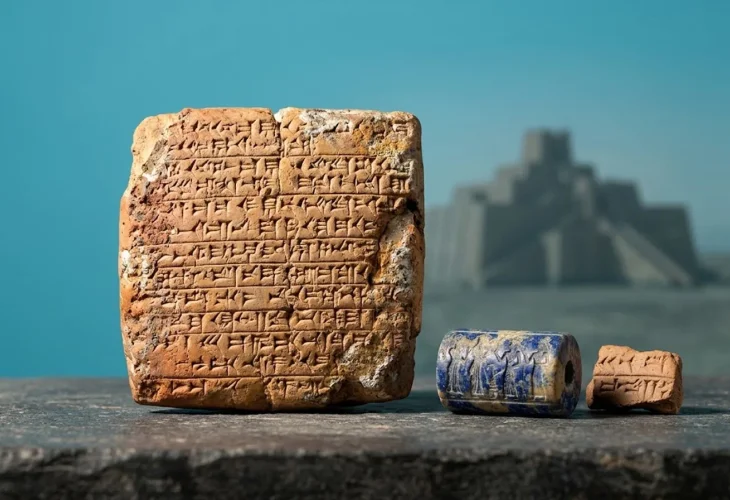
Nearly 4,000 years ago, Abraham our forefather lived in Ur of the Chaldees, an ancient city in Mesopotamia, in what is now southern Iraq.
The Torah tells us about Abraham's origins and introduces several members of his family, including Nachor, Serug, Terach, and Reu. But what traces of this ancient world have survived, and what can archaeology and historical writings tell us about Abraham's life and legacy?
Over the past century, fascinating discoveries have shed light on the cities, cultures, and traditions associated with the biblical patriarch.
The Ancient City of Ur and Abraham's Family
Between 1922 and 1934, British archaeologist Sir Leonard Woolley led extensive excavations at the ancient city of Ur, located at Tell el-Muqayyar in southern Iraq.
The excavations were carried out as a joint expedition of the British Museum and the University of Pennsylvania Museum.
Archaeologists uncovered temples, residential buildings, workshops, burial sites, and countless artifacts, revealing a sophisticated urban civilization that flourished thousands of years ago.
Among the discoveries were inscriptions containing names associated with Abraham's family, including Nachor, Serug, Terach, and Reu.
Although these names resemble those recorded in the Torah, their appearance does not establish that the individuals mentioned were Abraham's actual relatives. The name Abram itself was not identified in the excavations.
Nevertheless, Woolley referred to one of the residential areas as "Abraham's neighborhood," associating its well-preserved remains with the early second millennium BCE, the period traditionally connected with Abraham's lifetime.
While archaeology has not uncovered direct evidence identifying Abraham himself, the discoveries offer a remarkable glimpse into the ancient Mesopotamian world described in the Torah.
What Did Ancient Historians Write About Abraham?
Abraham's story was not preserved exclusively in the Torah. References to him and traditions associated with his life also appear in ancient historical writings.
The first-century Jewish historian Josephus, also known as Yosef ben Matityahu, discusses Abraham in his work Antiquities of the Jews.
He quotes Nicolaus of Damascus, a historian who lived during the first century BCE and recorded traditions about Abraham's early life.
According to Nicolaus, Abram came from the land of the Chaldeans, ruled in Damascus for a period, and later moved to Canaan.
This account differs from the Torah's description, which does not portray Abraham as a ruler of Damascus. Nevertheless, it demonstrates that traditions about Abraham circulated beyond the biblical narrative.
Josephus also refers to Berossus, a Babylonian priest and historian who lived during the third century BCE.
Berossus reportedly described a righteous man who lived among the Chaldeans in the tenth generation after the Flood and possessed extensive knowledge of the heavens.
Although Berossus did not identify this individual by name, Josephus associated the description with Abraham.
These references do not independently establish every detail of Abraham's life, but they show how his story and reputation were reflected in historical traditions preserved by later writers.
Was Abraham's Name Preserved in an Ancient Egyptian Inscription?
Another intriguing possible reference to Abraham comes from ancient Egypt.
Following the death of King Solomon, Pharaoh Shishak, generally identified with the Egyptian ruler Shoshenq I, launched a military campaign into the Land of Israel during the reign of Rechavam (Rehoboam), Solomon's son.
The Bible describes how Rechavam surrendered treasures from the Temple and royal palace during this period.
Shishak commemorated his military campaign in an inscription at the great temple complex of Karnak in Egypt, recording the names of numerous places associated with his expedition.
Among the names in the southern region of the Land of Israel is one that has been interpreted as Hagar Avram, meaning "the fortress of Abram" or "the fortified enclosure of Abram."
Some scholars have suggested that this name may preserve an ancient geographical tradition connected with Abraham.
The association is particularly interesting because the Torah describes Abraham spending significant periods of his life in the Negev, including the area around Be'er Sheva.
Israeli archaeologist Yochanan Aharoni proposed that Hagar Avram may actually refer to Be'er Sheva itself.
He questioned why Shishak's inscription would omit such an important settlement if the Egyptian campaign had passed through the region.
According to this interpretation, the place name may have reflected a local tradition connecting the area with Abraham.
However, the precise identification and meaning of the Egyptian name remain matters of scholarly interpretation. The inscription cannot be considered definitive proof that the site was named after the biblical Abraham.
Is There a Connection Between Abraham and Ancient Indian Traditions?
Some traditional interpretations have also drawn attention to possible similarities between Abraham's story and religious traditions from India.
In Hindu tradition, Brahma is an important divine figure, while Saraswati is associated with him as his consort.
The resemblance between the names Brahma and Abraham, and between Saraswati and Sarah, has led some writers to suggest a possible connection.
They relate this idea to the Torah's account of Abraham sending the sons of his concubines eastward:
"But to the sons of the concubines whom Abraham had, Abraham gave gifts; and while he was still alive, he sent them away from Isaac his son, eastward, to the land of the east" (Genesis 25:6).
Our Sages explain that the gifts Abraham gave them included shemot tumah, or names associated with spiritual impurity (Talmud, Sanhedrin 91a).
Some commentators have connected this teaching with the development of spiritual traditions in lands to the east.
However, the similarities between these names are not established linguistic or historical evidence that Hindu traditions originated with Abraham's descendants. They are best understood as speculative connections rather than proven historical facts.
Abraham's Influence Across the World
Whatever questions remain about the archaeological and historical evidence, one aspect of Abraham's legacy is unmistakable: his extraordinary influence on human history.
Hashem promised Abraham:
"And you shall be the father of a multitude of nations" (Genesis 17:4).
He was also told:
"And all the families of the earth shall be blessed through you" (Genesis 12:3).
Today, Judaism, Christianity, and Islam all recognize Abraham as a foundational figure in their religious traditions.
Together, followers of these three Abrahamic religions account for more than half of the world's population, although their beliefs and understandings of Abraham differ significantly.
From the ruins of ancient Ur to historical writings preserved across centuries, Abraham's story continues to inspire interest and discussion.
While not every proposed archaeological connection can be verified, the enduring reach of his legacy is remarkable.
Thousands of years after Abraham first answered Hashem's call, his name remains known throughout the world, reflecting the extraordinary fulfillment of the promise that he would become the father of many nations.

