

Interesting
This Animal's Greatest Strength Could Lead to Its Extinction
With protective scales and an incredibly long tongue, pangolins are unlike most mammals. Learn why they're endangered and what threatens their survival.
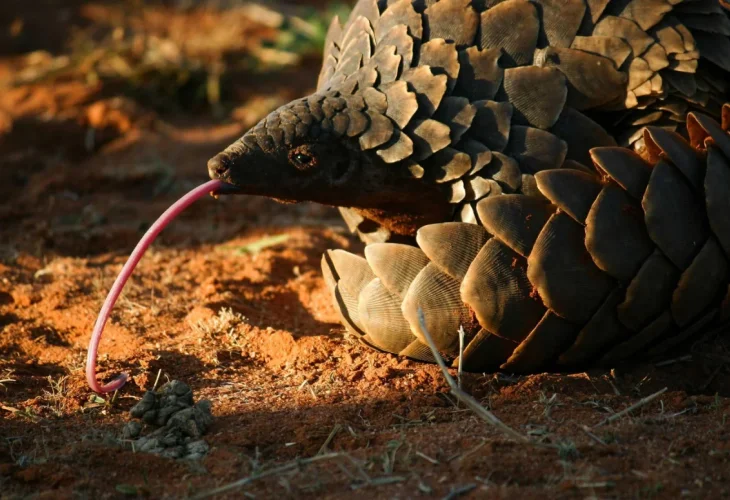
Imagine a small animal wandering through the forest after dark. Its body is covered in tough, overlapping scales, its tongue is unusually long, and when danger approaches, it has an extraordinary defense mechanism: it curls itself into a tight ball, using its natural armor to protect its vulnerable body.
Meet the pangolin, one of the world's most unusual mammals.
Its protective scales make it a difficult target for predators such as lions and leopards, which may struggle to break through its defenses. But against its greatest threat, humans, this remarkable survival strategy has become a dangerous weakness.
When a poacher approaches, a pangolin will often curl into a ball rather than attempt to escape. Unfortunately, this makes it easy to pick up and carry away.
It's one of the reasons this fascinating creature has become a symbol of the global illegal wildlife trade.
But what makes pangolins so unusual, why are they being hunted, and what could happen if they disappear?
What Makes Pangolins So Unique?
At first glance, a pangolin might look more like a reptile than a mammal. Its body is covered in hard, overlapping scales that form a protective layer of natural armor.
But unlike reptiles, pangolins give birth to live young and nurse their babies with milk.
Their scales are made of keratin, the same protein found in human hair and fingernails. When threatened, a pangolin can curl into a nearly impenetrable ball, protecting its soft underside from predators.
Pangolins also have remarkably long, sticky tongues, which they use to collect ants and termites from nests and narrow crevices.
Instead of chewing their food with teeth, which they lack, they swallow insects that are then ground up inside their muscular stomachs.
These unusual adaptations make pangolins highly specialized animals, perfectly suited to their natural environments.
Unfortunately, the very features that make them remarkable have also contributed to their decline.
Why Are Pangolins Hunted?
There are two main reasons pangolins are targeted by poachers: their meat and their scales.
In some countries, pangolin meat is considered an expensive delicacy. Their scales are also used in certain traditional medicine practices, despite the lack of reliable scientific evidence that they can treat illnesses.
The demand has fueled extensive international trafficking networks, with pangolins and their body parts illegally transported between countries and continents.
According to a report published in August 2025 by the International Union for Conservation of Nature (IUCN), seizures of pangolin products between 2016 and 2024 represented more than half a million animals.
These seizures occurred across 75 countries and involved 178 trafficking routes.
Approximately 99% of the seized body parts were pangolin scales.
Even more concerning, these figures account only for shipments intercepted by authorities. The true scale of illegal trafficking may be considerably greater.
Are Pangolins at Risk of Extinction?
There are eight species of pangolins worldwide, found across parts of Africa and Asia. All eight face threats to their survival, although their conservation status varies.
In 2017, strict international protections came into effect under the Convention on International Trade in Endangered Species of Wild Fauna and Flora (CITES), prohibiting commercial international trade in wild-caught pangolins.
However, despite these restrictions, illegal hunting and trafficking have continued.
One of the greatest challenges facing conservationists is determining how many pangolins remain in the wild.
These animals are naturally secretive, are primarily active at night, and often inhabit remote forests and other areas that are difficult for researchers to access.
As a result, scientists struggle to monitor their populations accurately.
In some regions, pangolin numbers could decline significantly before researchers are even able to detect the full extent of the problem.
What Would Happen if Pangolins Disappeared?
Pangolins are more than just fascinating creatures. They also play an important role in maintaining healthy ecosystems.
Because they consume large quantities of ants and termites, they help regulate insect populations and contribute to the natural balance of their habitats.
Their digging activities also benefit the environment. As pangolins search for food and create burrows, they disturb and loosen the soil, helping improve its structure and allowing air and water to move through it.
If pangolins disappear, these ecological functions could be disrupted, potentially affecting other animals, plants, and the environments they share.
Can Pangolins Be Saved?
Conservation organizations around the world are working to protect pangolins through a combination of anti-poaching efforts, habitat protection, wildlife rescue, and public education.
Animals confiscated from traffickers may be rehabilitated and, when possible, returned to suitable natural habitats.
Conservation groups are also working with local communities to raise awareness about the importance of protecting pangolins and reducing demand for illegally traded wildlife products.
But protecting these animals remains a significant challenge, particularly when international trafficking networks continue to profit from their capture.
The pangolin's story is a striking reminder that even an animal equipped with extraordinary natural defenses can be vulnerable to human activity.
For millions of years, its remarkable armor has helped protect it from predators. Today, however, its survival depends increasingly on something those scales cannot provide: protection from people.

