

Parashat Chayei Sarah
Why Is Isaac Connected to the Final Redemption?
Discover the deeper meaning of Isaac's name and how Chassidic teachings connect laughter, divine revelation, and the promise of everlasting joy.
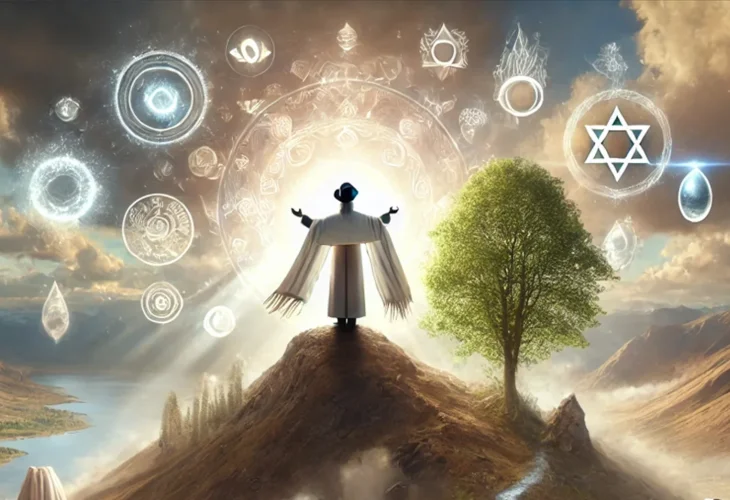
Our Sages teach that only three individuals are called the Patriarchs of the Jewish people: Abraham, Isaac, and Jacob. Each represents a unique approach to serving Hashem, and each offers timeless lessons that continue to guide us today.
Yet the Talmud reveals something extraordinary about Isaac (Yitzchak). In the time of the final redemption, he will be the one whom the Jewish people call "our father."
Why Isaac, specifically? What makes his spiritual mission so closely connected to the future redemption?
The answer lies in a remarkable teaching from the Talmud and the deeper meaning of Isaac's name.
Why Will the Jewish People Call Isaac Their Father?
The Talmud (Shabbat 89b) describes a fascinating exchange between Hashem and the three Patriarchs.
Hashem turns to Abraham and says, "Your children have sinned against Me." He then approaches Jacob with the same accusation.
But it is Isaac who responds by passionately defending the Jewish people and appealing to Hashem's mercy.
"Master of the Universe," Isaac asks, "Are they my children and not Your children?"
He reminds Hashem of the moment at Mount Sinai when the Jewish people declared, "We will do and we will hear," accepting the Torah with complete faith and commitment.
At that time, Hashem called Israel "My firstborn son." How, Isaac asks, can they now be described as belonging only to him?
Isaac continues his defense by pointing out that, when measured against the entirety of a person's life, the actual time spent committing sins is relatively small.
He then makes an extraordinary offer:
"If You bear them all, very well. And if not, half upon me and half upon You. And if not, all of them upon me, for I offered my soul before You."
Isaac is referring to the binding of Isaac, when he willingly submitted himself to Hashem's will.
According to the Talmud, the Jewish people will respond to Isaac's defense by declaring, "For you are our father."
But Isaac will immediately redirect their praise toward Hashem, reminding them that their ultimate source of salvation is not him, but the Creator Himself.
This remarkable passage reveals Isaac's extraordinary devotion to the Jewish people. Yet according to Chassidic teachings, it also points to a deeper connection between Isaac and the joy of the future redemption.
Why Is Isaac's Name Connected to Laughter?
The era of redemption is described by the prophets as a time of extraordinary happiness, when sorrow and suffering will give way to lasting joy.
As King David declares in Psalms (126:2):
"Then our mouths will be filled with laughter."
Similarly, Isaiah (35:10) describes the redeemed Jewish people with the words:
"Everlasting joy shall be upon their heads."
Chassidic teachings explain that this future joy is particularly connected to Isaac because his very name, Yitzchak, comes from the Hebrew word associated with laughter.
Interestingly, Abraham is associated with the quality of kindness, while Jacob represents truth. Yet neither of these qualities is directly expressed in their names.
Isaac, however, carries the idea of laughter within his name itself.
And this was no coincidence.
Even before Isaac was born, Hashem instructed Abraham to give his son this name. The command came before Sarah's laughter at the news of his birth and before the joy that would accompany his arrival.
This suggests that laughter was not merely a reaction to Isaac's miraculous birth. It was connected to his essential spiritual mission.
After his birth, Sarah declares:
"Hashem has made laughter for me; everyone who hears will laugh with me." (Genesis 21:6)
According to Chassidic teachings, these words contain a profound message about the purpose of Jewish life and the spiritual transformation of the world.
Finding Hashem Within a World That Conceals Him
To understand the deeper meaning of Sarah's words, we must first explore an important concept in Chassidic thought: the relationship between the divine names Elokim and Havayah.
The name Elokim is associated with the natural world and the concealment of Hashem's presence.
In fact, the Hebrew word hateva, meaning "nature," has the same numerical value as Elokim.
This connection teaches that the laws of nature can create the impression that the world operates independently, according to its own systems and processes.
We see the sun rise, plants grow, and seasons change. Because these events happen so regularly, it is easy to forget the divine power sustaining them.
The name Havayah, by contrast, represents Hashem's infinite existence and revelation, beyond the limitations of time and nature. It points to the One who was, is, and always will be.
Chassidic teachings explain that our spiritual task is to look beyond the apparent independence of the physical world and recognize Hashem's presence within every aspect of creation.
This does not mean denying the existence of the physical world. Rather, it means recognizing that everything depends entirely on Hashem and has no independent existence apart from Him.
This idea is expressed through two Hebrew terms: yesh, meaning "something," and ayin, meaning "nothingness."
Yesh represents the feeling of being an independent existence, separate from Hashem.
Ayin represents the recognition that everything derives its existence from Hashem and is completely dependent upon Him.
The spiritual mission of a Jew is to transform the experience of yesh into an awareness of ayin, replacing the illusion of independence with recognition of divine reality.
How Does Spiritual Transformation Create Joy?
At first glance, what does any of this have to do with laughter?
Chassidic teachings explain that laughter often arises when something unexpected happens, particularly when an ordinary situation is transformed in a surprising way.
Hashem created a world in which His presence is concealed. The physical world appears to operate independently, and human beings naturally experience themselves as separate individuals.
Yet when a person overcomes that concealment and chooses to recognize Hashem's presence, something extraordinary happens.
A world that seems disconnected from its Creator becomes a place where divine truth is revealed.
When a person sets aside selfish desires, overcomes spiritual obstacles, and acts according to Hashem's will, the apparent independence of the physical world is transformed into an expression of holiness.
According to Chassidic teachings, this transformation brings delight above, so to speak, because it fulfills the purpose for which Hashem created the world.
This is the deeper meaning of Sarah's declaration, "Hashem has made laughter for me."
The divine name Elokim, representing concealment within nature, becomes the very source of joy when that concealment is overcome.
The laughter is born from the transformation itself: what once appeared to hide Hashem becomes a means of revealing Him.
What Can We Learn From Isaac Digging Wells?
This spiritual mission is also reflected in one of the most distinctive activities described in Isaac's life: digging wells.
The Torah tells us that Isaac worked to uncover sources of water that had been buried or blocked.
On a simple level, these wells provided the water necessary for life.
But Chassidic teachings reveal a deeper symbolism.
Water represents spiritual vitality and holiness. When it lies hidden beneath the earth, it is present but concealed from view.
Digging a well does not create the water. It removes the layers of earth that prevent the water from being revealed.
In the same way, Isaac's spiritual mission was to uncover the holiness already present within the world.
Rather than escaping the physical world, he worked to reveal the divine life concealed within it.
This is also the task of every Jew.
We encounter situations in which Hashem's presence may seem hidden. We face challenges, distractions, temptations, and circumstances that make it difficult to recognize a deeper spiritual purpose.
Our responsibility is to remove those barriers through Torah, mitzvot, and sincere service of Hashem.
In the language of Chassidut, this means overcoming the influence of the sitra achra, the "other side," referring to forces that oppose holiness, and breaking through the kelipah, or spiritual shell, that conceals divine light.
By doing so, we reveal the holiness that was previously hidden.
How Our Actions Bring the Redemption Closer
The connection between Isaac and the future redemption now becomes clearer.
Isaac represents the spiritual work of transforming concealment into revelation, of uncovering holiness within a world that often seems disconnected from its Creator.
The final redemption will mark the fulfillment of this process, when Hashem's presence will be openly recognized and the concealment that characterizes our present world will give way to divine revelation.
That is why the redemption is described as a time of laughter and everlasting joy.
The transformation will be complete.
And according to Chassidic teachings, every Jew has a part in bringing that future closer.
Each time we overcome a temptation, perform a mitzvah, or choose to recognize Hashem's guidance within our everyday lives, we help reveal the divine purpose hidden within creation.
Even the smallest act of spiritual growth contributes to this greater transformation.
Isaac teaches us that holiness is not always something we must search for in distant or extraordinary places. Often, it is already present beneath the surface, waiting to be uncovered.
And when the world finally reveals the divine light hidden within it, the promise of the prophets will be fulfilled:
"Then our mouths will be filled with laughter."
Adapted from the teachings of Rabbi Dov Menachem Dobruskin.

