

Challah
More Than Bread: The Story of Challah
The origins of hafrashat challah, the evolution of the Shabbat loaf, and how an ancient kitchen ritual became a worldwide expression of Jewish identity and prayer.
- Maayan David
- | Updated
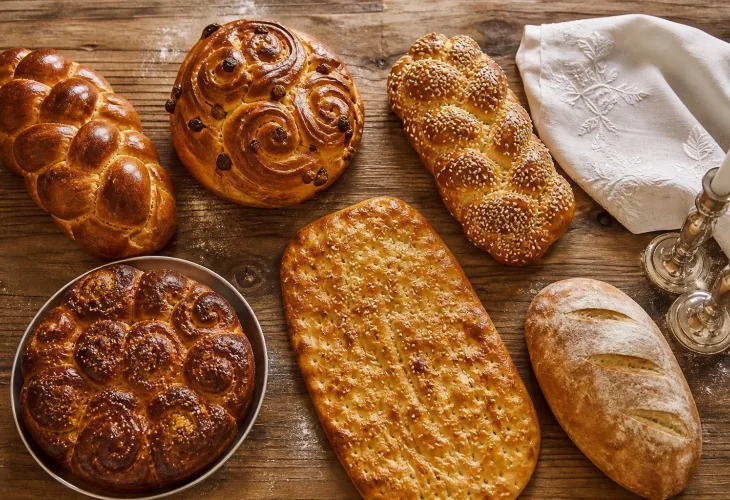 Illustrative image: Shabbat breads from Jewish communities around the world
Every Friday afternoon, in kitchens from Jerusalem to Johannesburg, a ritual unfolds that has changed very little in some two thousand years. Flour, water, yeast and patience come together. At a certain moment, the baker pulls off a small lump of dough, says a few words, and sets it aside. The lump is not baked or eaten. It is, in the language of the Torah, no longer yours.
This is hafrashat challah, the separation of the dough offering. For most of Jewish history it was a quiet and domestic mitzvah, performed without an audience or any fanfare. Today it fills stadiums, wedding halls and Instagram feeds. How did it happen? Let’s explore a story about bread, law, memory and the strange power of a ritual that asks you to give something away at the exact moment you've finished making it.
A Gift Written Into the Dough
The source is in the book of Numbers. When the Israelites enter the land, they are told to lift up the first of their dough as a gift. The commandment appears in Numbers 15:17-21, and the Mishnah and the Jerusalem Talmud each contain a tractate, Challah, devoted to working out its details. The text is brief, and the rabbis spent centuries filling in the gaps.
Notice what the word challah meant at the beginning. In its earliest sense it was the portion given to the priest, not a loaf; the term for Shabbat bread appears in a work written in Austria in 1488. The loaf on your table borrowed the name of the offering that was removed from it.
The law is demanding about where and when it applies. By Torah law, the obligation applies only in the Land of Israel, as the verse speaks of eating "the bread of the land," and only when the Jewish people are living there together. After exile, the rabbis kept the mitzvah alive anyway. The practice continues outside Israel as a rabbinic enactment, "so that we do not forget it," which ties the diaspora kitchen back to the Land.
Not every loaf qualifies. The obligation covers dough made from the five grains: wheat, barley, rye, oats and spelt. And there is a minimum amount. Below a certain amount of flour, nothing needs to be separated. Above it, you must separate, and above a higher threshold you also say a blessing. Authorities disagree on the numbers. Opinions range from about three pounds to five pounds of flour for a blessing, with the Mishnah Berurah allowing reliance on the smaller figure. Some contemporary sources put the blessing threshold at roughly sixteen and a half cups of flour, just under five pounds. Many a home baker has stood over a kitchen scale asking whether the flour in the bowl is enough.
The mitzvah does not belong to a particular group of people. It applies to everyone who kneads, as discussed in the Mishnah and codified in the Shulchan Aruch, Yoreh De'ah 322.
Then there's the question of what to do with the portion. With no Temple and no priests able to eat it, the practice changed. A common instruction is to take a piece about the size of a ping-pong ball, then either burn it or wrap it in two coverings and discard it. The one who separates it says a blessing, pulls out the dough and declares that it is challah.
Two Loaves, One Miracle
The mitzvah of separating dough is one thing. The Shabbat loaf is another, and their kinship is mostly one of name.
The two loaves on the Shabbat table come from the desert. In Exodus 16, manna fell daily, but on Fridays a double portion arrived, so nobody had to gather food on the day of rest. The Talmud (Shabbat 117b) has Rabbi Abba teach that one must break bread over two loaves, because the Torah describes the "double bread" gathered on the sixth day. The custom is called lechem mishneh. It applies on festivals as well as Shabbat, since manna did not fall on holidays either.
There is a nice detail about the mechanics. The Rama records a custom to knead enough dough on Friday to require separating challah and to use it for all the bread of the Shabbat meals, which stitches the two ideas together: the very act of preparing Shabbat bread puts you under the obligation of the dough offering. The dough you set aside and the dough you serve come from the same bowl.
The Braid Arrives
The braided loaf that most people now picture when they hear the word "challah" is a surprisingly late arrival. Before the fifteenth century, Ashkenazi Jews had no dedicated Shabbat bread and simply used a good white loaf, as many non-Ashkenazi Jews still do.
Then the shape changed. Braiding emerged in the fifteenth century among Ashkenazi Jews in Austria and southern Germany. The loaf was called berches, and it came with a past. The food historian Gil Marks traced it to a German festive bread, braided in imitation of a hair offering to appease a figure of folklore, the witch Holle. The Jews who baked it kept the plait and dropped the mythology.
Berches was a modest bread. It was typically made without eggs, and for that reason was sometimes called "water challah." Many versions added mashed potato for moisture. While weekday loaves were whole-grain and brown, berches used white flour, which helped mark the day as different. The richer, eggy, sweeter loaf familiar in America is a later development, shaped by Eastern European habits and immigrant kitchens. The name challah took over in America, and by around 1920 the Hebrew spelling had won out. Yet origins are not settled territory. At least one scholarly article has challenged the assumption that the braided loaf is purely Ashkenazi, arguing for a Sephardi connection. Bread history, like bread itself, resists being cut into clean slices.
A Map of Shabbat Breads
Walk the Jewish world and the idea of "challah" quickly stops meaning one thing. Sephardic Jews commonly used the flatbreads of their surroundings, while Central European Ashkenazi communities gradually embraced richer, leavened loaves.
The variety is dazzling. Yemenite Jews traditionally serve lachuch, a flat fried bread, and Persian Jewish tables feature barbari, a flat glazed loaf. Kubaneh, the Yemenite pull-apart bread baked overnight, is served on Shabbat morning with eggs, tomato and zhoug. Morocco gave the world pain petri, a braided Shabbat bread brushed with egg wash and topped with sesame seeds, and Moroccan Jews are also known for a turban-shaped loaf. Turkish Jews formed crescents, and North African bakers added saffron and sculpted flower-shaped loaves. Algeria has mouna, and Ethiopia dabo.
Even halacha shows regional accent. In Sephardic practice, a bread with too much sugar is reclassified as cake, which would change its blessing and disqualify it for Shabbat Kiddush. A sweet loaf that delights one table can be a problem at another.
The calendar adds shapes. For Rosh Hashanah, loaves are made round or spiral, often with raisins for a year of plenty. Some communities bake a "schlissel," or key, challah on the first Shabbat after Passover, shaped like a key or with a foil-wrapped key baked inside.
From Kitchen Corner to Main Stage
Which brings us back to the pinch of dough. For centuries, hafrashat challah was mostly a household matter. Then, in 2013, it stepped into public life.
The first big challah bake of the Shabbos Project was launched in South Africa in 2013, by organizer Robyn Smooker. The idea was simple: gather people to knead, separate and braid, as a prelude to keeping one full Shabbat together. It spread with startling speed. In 2015, over 1,700 people were ready to knead in Cape Town on opening night. Johannesburg had 5,000 registered for its own bake, with a live video link to Tel Aviv. Brooklyn unveiled a twenty-foot, six-stranded challah that earned a Guinness record. In Baltimore, more than two thousand people braided at the Pimlico Race Course. By the ninth year, the project reported 1,166 citywide events across the world.
One Jerusalem account gets at the mood. The event, in a hall that looked like a wedding venue, had a guest speaker relay a saying attributed to Rav Kanievsky: if people knew how powerful their prayers are at the moment of separating challah, no one would buy bread in stores. That, in a sentence, explains the surge. The moment of separation has become, for many, a moment of prayer.
Many sources describe it as an especially auspicious time for personal requests, and encourage prayer for health, a soulmate, or wholeness. One popular explanation offers a bit of numerology: the Hebrew letters of challah add up to 43, the same as the word gam, "also." Another explanation links the practice to a verse in Ezekiel and the idea that it brings blessing into the home.
And the circle widened well beyond the traditionally observant. One Israeli report describes how a private mitzvah has become a staged social event drawing secular participants, young people and celebrities. Winter and summer wedding seasons bring many separation ceremonies, bridal evenings among them, and the largest event the organizer led drew four thousand people. Some bat mitzvah celebrations bake bread and lead guests in the blessing.
Then came October 7, and the mitzvah took on a new register of urgency. Communities around the world gathered to separate challah and pray for Israel, and secular Israelis attended small gatherings for the first time. The events grew pointed and specific. In London, the Hostages and Missing Families Forum hosted an event for 133 participants, matching the number of hostages still in captivity, each making a "key" challah. In Ohio, every placemat carried the name of one hostage, so that each person would pray for a particular name as the dough was separated. An Israeli baker writing in the Jerusalem Post noticed that nearly everyone she spoke with had taken up challah-making since that day.
Is the popularity a sign of depth, or of a trend? Even insiders are candid. One organizer quoted by Ynet describes the mitzvah as increasingly seen as a social trend, alongside attending Selichot prayers, and says she tries to make it accessible to people who have no idea what it is. Both things can be true. A mitzvah can arrive in a room as an Instagram moment and still leave someone with the sense of having given something up.
The Pinch That Stays
Back in the kitchen, the logic hasn't changed. As with all first-fruit gifts, hafrashat challah reminds us that though we toiled to make our bread, it does not wholly belong to us. You work, you succeed, you pull away a piece, and you say: not all of this is mine.
That may be why this small act keeps finding new rooms to live in. The bread changed shape across centuries and borders: from plain loaf to braided berches, from flatbread to kubaneh, from a village oven shared with Christian neighbors to a stadium filled with thousands of mixing bowls. The pinch stayed. It travels well. It needs only flour, a few words and a moment of attention, and it can happen anywhere there is dough.

