

Torah Personalities
Who Was Haggai the Prophet? 10 Fascinating Facts
Discover the life and legacy of Haggai, one of Judaism's last prophets, whose powerful message inspired the rebuilding of the Second Temple in Jerusalem.
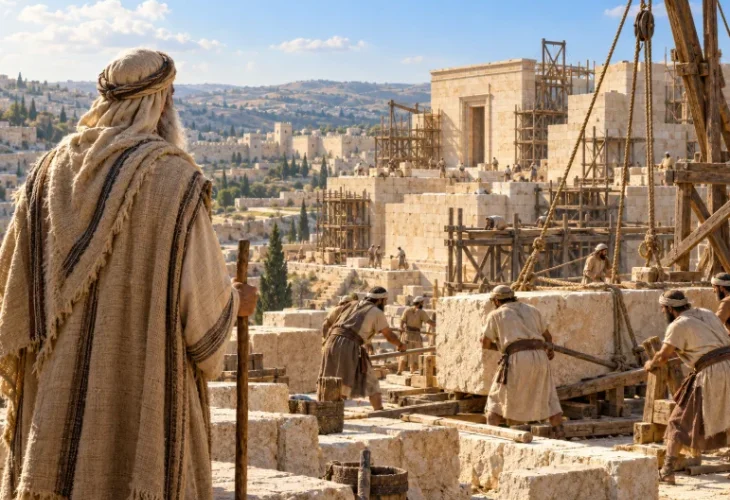
After 70 years of Babylonian exile, the Jewish people finally began returning to Jerusalem. The opportunity to rebuild the Holy Temple, which had been destroyed by the Babylonians, was within reach.
But the return to Zion was far from easy.
The Jewish people faced severe economic hardship, opposition from neighboring nations, and the overwhelming challenge of rebuilding a Temple that had once stood as the spiritual center of Jewish life. Although construction had begun, the work eventually came to a halt.
As the years passed, the initial excitement of returning to Jerusalem faded. The people became increasingly concerned with their daily struggles, and rebuilding the Temple seemed like an impossible task.
It was during this difficult period that Hashem sent Haggai the prophet (Chaggai) to deliver a powerful message: the time had come to rebuild His House.
Haggai's prophecies encouraged the Jewish people to overcome their difficulties, renew their commitment to Hashem, and begin rebuilding the Second Temple.
Here are 10 fascinating facts about Haggai, one of the last prophets in Jewish history, and the remarkable message of his biblical book.
1. Haggai Was a Prophet During the Return to Zion
Haggai lived during the period when the Jewish people began returning to the Land of Israel following the Babylonian exile.
His book is the tenth of the Twelve Minor Prophets, a collection of prophetic writings found in the Hebrew Bible.
Despite its importance, the Book of Haggai contains only two chapters, making it one of the shortest books of the Prophets.
Its central message is clear: the Jewish people must resume construction of the Second Temple and restore Jerusalem's spiritual significance.
Unlike prophetic books that address many different generations and events, Haggai focuses on a specific historical moment, when the future of the Temple depended on the people's willingness to act.
2. He Was Sent to Inspire a Discouraged Nation
Approximately 18 years after Cyrus, king of Persia, issued his declaration permitting the Jewish exiles to return and rebuild the Temple, the situation in Jerusalem remained difficult.
The Temple was still unfinished, neighboring nations had interfered with construction, and the people were struggling financially.
The enthusiasm described at the beginning of the Book of Ezra had gradually given way to frustration and uncertainty.
Haggai captured their hardship in a vivid description:
"You have sown much, and brought in little; you eat, but there is not enough to be satisfied; you drink, but not enough to be merry; you clothe yourselves, but no one is warm; and he who earns wages, earns wages into a bag with holes." (Haggai 1:6)
The people were working hard, yet their efforts seemed to produce little reward.
Haggai was sent to awaken their sense of purpose and encourage both the people and their leaders: Zerubbabel son of Shealtiel, the governor of Judah, and Joshua son of Jehozadak, the High Priest.
His message was that rebuilding the Temple was not an impossible dream. It was a responsibility they could fulfill, and their future blessing was connected to their willingness to undertake it.
3. Haggai Taught That a Temple Did Not Need to Be Magnificent to Be Holy
One of the greatest obstacles facing the returning exiles was the memory of Solomon's Temple.
The First Temple had been a magnificent structure, and the people lacked the wealth and resources needed to recreate its former splendor.
For those who remembered its glory, the prospect of building something far more modest may have seemed disappointing.
Haggai challenged this way of thinking.
He taught that the Jewish people should not delay rebuilding simply because they could not produce a Temple as impressive as the original.
Hashem did not need their wealth. He wanted their dedication and their willingness to restore His House.
As the prophet declared:
"The silver is Mine, and the gold is Mine, says Hashem of Hosts." (Haggai 2:8)
Haggai also delivered a remarkable promise:
"Great shall be the glory of this latter House more than the first, says Hashem of Hosts." (Haggai 2:9)
The message was that the Temple's significance would not be determined solely by the resources available at the beginning of construction.
The people responded to Haggai's call, and the Second Temple was eventually completed and dedicated in the sixth year of the reign of Darius, king of Persia.
4. Very Little Is Known About Haggai's Personal Life
Although Haggai played an important role in Jewish history, the Bible provides remarkably little information about his personal life.
We do not know much about his family, upbringing, or the circumstances in which he first became a prophet.
He is mentioned primarily in his own book and in the Book of Ezra (5:1 and 6:14).
The Book of Ezra describes how Haggai and Zechariah prophesied to the Jewish people and how their encouragement helped advance the rebuilding of the Temple.
Rather than focusing on Haggai's personal biography, the biblical account emphasizes his mission and the impact of his words.
His legacy is therefore closely connected to the restoration of the Second Temple and the spiritual renewal of the Jewish people.
5. He Was a Member of the Great Assembly
Haggai was not only a prophet. According to Jewish tradition, he also played an important role in the transmission of the Torah from one generation to the next.
Maimonides, known as the Rambam, explains in his introduction to the Mishneh Torah that Ezra and his court received the Torah tradition from Baruch ben Neriah and his court.
Ezra's court included the sages known as the Men of the Great Assembly (Anshei Knesset HaGedolah).
Among them were Haggai, Zechariah, and Malachi.
The Great Assembly played a central role in preserving and strengthening Jewish religious life during the early Second Temple period.
Haggai's inclusion among its members highlights his importance not only as a prophet who inspired the rebuilding of the Temple, but also as a link in the chain of Torah transmission.
6. His Teachings Were Connected to the Aramaic Translation of the Prophets
The Talmud in Megillah (3a) teaches that the Aramaic translation of the Prophets was transmitted by Yonatan ben Uziel from the teachings of Haggai, Zechariah, and Malachi.
Aramaic was widely spoken among Jews during parts of the Second Temple period and afterward, making translations of biblical texts especially important.
These translations helped make the words of the Prophets accessible to those who were less familiar with biblical Hebrew.
The Talmud's statement demonstrates the enduring authority of Haggai and his fellow prophets, whose teachings continued to influence the understanding and transmission of Scripture long after their lifetimes.
7. Haggai Was One of the Last Prophets in Jewish History
Haggai is frequently mentioned alongside Zechariah and Malachi, the three prophets traditionally associated with the final period of biblical prophecy.
According to the Talmud, their deaths marked the end of an extraordinary era in Jewish history.
The Sages teach:
"When Haggai, Zechariah, and Malachi died, the Holy Spirit departed from Israel, and nevertheless they would make use of a bat kol." (Sotah 48b)
A bat kol, literally a "daughter of a voice," refers to a heavenly voice or form of divine communication.
The Talmud explains that although the era of classical prophecy had ended, certain forms of heavenly guidance were still experienced.
Haggai therefore stands at a significant turning point in Jewish history, connecting the age of the biblical prophets with the generations of sages who followed.
8. His Name Has Connections to Other Biblical Figures
The name Haggai, along with related forms, appears elsewhere in the Bible.
One of the sons of Gad, a son of Jacob, was named Haggi (Genesis 46:16). His descendants are also mentioned in Numbers 26:15.
Another related name is Haggith, one of King David's wives and the mother of Adonijah.
Although these figures are not identified with Haggai the prophet, the similarity of their names reflects a recurring biblical naming tradition.
The modern Israeli community of Beit Hagai also bears the prophet's name.
9. His Book Describes How the People Responded to His Call
One of the most striking features of the Book of Haggai is that it does not simply record a prophet delivering a warning. It also describes how the Jewish people responded.
At the beginning of the book, Haggai explains that the people's economic difficulties are connected to their neglect of the Temple.
They have been occupied with their own homes while Hashem's House remains in ruins.
The prophet declares:
"You looked for much, and behold, it came to little; and when you brought it home, I blew upon it. Why? says Hashem of Hosts. Because of My House that lies in ruins, while each of you runs to his own house!" (Haggai 1:9)
He continues by explaining that the heavens have withheld their dew and the earth its produce.
The message was direct: the people had placed their personal concerns ahead of rebuilding the spiritual center of the nation.
But Haggai's words did not fall on deaf ears.
The book records that Zerubbabel, Joshua the High Priest, and the remaining people listened to the prophet's message.
"And Zerubbabel son of Shealtiel, and Joshua son of Jehozadak the High Priest, and all the remnant of the people, heeded the voice of Hashem and the words of Haggai the prophet." (Haggai 1:12)
Soon afterward, the people resumed their work on the Temple.
Haggai's prophecy had accomplished its purpose: it transformed discouragement into action.
The prophet also promised that the glory of the Second Temple would surpass that of the First.
The Talmud later describes the extraordinary beauty of the Temple as rebuilt by Herod.
In Sukkah (51b), the Sages declare that anyone who had not seen that Temple in its splendor had never seen a truly magnificent building.
This later grandeur is understood as one expression of the fulfillment of Haggai's prophecy.
10. He Promised Blessing From the Day the Temple Was Founded
One of the most significant turning points in the Book of Haggai occurs on the 24th day of the Hebrew month of Kislev.
On that day, Haggai delivered a prophecy connecting the renewed foundation of the Temple with a change in the people's fortunes.
Until then, the land had suffered from poor harvests and economic difficulties.
But the prophet announced that a new period was beginning.
"From this day I will bless." (Haggai 2:19)
According to Haggai's message, the people's renewed commitment to building Hashem's House would bring blessing to their agricultural and economic lives.
The promise was not merely about financial prosperity.
It reflected a deeper spiritual principle: when the Jewish people renewed their dedication to Hashem and placed His service at the center of their lives, they opened the way for blessing.
The 24th of Kislev thus became a significant date in Haggai's prophecies, marking the transition from neglect and hardship toward renewed commitment and hope.
Haggai's Timeless Message: Don't Wait for Perfect Conditions
Although Haggai lived more than 2,400 years ago, his message remains deeply relevant.
The Jewish people of his generation faced genuine obstacles. They lacked resources, struggled economically, and encountered opposition from those around them.
It would have been easy to conclude that rebuilding the Temple should wait until conditions improved.
But Haggai taught them that spiritual responsibilities cannot always be postponed until life becomes comfortable.
Sometimes, the first step must be taken while difficulties still exist.
The returning exiles did not have the wealth of King Solomon or the security of earlier generations. What they did have was the opportunity to rebuild, and the willingness to act upon Hashem's command.
Through Haggai's encouragement, they found the strength to begin again.
His short biblical book preserves a powerful lesson about faith, perseverance, and priorities: we do not always need perfect circumstances to begin doing what is right.
Sometimes, the blessing begins when we take that first step.

