

Interesting
800 Lawyers and Judges Gather to Study the Talmud
A Chabad rabbi's request for an $1,800 donation sparked an annual conference where 800 lawyers and judges explore modern legal issues through the Talmud.
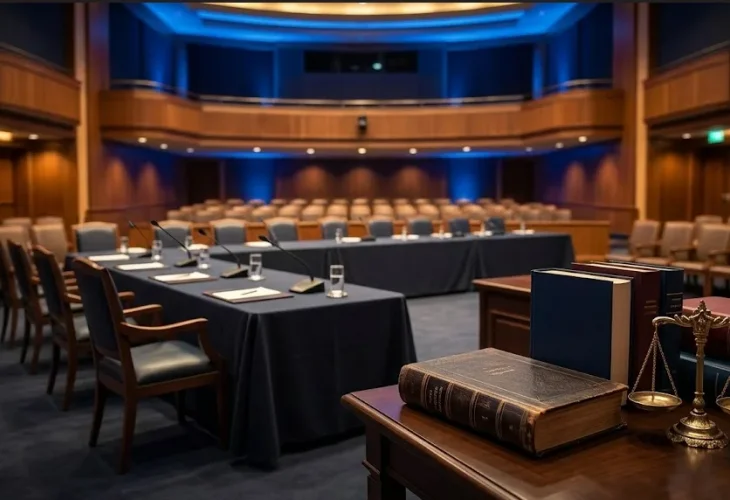
What began as a simple fundraising meeting between a Chabad rabbi and a Jewish attorney in New Jersey has grown into an annual gathering that attracts hundreds of lawyers and judges eager to explore modern legal dilemmas through the wisdom of the Talmud.
The remarkable initiative began with a few names scribbled on a napkin and a question that seemed unlikely to lead anywhere.
Rabbi Shalom Lubin, a Chabad emissary in New Jersey who founded a local Chabad House with his wife, had arranged a meeting with a Jewish attorney to seek financial support for his work.
But as their conversation turned to the legal profession, Rabbi Lubin recognized an unexpected opportunity.
What if Jewish attorneys could come together to discuss contemporary legal issues through the lens of the Talmud and Jewish law?
He asked the attorney whether his colleagues might be interested in attending an evening devoted to exploring the connections between modern law and ancient Jewish teachings.
The attorney was skeptical. He doubted that many legal professionals would be interested in such an event, but he nevertheless wrote down a handful of names on a napkin, suggesting a few people who might be willing to attend.
Neither man could have imagined what that small gesture would eventually become.
Rabbi Lubin believed that the Talmud, with its extensive discussions of justice, ethics, responsibility, and human behavior, could offer legal professionals a valuable perspective on the complex questions they encounter in their work.
And so, an idea that began on a napkin gradually developed into an annual conference bringing together Jewish scholarship and the American legal system.
From a Handful of Names to an Annual Legal Conference
The first conference took place in June 2007 at the Rabbinical College of America in Morristown, New Jersey.
Rabbi Shlomo Yaffe presented the Talmudic perspective on legal issues, while attorneys Stuart Lederman and Howard Danzig explored the corresponding questions in contemporary law.
The concept quickly gained momentum.
By the following year, the gathering had adopted a panel discussion format, allowing participants to explore legal and ethical questions from multiple perspectives.
Attendance continued to grow, and law firms began reserving entire tables for their attorneys.
What had started as a small attempt to connect Jewish professionals with their heritage was becoming an established event within New Jersey's legal community.
Over the years, the conference has addressed a wide range of issues relevant to both Jewish law and modern society.
Topics have included individual rights, professional ethics during economic crises, cancel culture and the possibility of personal rehabilitation, questions of war and peace, and the role of truth in the pursuit of justice.
These discussions highlight how questions that appear uniquely modern often have parallels in Jewish legal and ethical teachings developed centuries ago.
800 Attorneys and Judges Explore Jewish Legal Ethics
The twentieth annual gathering, held recently, marked another milestone for the initiative, drawing approximately 800 attorneys and judges.
This year's discussion focused on the ethics of conflicts of interest, examining how Torah principles can inform the responsibilities and decisions of legal professionals.
Rabbi Lubin moderated a panel featuring federal appeals court Judge Patty Shwartz, New Jersey State Senator Jon Bramnick, and Rabbi Michael Broyde, a professor at Emory University School of Law.
The event brought together perspectives from the judiciary, government, academia, and Jewish scholarship, demonstrating how traditional Jewish sources can contribute to conversations about contemporary professional ethics.
For many participants, however, the conference offers something beyond intellectual discussion. It provides an opportunity to connect their professional identities with their Jewish heritage.
One of those participants is Jason Navarino, a partner in the corporate and tax practice at McCarter & English in Newark.
Navarino's connection to the event goes back to his time clerking for Justice Albin. During that period, he witnessed Rabbi Lubin invite the justice to participate in the conference and even helped him prepare his remarks.
A Princeton graduate, Navarino first encountered Chabad while spending a semester at Oxford University.
Since then, his involvement in Jewish communal life has continued to grow. He has served as president of his Jewish congregation and was recently elected to the board of the Jewish Lawyers Association of New Jersey.
For Navarino, the annual conference brings together people from different areas of his life, including friends, professional colleagues, and members of his synagogue.
“It brings all of my worlds together,” he explains.
He also believes that exploring the relationship between Jewish teachings and his work as an attorney has strengthened his personal connection to Judaism.
“It makes me proud to be a Jew first, and a lawyer second.”
The Donation That Never Came, and the Opportunity That Followed
Looking back on the initiative's unlikely beginnings, Rabbi Lubin sees a remarkable lesson in how unexpected opportunities can emerge from seemingly ordinary encounters.
After all, his original intention was not to organize a legal conference or establish an annual gathering for hundreds of Jewish professionals.
He had simply gone to a meeting hoping to secure an $1,800 donation for his Chabad House.
Instead, the conversation took an entirely different direction, leading to an idea that would eventually connect countless attorneys and judges with Jewish learning.
Today, Rabbi Lubin reflects on what might have happened if the attorney had simply written him the check he originally came to request.
Had he received that donation, he believes, the conference might never have existed.
What began as an unsuccessful fundraising opportunity became something far greater: an enduring initiative that continues to bring Jewish wisdom into conversations about justice, ethics, and the law.
And it all started with a few names written on a napkin.

