

Behind the News
The Streets Are Burning: Is France's Jewish Exodus Beginning?
Amid growing fears over safety and political instability in France, thousands of French Jews are considering moving to Israel. Ariel Kandel, CEO of Qualita, explains why aliyah is becoming increasingly urgent and what Israel must do to help families build new lives.
- Michal Arieli
- | Updated
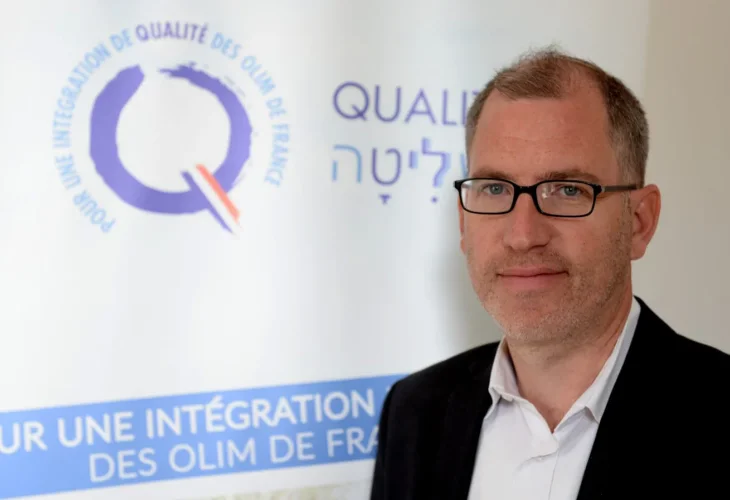 Ariel Kandel, CEO of Qualita, the umbrella organization for French immigrants in Israel (Photo courtesy of the organization)
The disturbing images emerging from the streets of Paris—burned-out shops, widespread vandalism, destruction, and violent crowds—have shocked observers around the world. For France’s Jewish community, however, the unrest represents far more than another wave of social or political protests. It has intensified fears about their safety and raised troubling questions about the future of Jewish life in the country.
“The demonstrations we are seeing in the streets were never supposed to have anything to do with Jews,” explains Ariel Kandel, CEO of Qualita, the umbrella organization representing French immigrants in Israel. “These are protests involving students and young people, particularly from minority communities, that repeatedly end in destruction across Paris and other parts of France.”
According to Kandel, the unrest has also become entangled in the country’s political struggles. “Some people believe the rioters are simply enjoying themselves. Others see a connection to the elections scheduled for May. The far left is attempting to capitalize on the protests to overcome a shortfall of 400,000 votes after failing to reach the second round in the previous election. They are now trying to use the events of October 7 to gain political support, which is how Israel has become part of the conversation.”
How are the elections in France connected to events in Israel?
Kandel believes that radical Islamist groups are playing a significant role in the unrest, which some observers regard as a possible preview of the tensions surrounding the upcoming elections.
“According to the polls, the right-wing candidate appears likely to become France’s next president,” he says. “The greatest concern is how the country’s Muslim population will respond. If widespread demonstrations continue not for a few weeks, but for months, with protesters determined to remain in the streets indefinitely, Jewish communities could find themselves among the first to suffer.”
He emphasizes that these concerns extend well beyond his own organization. “Jewish community leaders have been sounding the alarm, and the issue dominates coverage in the French Jewish press. It is constantly being discussed in the media and within Jewish households. It feels as though there is hardly a Jewish family in France that is not talking about aliyah. People increasingly believe that the situation cannot simply be ignored.”
Do you believe these fears are justified?
“Unfortunately, yes. The outlook is deeply concerning,” Kandel responds.
He points to the vulnerability of Jewish businesses and institutions, particularly those that are easily identifiable. “Anyone intent on targeting Jewish life does not necessarily have to approach a synagogue or community center. Paris alone has approximately 200 kosher restaurants, and these are highly visible, accessible locations.”
Kandel says that concerns about personal security have also entered Jewish homes. Families worry that information shared routinely with delivery workers and service providers—including addresses, telephone numbers, and building access codes—could potentially be misused.
“People are genuinely afraid that someone could gain access to their homes,” he explains. “They feel that information once considered private is now available to too many people. Whether or not every fear is realized, the anxiety itself has become part of daily life.”
The growing sense of insecurity is reflected, Kandel says, in the number of French Jews considering a move to Israel.
“During 2026, 4,200 immigrants have arrived in Israel from France, and the year is not yet over. That is more than 1,000 above the number of immigrants from the United States, despite the American Jewish population being approximately ten times larger. We estimate that immigration from France could reach 10,000 people next year.”
Does this mean that French Jewry is approaching its end?
“It would be premature to say that,” Kandel replies. “France still has dozens of synagogues, 25 Jewish high schools, and nearly 100 Jewish schools. A community with such extensive institutions is not going to disappear overnight.”
Nevertheless, he believes the demographic trend is unmistakable. “When we organize aliyah fairs, approximately 4,000 families register. Based on our estimates, that represents close to 20,000 people actively exploring the possibility of leaving France.”
Kandel explains that until several years ago, the French Jewish population actively connected to communal life was commonly estimated at around 200,000. He estimates that roughly one-third have immigrated to Israel over the past decade, leaving fewer than 150,000 today.
“If another 50,000 arrive in Israel over the next two years, the remaining community will be less than half its former size, and the decline is likely to continue. French Jewry will not cease to exist, but there is little doubt that its population will become significantly smaller.”
If so many families are considering aliyah, what prevents them from leaving?
“Because leaving France means giving up an enormous amount,” Kandel explains. “Immigration is not simply a matter of purchasing a plane ticket. It involves uprooting an entire life.”
France's extensive social welfare system is one of the greatest obstacles. According to Kandel, families are accustomed to generous healthcare and educational benefits, including coverage for dental care, eyeglasses, and university studies. He also points to unemployment benefits, paid vacation, and other social protections that provide families with a level of financial security they fear losing.
“People who have worked in France for two years may be entitled to two years of unemployment benefits amounting to 80 percent of their salary. Employees receive five weeks of annual vacation, and the list of benefits is extensive,” he says.
“For a family that has built its life around these protections, moving to Israel requires considerable sacrifice. Even people who desperately want to leave may hesitate when they consider the practical consequences.”
That is precisely why Kandel believes Israel must do more to encourage and support potential immigrants. “We have an opportunity to help tens of thousands of people, but we cannot expect them to make such a significant move without support. If we fail to create the necessary conditions, many will simply remain where they are, despite their concerns.”
What alternatives do French Jews have besides moving to Israel?
“Very few,” Kandel says. “Antisemitism is also a concern in other European countries, so moving from France to another European destination does not necessarily solve the problem.”
He notes that Britain, once a popular destination for French Jewish families, is no longer considered an attractive alternative by many prospective emigrants. Australia and South Africa have similarly fallen out of favor.
“Miami may be an option for some, but only for people who have significant financial resources and the necessary immigration status. That generally means younger, wealthier individuals. For families with children, relocating to the United States can be prohibitively difficult.” As a result, he believes Israel is increasingly becoming the only practical destination for many French Jewish families.
Yet the difficulties of integration remain substantial. “We cannot realistically promise immigrants everything they currently receive in France,” he acknowledges. “But that does not mean we cannot provide meaningful assistance.”
Kandel calls for a comprehensive national strategy addressing employment, education, housing, bureaucratic obstacles, and community integration. Assistance with rental payments during the first year, guidance through administrative procedures, and programs that help families establish themselves in suitable communities could make a considerable difference.
Above all, he emphasizes the importance of education. “For many families, education is the greatest concern. In France, children generally remain in school until the afternoon, and by the time they return home, the weather often keeps them indoors. In Israel, educational frameworks may finish considerably earlier, leaving children with more unstructured time.”
For young immigrants already struggling with language barriers, cultural differences, and the emotional challenges of relocation, Kandel fears that this lack of structure could contribute to disengagement from school and religious life.
“Parents are deeply worried about their children becoming at-risk youth,” he says. “We urgently need educational programs designed specifically for young immigrants, programs that recognize their backgrounds and help them adjust successfully to life in Israel.”
He stresses that the issue requires government involvement rather than isolated initiatives. “We will have to see whether the next government gives this matter the attention it deserves. But with the unrest already taking place in France, and the possibility of even greater instability in the coming months, Israel cannot afford to ignore what is happening.”
Despite these challenges, are you optimistic about Israel’s ability to respond?
“Absolutely,” Kandel says. “I have been working in this field for many years, and for the first time, I feel genuinely optimistic.”
He believes Israel now has both the experience and the resources to develop a coordinated response to the challenges facing prospective immigrants from France. What remains, he argues, is the political will to bring the relevant organizations together and translate that potential into a concrete plan.
“There are organizations in Israel that could make an enormous difference if they worked together,” he explains. “With a comprehensive national program, we could help new immigrants integrate properly, address their needs, and give them a genuine opportunity to build successful lives here.”
For Kandel, the goal of bringing at least 50,000 French Jews to Israel over the coming years is ambitious but achievable. “The people are interested, the need is growing, and the opportunity is there,” he concludes. “Now we have to make sure Israel is ready to welcome them.”

